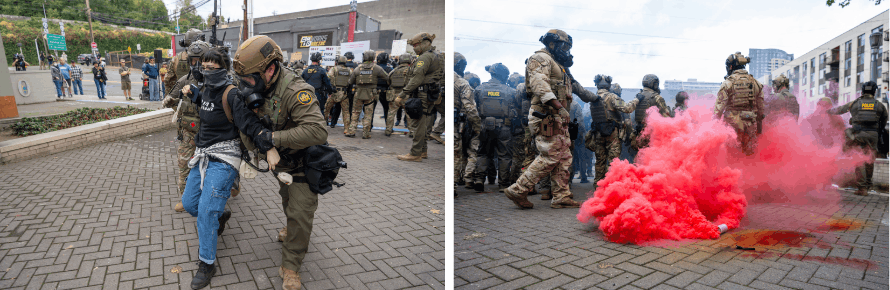
OK, it's time to end the consistent excuses being made for what is being done on the streets of this nation. Despite the belief of some here, ICE is required to follow the constitution, which they are not doing at this time.
Understanding the Legal Limits on ICE: Detentions, Arrests, Force, and Your Rights
ICE agents have federal authority to question, detain, and arrest people they suspect of immigration violations. But, critics say, recent ICE operations are much more than that. They categorize these crackdowns as broad sweeps that disproportionately affect racial minorities. Bystander videos show, and lawsuits describe, agents dragging people, breaking car windows, and forcing people to the ground, including both noncitizens and U.S. citizens.
When and How Can ICE Agents Detain and Arrest Noncitizens?
Federal law allows immigration officers to question, stop, and arrest noncitizens for immigration violations and certain federal crimes.
Detaining Noncitizens
When an agent has reasonable suspicion that a person is in the United States illegally, they can briefly detain them to ask questions on immigration status. According to the U.S. Supreme Court, officers can consider race and ethnicity when making this determination, along with other clues like the type of work the person is doing and their accent. Detentions based on these factors are sometimes called "Kavanaugh stops" due to Justice Kavanaugh's concurring opinion in the case of
Noem v. Vasquez Perdomo. (606 U.S. ___ (2025).)
Anyone facing a "Kavanaugh stop" doesn't have to answer an agent's questions.
Arresting Noncitizens
An ICE officer who has completed immigration law enforcement training may arrest a noncitizen without a warrant if the officer:
- personally sees the person entering or attempting to enter the country illegally, or
- has "reason to believe" the person committed an immigration offense and is likely to escape before a warrant can be obtained.
Courts generally treat this "reason-to-believe" standard as comparable to probable cause.
ICE agents can also arrest noncitizens for violations of federal law, like assault on or obstruction of federal officers.
Administrative ICE Warrants
For civil immigration violations (such as being in the U.S. without lawful status), ICE usually relies on "administrative warrants" signed by immigration officials. These warrants allow arrests in public places. They don't authorize ICE agents to enter private homes or nonpublic areas without consent or another legal basis.
(8 U.S.C. § 1357; 8 C.F.R. part 287; 40 U.S.C. § 1315 (2026).)
Can ICE Agents Arrest Protesters?
ICE agents have limited authority to arrest people for non-immigration offenses. They may arrest protesters for federal crimes, such as assaulting a federal officer, damaging federal property, or obstructing an enforcement operation. These arrests must still comply with the Fourth Amendment, meaning they must be supported by probable cause and carried out with only necessary and reasonable force.
Arrests that appear to target people because of their signs, messages, or political views—rather than their conduct or immigration status—can be challenged as unconstitutional retaliation under the First Amendment. Several lawsuits have argued that ICE used excessive and retaliatory force against demonstrators near ICE facilities and in public areas, including during Operation Midway Blitz (Chicago) and Operation Metro Surge (Twin Cities).
(8 U.S.C. § 1357; 8 C.F.R. part 287; 40 U.S.C. § 1315 (2026).)
How Much Force Can ICE Agents Use in Arrests?
ICE follows
Department of Homeland Security (DHS) use-of-force policies, which require that any force be "objectively reasonable" in light of:
- the seriousness of the offense
- the immediate threat, and
- whether the person is resisting or fleeing.
Non-lethal force can include physical holds, takedowns, and empty-hand strikes, but agents are expected to use the minimum force needed to control the situation. Excessive force is prohibited by policy and the Fourth Amendment. (Deadly force is discussed
below.)
(ICE Directive 19000.3 on firearms and use of force can be found
here.)
Can ICE Agents Use Tear Gas and Pepper Balls on Crowds?
DHS
policy requires that tear gas, pepper balls, and other projectiles be used only when proportional and necessary to address active resistance or genuine safety threats.
Learn when ICE can stop, search, or arrest you, how much force agents can use, and what to do if your rights are violated during an ICE encounter.

www.nolo.com