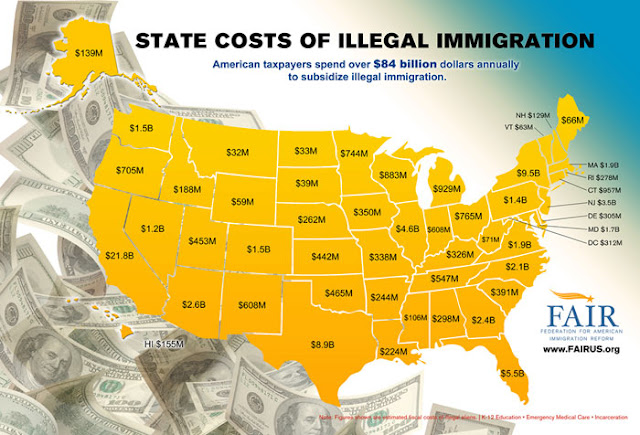
What do I think is preventing people from sneaking into North Korea? The fact that it is a totalitarian shit hole where people are starving to death might be a start. The mines and fences along the DMZ is to prevent people from LEAVING. Other nations enforce their immigration laws in much the same way we do. They do not call children fleeing violence and poverty "invaders". And, it is the biggest lie that illegals are a drain on our economy. They are a net benefit and removing them, in addition to costing hundreds of billions and turning us into more of a police state, would COST US lost taxes and lost economic activity. If every illegal in Texas or Arizona disappeared tomorrow, those states would suffer economically.
You are full of shit. Every comment you made is total, unsupportable garbage.
"When analyzed from the vantage point of information derived from reputable, nonpartisan sources (the Pew Research Center, USDA, United States Department of Labor, and leading economists and researchers) then one can obtain a clearer view of this muddled discussion. The truth of the matter is that illegal immigrants are important to the U.S. economy, as well as vital to certain industries like agriculture.
According to the Pew Research Hispanic Trends Project, there were 8.4 million unauthorized immigrants employed in the U.S.; representing 5.2 percent of the U.S. labor force (an increase from 3.8 percent in 2000). Their importance was highlighted in a report by Texas Comptroller Susan Combs that stated, “Without the undocumented population, Texas’ work force would decrease by 6.3 percent” and Texas’ gross state product would decrease by 2.1 percent. Furthermore, certain segments of the U.S. economy, like agriculture, are entirely dependent upon illegal immigrants.
The
U.S. Department of Agriculture states that, “about half of the hired workers employed in U.S. crop agriculture were unauthorized, with the overwhelming majority of these workers coming from Mexico.” The USDA has also warned that, “any potential immigration reform could have significant impacts on the U.S. fruit and vegetable industry.” From the perspective of National Milk Producers Federation in 2009, retail milk prices would increase by 61 percent if its immigrant labor force were to be eliminated.
Echoing the Department of Labor, the USDA, and the National Milk Producers Federation, agricultural labor economist James S. Holt made the following statement to Congress in 2007: “The reality, however, is that if we deported a substantial number of undocumented farm workers, there would be a tremendous labor shortage.”
In terms of overall numbers, The Department of Labor reports that of the 2.5 million farm workers in the U.S., over half (53 percent) are illegal immigrants. Growers and labor unions put this figure at 70 percent.
But what about the immense strain on social services and money spent on welfare for these law breakers? The
Congressional Budget Office in 2007 answered this question in the following manner: “Over the past two decades, most efforts to estimate the fiscal impact of immigration in the United States have concluded that, in aggregate and over the long term, tax revenues of all types generated by immigrants—both legal and unauthorized—exceed the cost of the services they use.” According to the New York Times, the chief actuary of the Social Security Administration claims that undocumented workers have contributed close to 10% ($300 billion) of the Social Security Trust Fund.
Finally, the aggregate economic impact of illegal immigration is debatable, but any claim that they’ve ruined the country doesn’t correlate to the views of any notable economist. An open letter to President George W. Bush in 2006, signed by around five hundred economists (including five Nobel laureates) stated the following: “While a small percentage of native-born Americans may be harmed by immigration, vastly more Americans benefit from the contributions that immigrants make to our economy, including lower consumer prices.”
Although Harvard economist Jorge Borjas has stated that illegal immigrants from 1980-2000 have reduced the wages of high school dropouts in the U.S, he also states that the average American’s wealth has increased by 1 percent because of illegal immigration. In an op-ed published in the Los Angeles Times, UC Davis economist Giovanni Peri stated that new laws are needed to meet demands within industries like construction, agriculture, and hospitality: “In recent decades, the high demand for these services and the pressure for keeping their cost low and prices competitive have generated incentives to hire undocumented workers.”
Some people claim that illegal immigrants represent an assault on our sovereignty. If this is true, then it might be the first time in world history that a country has employed its invaders. When illegal immigrants cross the border, there’s a citizen waiting to hire them and benefit in some manner from their labor. The sooner our country realizes that immigration reform should be based upon the views of economists and nonpartisan academic researchers, rather than think tanks and radio show hosts, then Congress will finally be able to help solve this national dilemma. "
Illegal immigrants benefit the U.S. economy
From the President's Council on Economic Advisers:
In 2006, foreign-born workers accounted for 15% of the U.S. labor force, and over the last decade they have accounted for about half of the growth in the labor force. That immigration has fueled U.S. macroeconomic growth is both uncontroversial and unsurprising – more total workers yield more total output. That immigrant workers benefit from working in the United States is also uncontroversial and unsurprising – few would come here otherwise.1
Assessing how immigration affects the well-being of U.S. natives is more complicated. This is because immigration’s economic impact is complex and may play out over generations, and because not all natives are alike in terms of their economic characteristics. Even in retrospect it is not easy to distinguish the influence of immigration from that of other economic forces at work at the same time. Nor is it easy to project costs and benefits far into the future. Nonetheless, economists and demographers have made headway on many of the measurement problems. This white paper assesses immigration’s economic impact based on the professional literature and concludes that immigration has a positive effect on the American economy as a whole and on the income of native-born American workers.
Key Findings
- On average, US natives benefit from immigration. Immigrants tend to complement (not substitute for) natives, raising natives’ productivity and income.
- Careful studies of the long-run fiscal effects of immigration conclude that it is likely to have a modest, positive influence.
- Skilled immigrants are likely to be especially beneficial to natives. In addition to contributions to innovation, they have a significant positive fiscal impact.
General Points
- Immigrants are a critical part of the U.S. workforce and contribute to productivity growth and technological advancement. They make up 15% of all workers and even larger shares of certain occupations such as construction, food services and health care. Approximately 40% of Ph.D. scientists working in the United States were born abroad. (Source: Bureau of Labor Statistics; American Community Survey)
- Many immigrants are entrepreneurs. The Kauffman Foundation’s index of entrepreneurial activity is nearly 40% higher for immigrants than for natives. (Source: Kauffman Foundation)
- Immigrants and their children assimilate into U.S. culture. For example, although 72% of first-generation Latino immigrants use Spanish as their predominant language, only 7% of the second generation are Spanish-dominant. (Source: Pew Hispanic Center/Kaiser Family Foundation)
- Immigrants have lower crime rates than natives. Among men aged 18 to 40, immigrants are much less likely to be incarcerated than natives. (Source: Butcher and Piehl)
- Immigrants slightly improve the solvency of pay-as-you-go entitlement programs such as Social Security and Medicare. The 2007 OASDI Trustees Report indicates that an additional 100,000 net immigrants per year would increase the long-range actuarial balance by about 0.07% of taxable payroll. (Source: Social Security Administration)
- The long-run impact of immigration on public budgets is likely to be positive. Projections of future taxes and government spending are subject to uncertainty, but a careful study published by the National Research Council estimated that immigrants and their descendants would contribute about $80,000 more in taxes (in 1996 dollars) than they would receive in public services. (Source: Smith and Edmonston)