I thought you were different but your "Whiteness" is showing. You use Detroit as your frame of reference in judging ALl Blacks in America…. I thought you knew better… I won't waste my time trying to prove it to you. Google it yourself if you really care.
what about chicago, or atlanta or ferguson, East St. Louis or baltimore. LA? how many fking run down towns do you need to see to see the failure that is a democrude?
Well, you haven't been to all of those towns you just read what your talking heads say about them. I've been to most of the largest cities in the USA and I agree with this author's perspective. The anti-Black propaganda persists only on a superficial level but that is enough to sway people like you. Here is a link that might spur you to look a bit further than Fox News or Rush Limbaugh!
The Cities Where African-Americans Are Doing The Best Economically
son, I live in Chicago today. this past weekend 40 shot 7 murdered. My father was born in Ferguson before it turned over, I've been in Baltimore, LA and Atlanta, I've been on the trains at each of these towns. So I am very familiar with what happens in these towns. I grew up in Berkley, MO. It is up there with Ferguson. You should learn your opponent before making stupid posts.
BTW, I challenge you to walk the streets at night in any of those neighborhoods. D'OH!!!!
They are the way they are due to lack of business. PERIOD!!!!!!!!!!
And guess why businesses won't go in those areas?
Impact Entrepreneurship is Thriving in Chicago
At a high level, there are a number of organizations bringing people together in this space.
- Forefront has worked over the past year to build a Social Innovation Roundtable in order to drive a conversation about moving more capital into nonprofit and for profit social enterprises in the city.
- The Chicago Community Trust (CCT), MacArthur Foundation, and Calvert Foundation announced Benefit Chicago, a collaboration that aims to deploy $100 million in impact investments into nonprofits and social enterprises in Chicago. Bringing together a private foundation, a community foundation and a non-profit financial institution has enabled a unique structure whereby anyone from an individual to a business to an institution can invest in the community.
- The Social Enterprise Alliance Chicago hosts panels and seminars with industry leaders on topics in the space,pitch nights to showcase social entrepreneurs, and monthly happy hours to network.
- Goodcity supports both nonprofit organizations and for-profit organizations creating or enhancing neighborhood programs.
- Seed613 (formerly JCC Pretense) has partnered with Upstart Chicago to work with entrepreneurs who are redesigning the experience and expression of Jewish life that have a lasting and positive effect on the community.
- Social Venture Partners Chicago supports nonprofit organizations making meaningful and sustainable improvements within the Chicagoland community and host a yearly Fast Pitch.The Center for Neighborhood Technology (CNT) works to promote more livable and sustainable urban communities. Along with working on long-term community projects, they host events that bring together community members to solve neighborhood problems through tech and global community challenges.
- The Center for Neighborhood Technology (CNT) works to promote more livable and sustainable urban communities. Along with working on long-term community projects, they host events that bring together community members to solve neighborhood problems through tech and global community challenges.
There are also a number of initiatives supporting a broader movement toward business with purpose.
- Conscious Capitalism in Chicago supports organizations in expanding their awareness, responsibility, results and impact in the world. Their yearly Summit brings together participants eager to deepen their practice of conscious capitalism.
- Net Impact Chicago supports the community of impact focused professionals and students through monthly networking events, curation of job postings, and seminars.
- One of the fastest growing paths toward business with purpose is to become certified as a B Corporation. In Illinois alone there are 21 registered B Corps pledging to make an impact.
- If business with a purpose is something you’re just starting to think about, the Conscious Business Network is an on-line and live forum for professionals and leaders who are exploring purpose-driven possibilities.
Many of the Chicago region’s top colleges and universities have also stepped in to play a leading role. The Social Enterprise Initiative at Booth hosts an annual
New Venture Challenge, Loyola hosts the
Quinlan Social Enterprise Competition and the Northern Illinois CASE
Pitch With a CAUSE provides seed funding to a social enterprise winner. Northwestern’s
Kellogg School of Management’s Social Impact focus is designed to equip the next generation of business leaders to serve as socially responsible leaders — whether in nonprofit, for-profit or governmental organizations. And of course we have to point out that Impact Engine itself was founded by two university leaders – Linda Darragh was Director of Entrepreneurship Programs at Booth and Jamie Jones was Director of Social Entrepreneurship at Northwestern University’s Kellogg (SEEK) Program, Kellogg when they formed Impact Engine.
There is also a lot of effort being channeled into sector-specific work. When it comes to clean energy, Chicago has the
Clean Energy Trust, who has spearheaded programs that are revolutionizing the Midwest as a clean energy ecosystem, invested $1 million dollars in energy startups through the
Clean Energy Challenge.
The Energy Foundry is also a leading investor of venture capital in today’s most promising energy innovators.
Food is another hot sector: in 2014, The Chicago Community Trust in partnership with Kinship Foundation launched
Food:Land:Opportunity a multi-year initiative that aims to create a resilient local food economy while promoting market innovation and building wealth and assets in the Chicago region’s communities. They’re also hosting the
Food to Market Challenge in October 2016 to help boost Chicago’s supply of local, sustainable food.
The Good Food Business Accelerator, created by Family Farmed, supports entrepreneurs making an impact in supply chains for sustainable local food, and their first class of fellows went on to raise $17 million dollars in follow on investment. Helping to fund companies is the food sector is
SLoFIG, a network of angel investors using private investment to re-establish a robust, sustainable local food system across the Chicago foodshed. Their investment model values both a impact and financial returns.
In the healthcare sector, check out the
weekly events and workshops that
MATTER hosts to keep entrepreneurs up-to-date with the latest trends in health innovation, and
HealthBox, which drives collaboration between inventors, entrepreneurs and the healthcare industry.
Civic tech is also making an impact in Chicago. The
Center for Neighborhood Technology (CNT) works to promote more livable and sustainable urban communities. Along with working on long-term community projects, they
host events that bring together community members to solve neighborhood problems by create workable prototypes of apps that make local neighborhoods more sustainable, both environmentally and economically. Join CNT on June 17th at the
Sustain-A-City Celebration to hear pitches from the finalists of the
Urban Sustainability Apps Competition.
Civic Blue1647 is using civic data to teach people about data and helping to start a conversation between technologists and the community in order to spark innovation at the neighborhood level.
Last but not least, the early success and recognition of Chicago impact entrepreneurs is paving the way for other entrepreneurs and investors to expand this movement. Of course, we have to highlight a number of Impact Engine portfolio companies:
- ThinkCERCA is an award-winning literacy platform that encourages students in grades 4 – 12 to build evidence-based arguments and has been recognized by Bill Gates as an innovative literacy tool that’s showing positive results for students!
- Piece & Co. is a fashion company that acts as a bridge between traditional artisan techniques and global fashion. By providing sustainable employment to women artisans in developing countries, Piece & Co.’s artisans create handmade textiles for the fashion industry. They have secured partnerships with designers Rachel Roy and Cynthia Rowley, Madewell, Toms, Crate & Barrel, Nordstrom, Alice + Olivia, J.Crew, Diane von Furstenberg, Tory Burch,Rebecca Minkoff, and Bucketfeet, just to name a few!
- Sokowatch uses the ubiquitous cellphone to help health organizations and consumer products manufacturers track inventory in developing countries where supply-chain management is a contradiction in terms. Sokowatch has been recognized by national and international impact leaders like the Prince of Wales Young Sustainability Entrepreneurs Prize, 1776 Challenge Cup, The Case Foundation, and was most recently named to Crain’s 20 In Their 20’s.
Those are just a few success stories, check out our
whole portfolio.
Impact Entrepreneurship is Thriving in Chicago
10,000 Small Businesses program thriving in Chicago
10,000 Small Businesses program thriving in Chicago
Home Ownership and Thriving Businesses Reduce Crime, according to Treasurer
Home Ownership and Thriving Businesses Reduce Crime, according to Treasurer - Gary/Chicago Crusader
New Business is Thriving in Chicago Claims City Business Solutions
New business Thriving in Chicago Claims City Business Solutions
123 Black-Owned Restaurants and Eateries in the Chicago area
123 Black-Owned Restaurants and Eateries in the Chicago area - Bean Soup Times
African-American’s Buying Power Projected to be $1.1 Trillion By 2015
The Nielsen Company study entitled “African-American Consumers: Still Vital, Still Growing,” which was commissioned by the National Newspaper Publishers Association, shows the underrepresented potential and spending power of the African American
The report’s findings, which will be presented at the June conference of the National Association of Black Accountants Conference in Nashville, Tennessee, found that the African American population is an economic force to be reckoned with, with a projected buying power of $1.1 trillion by 2015.
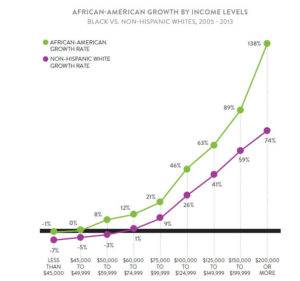
Also worth noting, the population of African-American consumers growth outpaces the rest of the population by 30 percent. Additionally, the demographic is younger, more educated and has higher incomes than commonly believed.
According to the study: between 2000 and 2009, the number of African Americans attending some college or earning degrees has grown: 45 percent of men; 54 percent of women. Households earning $75,000 or more grew by more than 60 percent, faster than the rest of the population. African American’s average income nationwide is $47,290.
African-American's Buying Power To Be $1.1 Trillion By 2015
Keep believing that we all live in poverty.