To review .
The British Navy Bombarded Ft. McHenry in 1814. There were no Air Fields in 1775. The U.S. Army could never have rammed the Ramparts.
Maine was NOT a colony in 1775.
No U.S. Navy in 1775.
Poor deluded Con...you really love to lied to.
Um, what the ever-loving ****? Does your knowledge of history come from a video game or something? That was quite a bold statement to be utterly and completely wrong about. Behold, the Continental Navy of the United States during the Revolutionary war, formed in 1775:
Category:Ships of the Continental Navy - Wikipedia
View attachment 268192
"Give Me A Fast Ship: The Continental Navy and America's Revolution at Sea" (hell, just read the summary, you'll learn many interesting things about the Revolutionary war)
View attachment 268193
"Sea Raiders of The American Revolution: The Continental Navy in European Waters" (you'll also learn some interesting information in the summary of this book as well)
One of the most famous naval battles of the Revolutionary war was led by Continental Navy Commander John Paul Jones in 1779, when he decided to attack the British fleet. He led his ship,
the U.S.S Bonhomme Richard, and a group of other naval vessels into battle with British commander Richard Pearson, who commanded the ship
the Serapis, in the
Battle of Flamborough head. It was a brutal battle with many casualties. At one point, Jones rammed the
Bonhomme into the
Serapis, which was a much more fortified ship, causing the
Bonhomme Richard to lose its main cannons and begin taking on water. This is the greatest part --
the British commander asked John Paul Jones to surrender, to which Jones replied, “I have not yet begun to fight”. Jones determined that the only option for victory was to capture the
Serapis by boarding her. The battle raged on as the crew tried to tie on to the
Serapis and board her (like a scene from a Pirates of the Caribbean movie) which they eventually succeeded in doing as the
Bonhomme sank, and the British commander Pearson surrendered.
Commander Jones proceeded to fly the U.S. flag on the mast of the
Serapis as they made their way to a Dutch harbor for safe haven. That flag, however, had been hastily made by Jones and his men before the battle and bore little resemblance to the flag specification in the 1777 Flag Resolution. Nevertheless, the story was so epic and bad ass that the flag became officially known as the
Serapis Flag, and has been recreated and displayed for special events for over 200 years since then, including being featured on the crest of the
USS John Paul Jones (DDG-53).
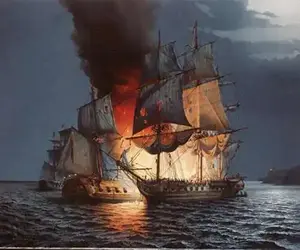
Here's a painting depicting the
Serapis after it was under the control of Commander Jones, shown flying the Serapis Flag (circled just in case it doesn't jump out at you, as it's a dark painting)
View attachment 268210
And here's a better look at the Serapis Flag
View attachment 268211
And finally, for those posters who are shockingly unaware that we had a navy during the Revolutionary War, and don't have any interest in reading the books I linked above, here's a video covering the history of the Continental Navy from 1775 to 1783: