Were we to chart on a graph the rise in polarization in Washington, it would correlate with the broadcast changes that began with Downey. Consider that every year for the last three decades, the National Journal has been tracking the ideological leanings of Congress. That analysis suggests we are at an all-time high for polarization.
In 2014, and for the fourth straight year, every Senate Republican was more conservative than every Senate Democrat, and every Senate Democrat was more liberal than every Senate Republican. (The House is similarly divided.) Resist any temptation to think it has always been like this. According to the Journal, in 1982, on Ronald Reagan's watch, "58 senators and 344 House members had voting records that put them between the most liberal Republican and the most conservative Democrat."
There were so many Republican Senate moderates during Reagan's time in the White House that they had their own weekly gathering, the Wednesday Lunch Club. Members included Alan Simpson, Ted Stevens, Nancy Kassebaum, John Heinz, Arlen Specter, Bob Packwood and Bob Dole. Today there would be no members showing up for lunch.
Here's another barometer of change in the last 30 years: According to tabulations from Congressional Quarterly, as late as the 1970s, the typical member of one party voted with his colleagues just over 60% of the time. Those numbers have risen every decade. In 2010, Democrats voted together 91% of the time, and Republicans 89% of the time.
Unfortunately, those able to reverse these trends have
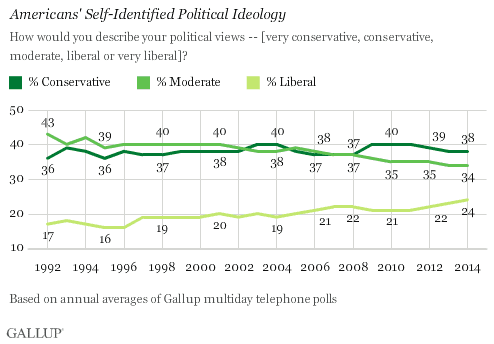
ceded the debate to the loudest voices. A Gallup survey released in January found that more Americans regard themselves as independent (43%) than Democrat (30%) or Republican (26%). But any ground gained by the nonpartisan ranks continues to be offset by higher political interest resting at the political extremes. It's all about passion. As documented by Pew Research Center this past spring, liberals and conservatives
exceed moderates and independents in their level of political interest, which translates into voter participation.