BS. What type target did you qualify on? What ranges did you shoot and what positions for the various ranges? What firing rates did you use? How many rounds did you expend per position?
Bullet weight does not make a particular cartridge more accurate. Any first year shooter knows that. One of the most accurate rifles in the world is the 6.5X55 Swede and it uses anywhere from a 108 grain all the way up to a 140 grain bullet. It has an absurdly high BC and THAT'S what makes it so accurate. Not the weight of the bullet.
The M-14 on full auto is completely uncontrollabe. It is nowhere near what a BAR is (I've owned both) the BAR weighs 10 pounds more than the M-14 and fires at a slower ROF. Placing the bipod on the gas tube in that location will dirrectly imping on teh barrel (a total no no if you knew anything) which further reduces your accuracy.
I'm going to give you some advice, never try and bullshit your way around people who know firearms, we know very well what you do and don't know...and you don't know shit.
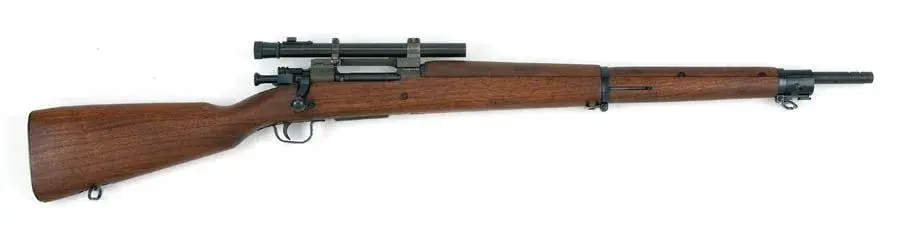
BTW, below is my M21. Unlike you I actually have the things I claim to have.
You think you are demonstrating you know something about firearms? In fact you demonstrate you can't even read. I never claimed to have any weapons and have said I don't have any. You only impress yourself with what you think you know. Were you in the service when they issued M-14s and later switched to M-16s?
The only reason to use the M-14 on auto would be when a human wave is attacking you at close range. How much accuracy do you need against a human wave? How many rounds are you going to shoot before the weapon gives out? If you were being attacked by a large group and the enemy was still in the distance, say 1100 to 700 yards, you could lay down some fire with an M-14 and tracers to start picking off the enemy, but auto is going to kick that weapon all over the place and not hit anything at that distance. Shooting the weapon is counter-productive unless you are hitting the enemy. If there are large amounts of enemy like in Korea and they are at an extreme distance, you can use tracers to adjust your sights and drop rounds in on them. It's good to have your ammo set up to fire a tracer every once in awhile and make adjustment, but tracers aren't good at short distances, because they give away your position. If you are familiar with your weapon, you will know how to set the sights for shorter than extreme distances and elevation changes and should have a good idea where to start setting them at extreme distances. The only time to use that auto fire is when you are about to be overrun and the enemy are so close that those two and three round burst have to hit someone. If you were trained well, you'd be zone firing before that time.
You were comparing an M-14 to an M-16 or AR. The M-16 has a 63 gr bullet max. The M-14 has a 174 gr bullet max. Your other gr examples above aren't small bullets like the M-16 and that's why they are accurate at a distance. The difference is the M-14 will put about 20 gr of bullet out there, but the M-16 while putting out less gr is doing it with two and a half times the bullets. Having all that extra lead flying around creates more injuries, though less lethal ones. At shorter distances, the advantage of the weapon goes to the M-16 and it goes to the M-14 at longer distances.
The basic Physics of projectiles has to involve the forces that act on the projectile. Obviously, shooting at a target up or down in elevation changes the path of a bullet from what it would be at equal elevation. If the sight setting were zeroed in for level shooting, using those settings to shoot at a target with a higher elevation would cause the bullet to fall short and using those settings to shoot at a target with a lower elevation would cause the bullet to overshoot the target. The weight of the projectile isn't influenced differently with gravity. Dropping two things with different weights will cause them to hit the ground at the same time. The only difference in how a projectile travels through the air is the resistance of the air. A larger diameter bullet will encounter slightly more air resistance.
Wind direction and speed are a major variable affecting the path of a bullet, so skipping all the obvious variables involved, it's best to consider it an inaccurate estimate. It's hard to tell if the wind will maintain it's velocity throughout the path of a bullet. That's why bullets less affected by the wind are better at long distances. How a bullet is affected by the wind is related to it's mass and velocity. The amount of area that the wind can affect on a bullet is also a factor when comparing bullets of different sizes and shapes. The wind is a force and a bullet having more force is less affected in the resultant force, which means it doesn't move off the direction of the target as much. A bullet becomes more accurate with more velocity and more mass. The product of mass and velocity is momentum, which is easily conceptualized as the resistance to change from a force. You claim the mass of a bullet doesn't affect it's accuracy, but mass translates into momentum which means the bullet with the higher momentum isn't affected by forces as much as a bullet with lower momentum.
Now if you compare bullets with the same momentum, you can see the picture from a different angle. It is possible to make a bullet or projectile that has an identical aerodynamic shape, but is made with materials of different mass and still has the same momentum. Consider bullets made out of lead, aluminum and depleted uranium. An aluminum bullet would have to have a higher velocity than a lead bullet to have equal momentum and a depleted uranium bullet would have to have a lower velocity. In this case the lighter aluminum bullet would be more accurate, than the lead and the depleted uranium would be least accurate. The reason is simply the faster bullet travels to it's destination in less time. The faster it travels, the less time there is for forces to act on it. Having a lighter bullet isn't the case with 5.56×45mm NATO and 7.62×51mm NATO ammo, because the momentum is no where near the same. The 7.62×51mm NATO ammo has a velocity of 790 m/s and a weight of 174 gr. The 5.56×45mm NATO has a velocity of 936 m/s and a weight of 63 gr. The M-16 bullet is almost 18.5% faster, which helps, but it's only 36.2% of the weight of the M-14 bullet. The M-14 bullet has 2.33 times the momentum as the M-16 bullet and when fired with weapons of equal quality, the M-14 ammo is more accurate. All that extra momentum more than compensates for the M-14 bullet traveling at 84.4% of the speed of the M-16 bullet. The amount of extra time the M-14 bullet is experiencing external ballistic forces isn't long enough to counter the resistance to forces that the addition momentum gives the bullet. The only possible way an M-16 could be more accurate than an M-14 is comparing a worn out M-14 to a match grade M-16. Bench firing the weapon without wind will identify a worn out weapon. When the quality of the weapons are the same, the M-14 has to be more accurate.
Normal rifle ranges are level and have distance markers. The ones they used to qualify with in the Marines, when I was there, had 200, 300 and 500 yard positions. Firing the rifle range at boot camp was the most eventful, because they would spend time to fam fire or fire for familiarization the weapon during the week they trained us to shoot. Their plan was to teach us how to fire the weapon. How to set the weapon for the various distances and positions during the first week and practice for four days and qualify on the fifth day the next week. That meant in the second week you were shooting the course five times with the final day being your qualifying score. The course consisted of 50 rounds and bullseyes being worth 5 points, meaning a perfect score was 250 points. I know expert was 220 or above, sharpshooter was 210 to 219 and I believe marksman was 190 to 209. Below 190 you failed and Marines have to qualify, so you are going to do it again and go back in training. The easiest way to describe the positions is there are four - offhand (standing), kneeling, sitting and prone. 3 events used 10 rounds and 4 events used 5 rounds. On the 200 yard line, we fired the 5 round offhand, kneeling and sitting plus a 10 round rapid fire sitting. On the 300 yard line, we fired the 5 round sitting and a 10 round rapid fire prone. On the 500 yard line, we fired a 10 round prone. There were 3 types of targets. A bullseye at the 500 yard line was a human shaped black silhouette, about the size of a real skinny person from the waste up. The rapid fires were also a human shaped black silhouette, but it was cut short around midway, let's say around the heart area, so it was maybe half the size as the 500 yard target. The other targets were round bullseyes, alternating black and white. All the targets were ringed with decreasing scores away from the bullseye.