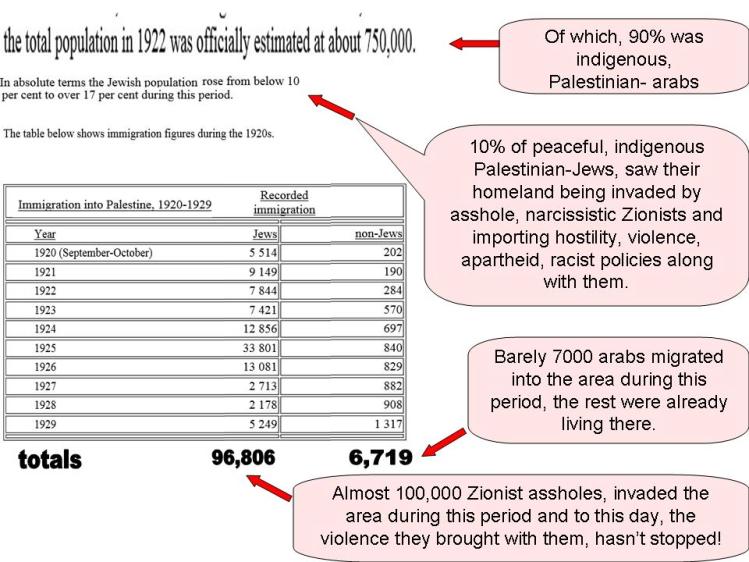
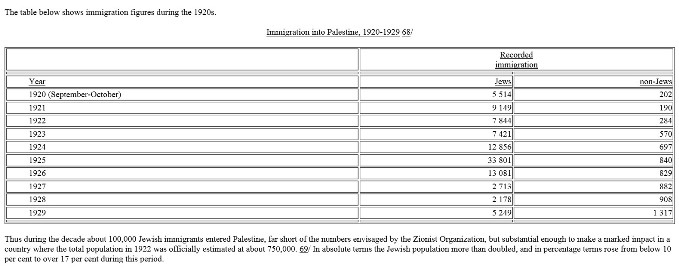
Arabs didn't migrate into the area. You did!
Arab immigration composed 36.8 percent of the total immigration into pre-State Israel.
Arab immigration into Palestine, and specifically into pre-State Israel during the census period 1922-1931 reflects, to some degree, the different levels of economic activity within Palestine and between it and the contiguous Arab States. Arab immigration accounted for 38.7 percent of the total increase in Arab settled population in pre-State Israel, and constituted 11.8 percent of its 1931 population. Although less numerically than the Jewish immigration during the period, the significance of Arab immigration is nonetheless emphasized by its comparison with the Jewish population inflov;. Arab immigration composed 36.8 percent of the total immigration into pre-State Israel. The situation in non-Israel Palestine was somewhat different. There, Arab migration v;as positive, but inconsequential.
*
54,790 Arabs migrated just in the short period of the Mandate.
So compared to the waves of invading Arabian tribes throughout the history, Jewish immigration was just a drop in the bucket. While it took centuries for invading Arabian tribes to turn the place into a barren land full of swamps and disease, it took less than a 100 years of Jewish immigration to turn the place into the most advanced country in the middle east.
The land itself shows whom it belongs to.
There is something missing here.
The 1925 citizenship order automatically gave Palestinian citizenship to all of the Palestinians who were present in the country at that time. Those who were out of the country for any reason were not counted. However, the order stipulated that all Palestinians had two years to return home or lose their citizenship.
This number was not mentioned.
Don't bring up the old Israel made the desert bloom canard again. Palestine produced a surplus of food that was exported to other Arab countries and Europe.
So does apply to Jews who fled because of rough conditions under the Muslim rule.
----------------------------------------------------------
Bedouin tribes, such as the notorious Ben Sakk'r, of whom H. B. Tristram (The Land of Israel: A Journal of Travels in Palestine, Society for Promoting Christian Knowledge, London, 1865) wrote that they "can muster 1,000 cavalry and always join their brethren when a raid or war is on the move. They have obtained their present possessions gradually and, in great measure, by driving out the fellahin (peasants), destroying their villages and reducing their rich corn-fields to pasturage." (p. 488.)
Tristram goes on to present a remarkable and highly revealing description of conditions in Palestine on both sides of the Jordan River in the middle of the 19th century—a description that belies the Arab claim of a tranquil, normally developing Palestinian rural economy allegedly disrupted by Jewish immigration and settlement.
"Tristram goes on to present a remarkable and highly revealing description of conditions in Palestine on both sides of the Jordan River in the middle of the 19th century—a description that belies the Arab claim of a tranquil, normally developing Palestinian rural economy allegedly disrupted by Jewish immigration and settlement. A few years ago, the whole Ghor was in the hands of the fellahin, and much of it cultivated for corn. Now the whole of it is in the hands of the Bedouin, who eschew all agriculture, except in a few spots cultivated here and there by their slaves; and with the Bedouin come lawlessness and the uprooting of all Turkish authority. No government is now acknowledged on the east side; and unless the Porte acts with greater firmness and caution than is his wont . . . Palestine will be desolated and given up to the nomads. The same thing is now going on over the plain of Sharon, where, both in the north and south, land is going out of cultivation, and whole villages rapidly disappearing from the face of the earth.
Since the year 1838, no less than 20 villages have been thus erased from the map and the stationary population extirpated. Very rapidly the Bedouin are encroaching wherever horse can be ridden; and the Government is utterly powerless to resist them or to defend its subjects. (p. 490)"
With regard to yet another region in Palestine—the Beisan (Beit Shean) area—we quote from the report of Mr. Lewis French, Director of Development appointed by the British Government in 1931: We found it inhabited by fellahin who lived in mud hovels and suffered severely from the prevalent malaria. . . . Large areas of their lands were uncultivated and covered with weeds. There were no trees, no vegetables. The fellahin, if not themselves cattle thieves, were always ready to harbour these and other criminals. The individual plots of cultivation changed hands annually. There was little public security, and the fellahin's lot was an alternation of pillage and blackmail by their neighbours the Bedouin.
This, then, was the picture of Palestine in the closing decades of the 19th century and up to the First World War:
a land that was overwhelmingly desert, with nomads continually encroaching on the settled areas and its farmers; a lack of elementary facilities and equipment; peasants wallowing in poverty, ignorance and disease, saddled with debts (interest rates at times were as high as 60 per cent) and threatened by warlike nomads or neighbouring clans. T h e result was a growing neglect of the soil and a flight from the villages, with a mounting concentration of lands in the hands of a small number of large landowners, frequently residing in such distant Arab capitals as Beirut and Damascus, Cairo and Kuwait. Here, in other words, was a social and economic order that
had all the earmarks of a medieval feudal society.
https://www.wordfromjerusalem.com/wp-content/uploads/2008/11/the-case-for-israel-appendix2.pdf
Q. Wonder why Jews resisted the notion of another Muslim rule?