" I
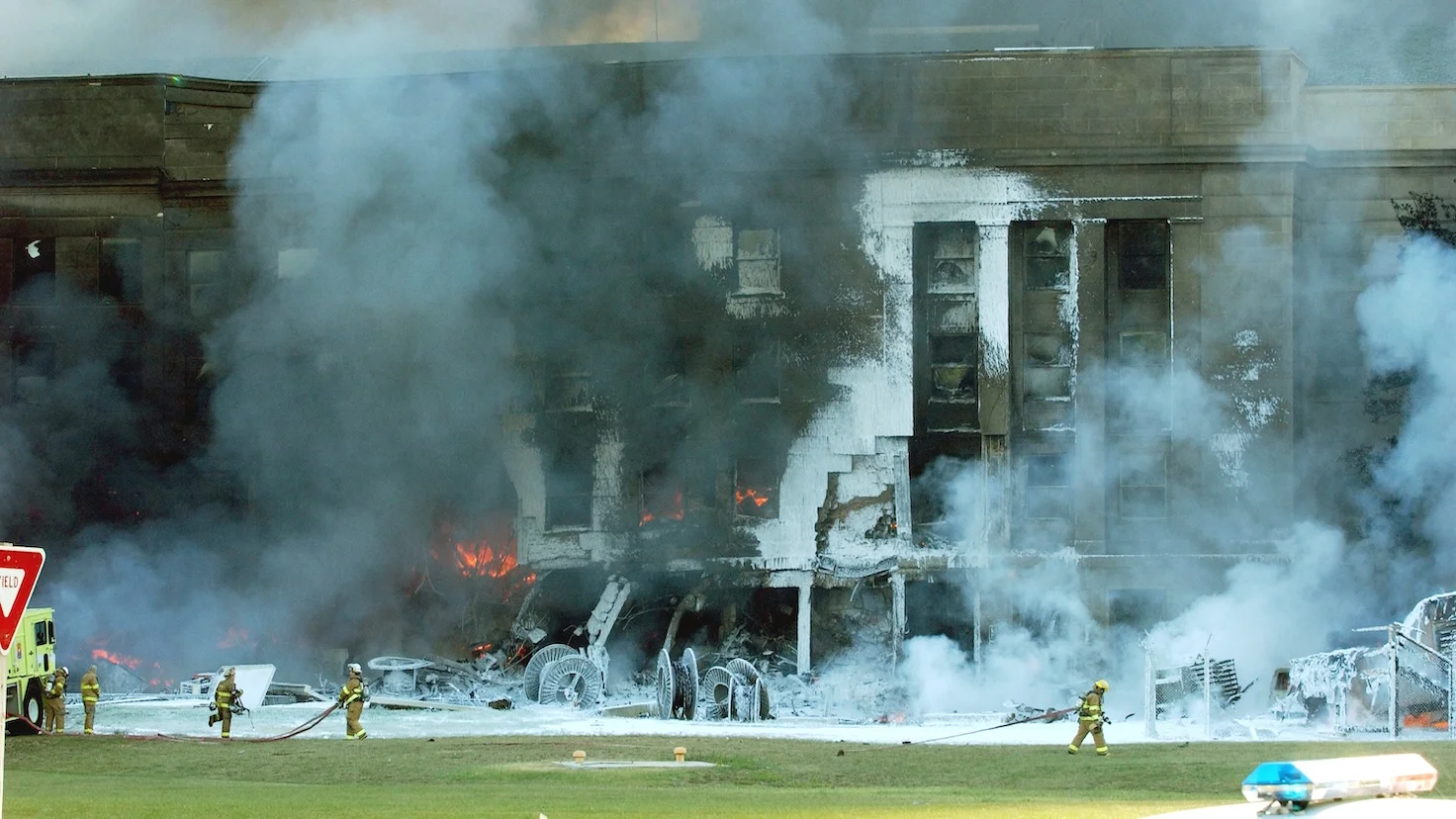
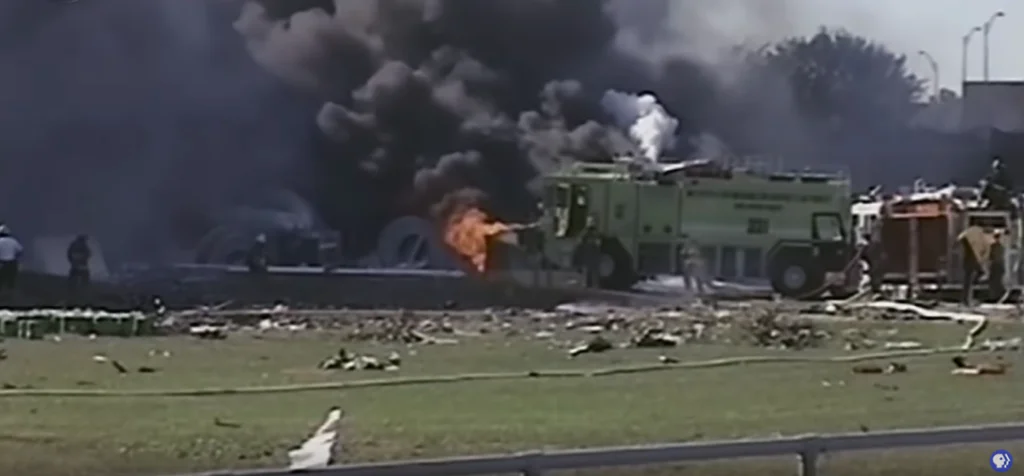
t was CNN’s Jamie McIntyre who first questioned the official narrative. On the day of 9/11, he said on live television, “There’s no evidence of a plane having crashed anywhere near the Pentagon.”"
Part 2:
============
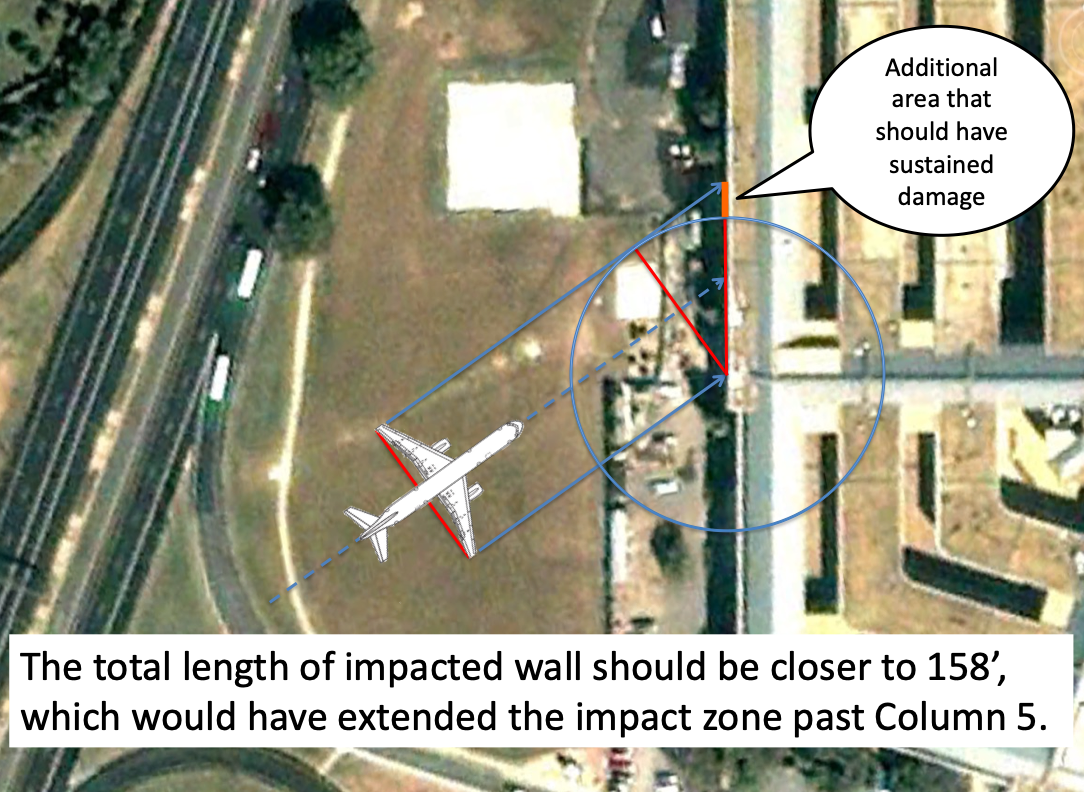
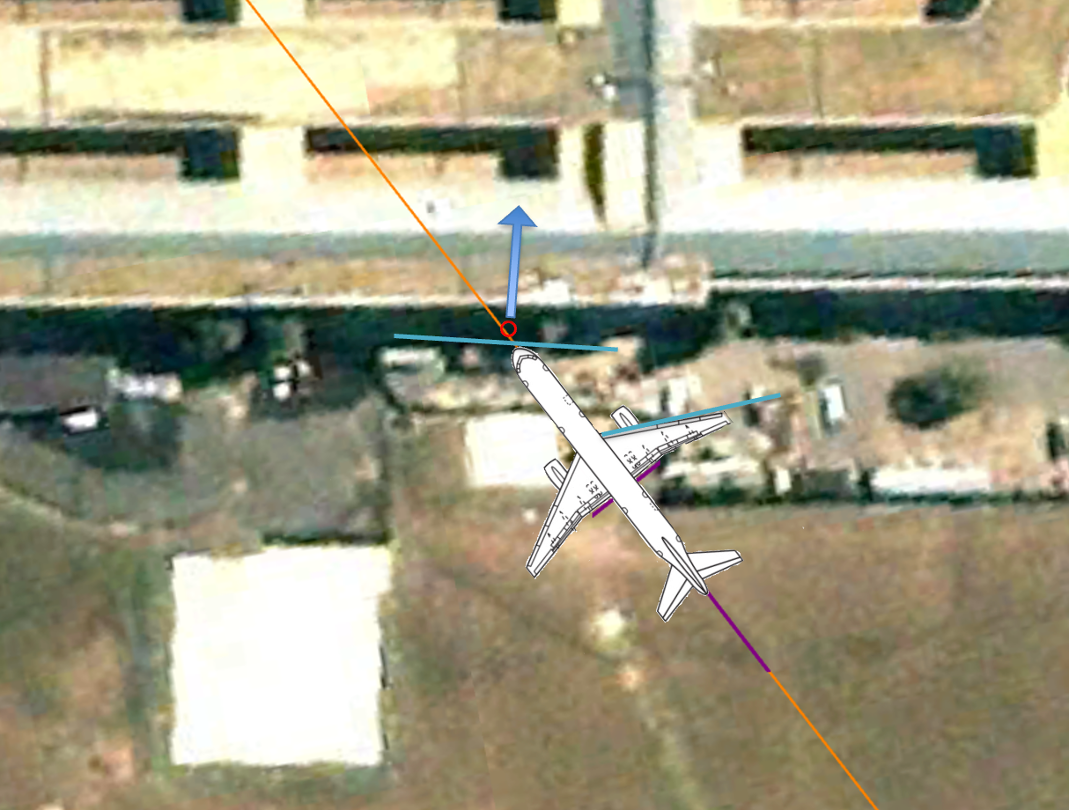
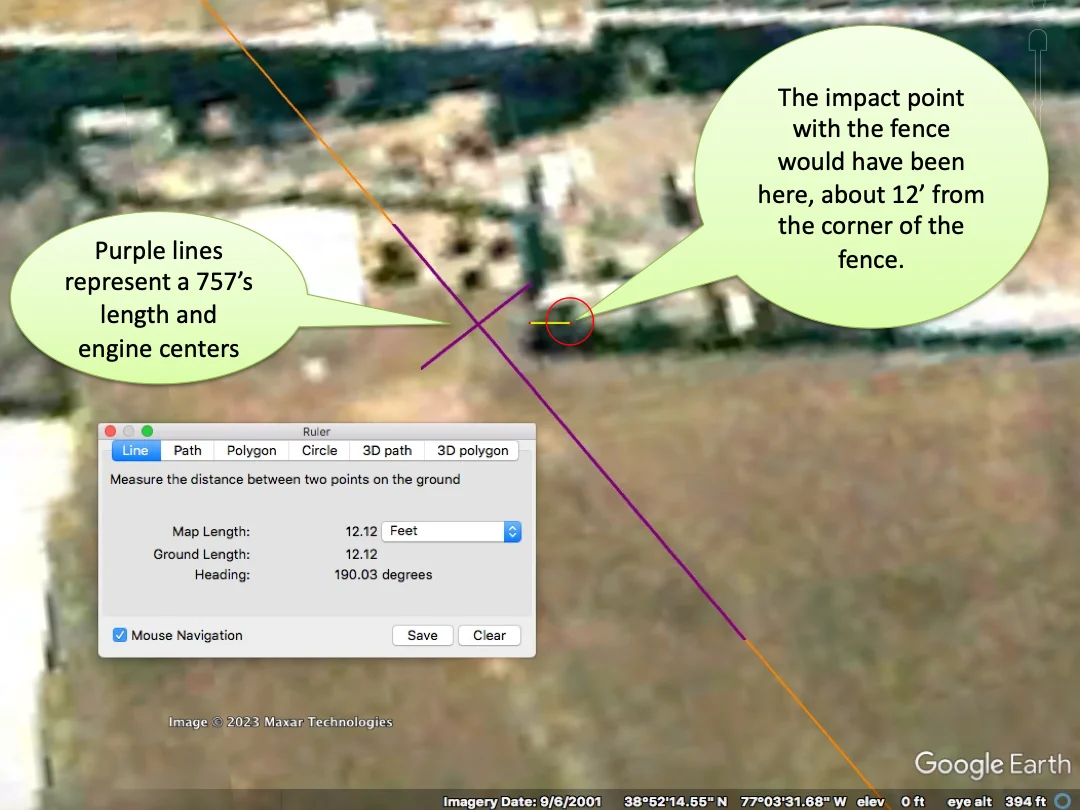
Fig. 15 – Google Earth image with correctly scaled 757 on alleged path
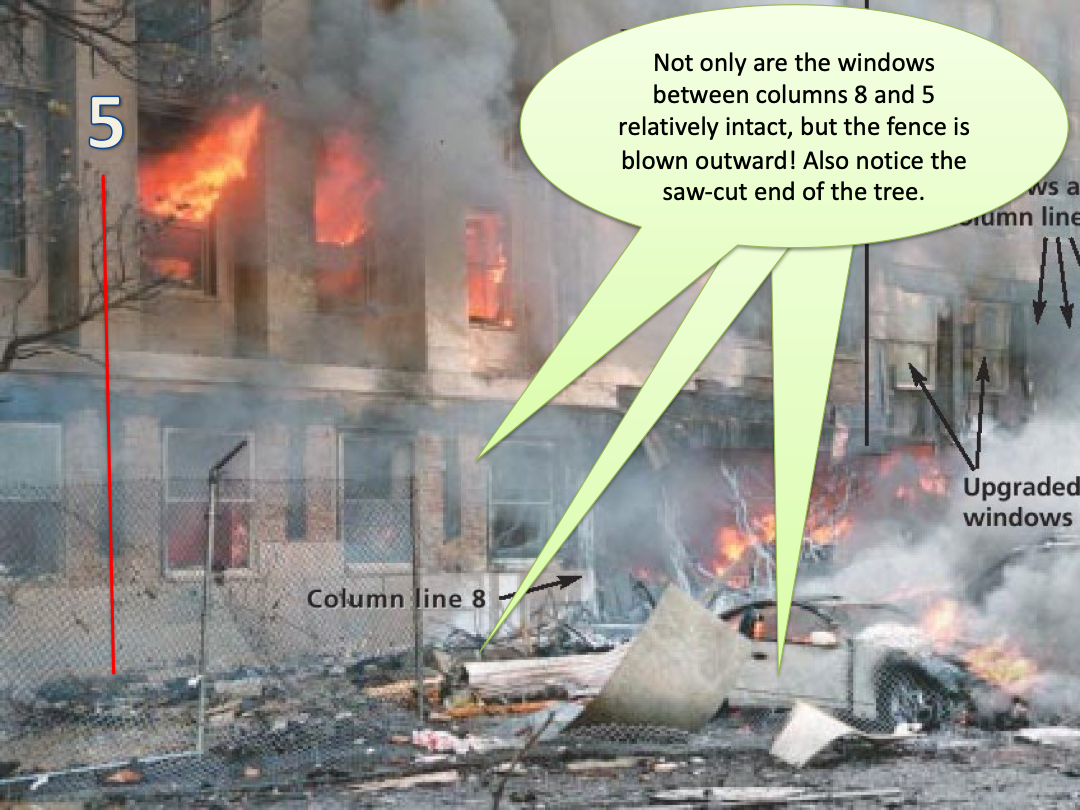
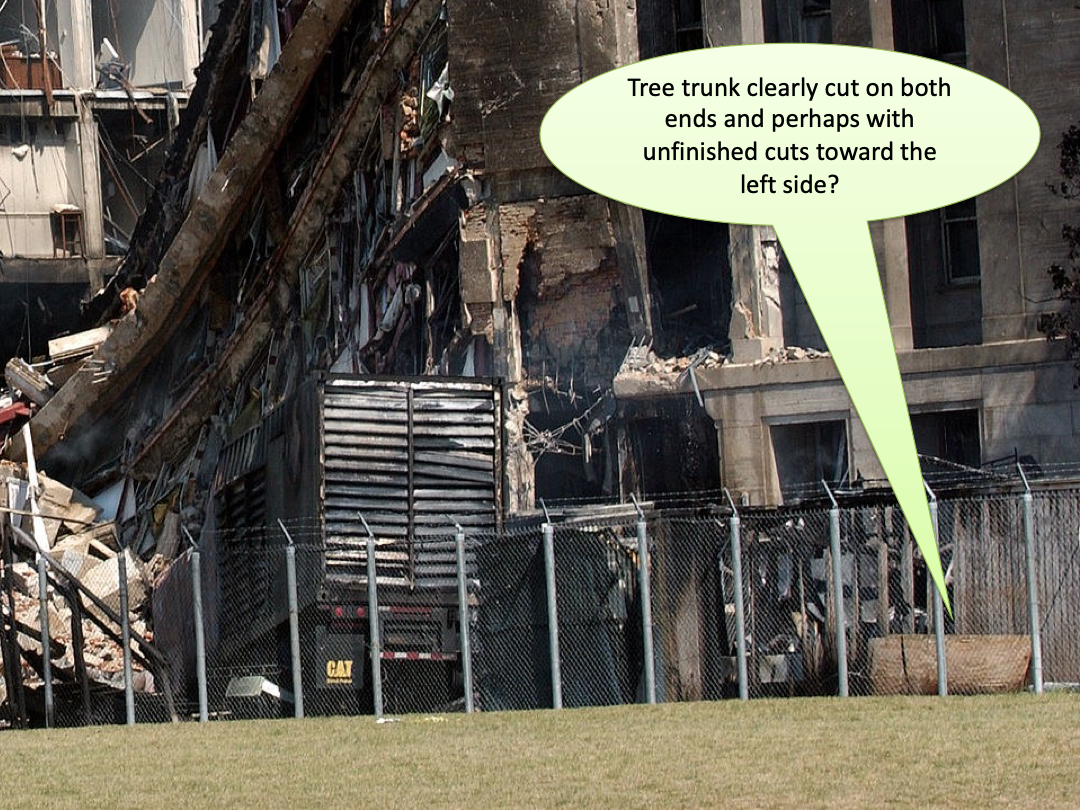
We should consider that the angular nature of an impact would have deflected the large tree toward the east. An explosive directional charge to remove the tree could also move it about. In Fig. 16 below, the photo shows a large portion of a tree trunk that had been cut by a saw in several places. Also, refer back to Fig. 3 to see a substantial portion of a tree with a saw cut; that photo was taken immediately after the event. So, the tree actually appears to have been cut into pieces with a saw, with those cuts occurring
before the event.
Fig. 16 – Zoom in to see unfinished chainsaw cuts on tree trunk
The argument that a 155-foot airplane traveling at many hundreds of miles per hour and weighing over 100,000 pounds would not have the impulse to move the tree into the building is implausible. And to think that its massive fuselage would shed
only pieces of its logo and leave them scattered like shrapnel on the northern lawn is equally unlikely. A 9/11 researcher named Adam Ruff pointed out that a large percentage of the scrap aluminum bore “American Airlines” livery, relative to the very small percentage of actual airline fuselage that has lettering on it.
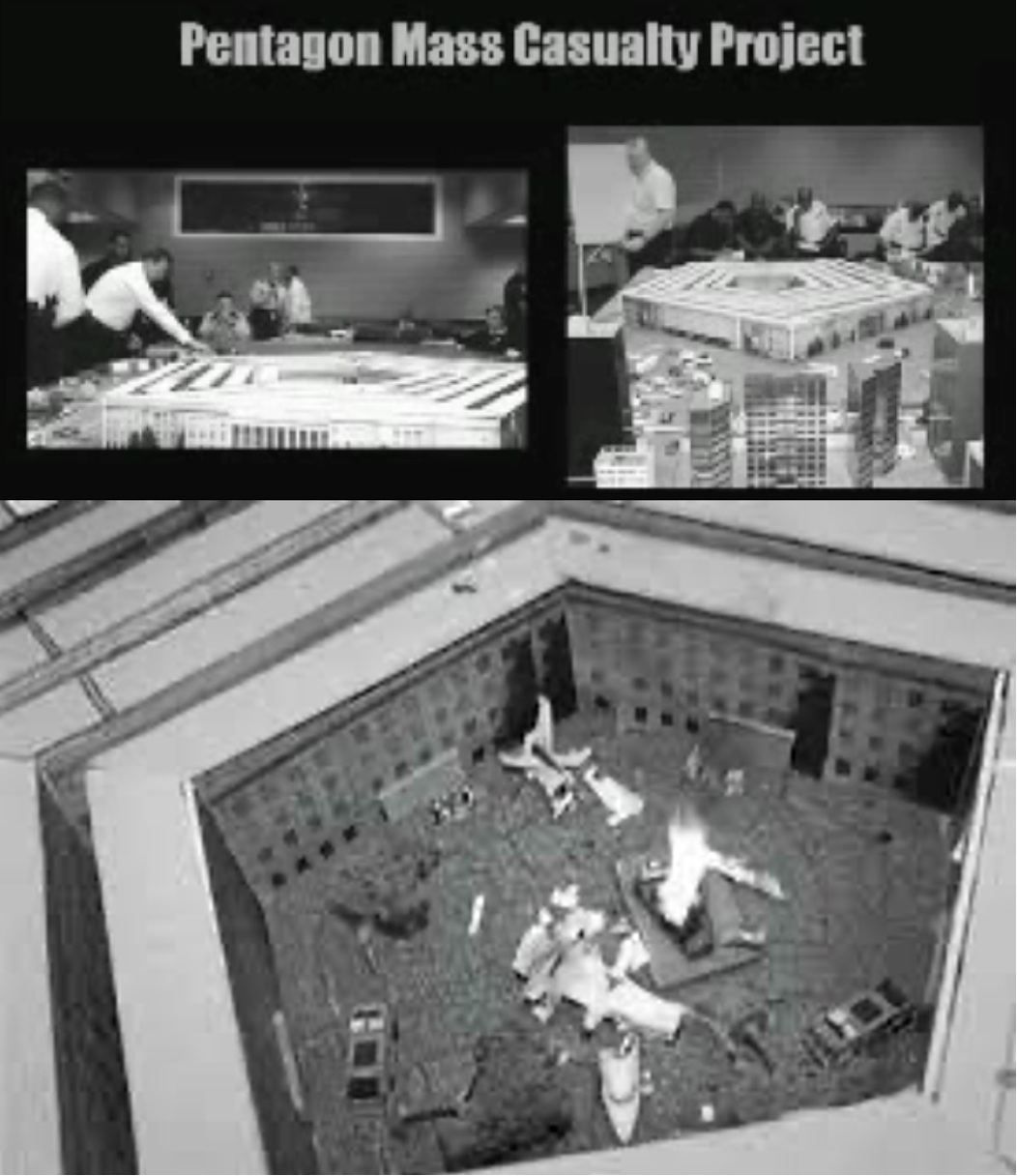
Statistically, this makes it reasonable to infer that the same elements who may have carried out the deception also intentionally deposited those recognizable aluminum scraps on the lawn. Fig. 17 below shows a Pentagon simulation from late 2000, in which planners simulated a large airline crash at the building and deposited pieces of simulated wreckage in their model.
Fig. 17 – Images of Pentagon MASCAL planning, circa 2000
Regarding the alignment of the retaining wall and the generator, those have long been interesting features of the events of that day. If bad actors were to
simulate the crash of a large plane into the Pentagon—a crash directly over what is arguably the most sensitive data cable on Earth—they would need to differentiate the explosive scene from other forms of deflagration.
Strategically placing props such as light poles and a damaged trailer along a feigned linear trajectory would achieve their objective.
The retaining wall and trailer are about 60 feet apart. A 757’s engine centers are about 43 feet apart. A 52˚ approach angle places the vectored impact points just about where the wall and the trailer were damaged.
But was that damage caused by a 757 or by a deceptive team with a tape measure and a devious scheme?
Fig. 18 – Generator impact would have occurred at the red circle
Note that the retaining wall appears broken, with fracture patterns that are incongruent with the alleged angle of approach. Note, too, that the ground around the fractured wall is pristine, with no gouges. Then note that an extreme bank would place the distal aspect of the left wing into the steam vault or into the ground. Finally, note that, for any large aircraft, a left bank also means a left turn. Yet LPI purports the trajectory of an impacting aircraft was straight and level.
Fig. 19 – Images of the retaining wall show many problems
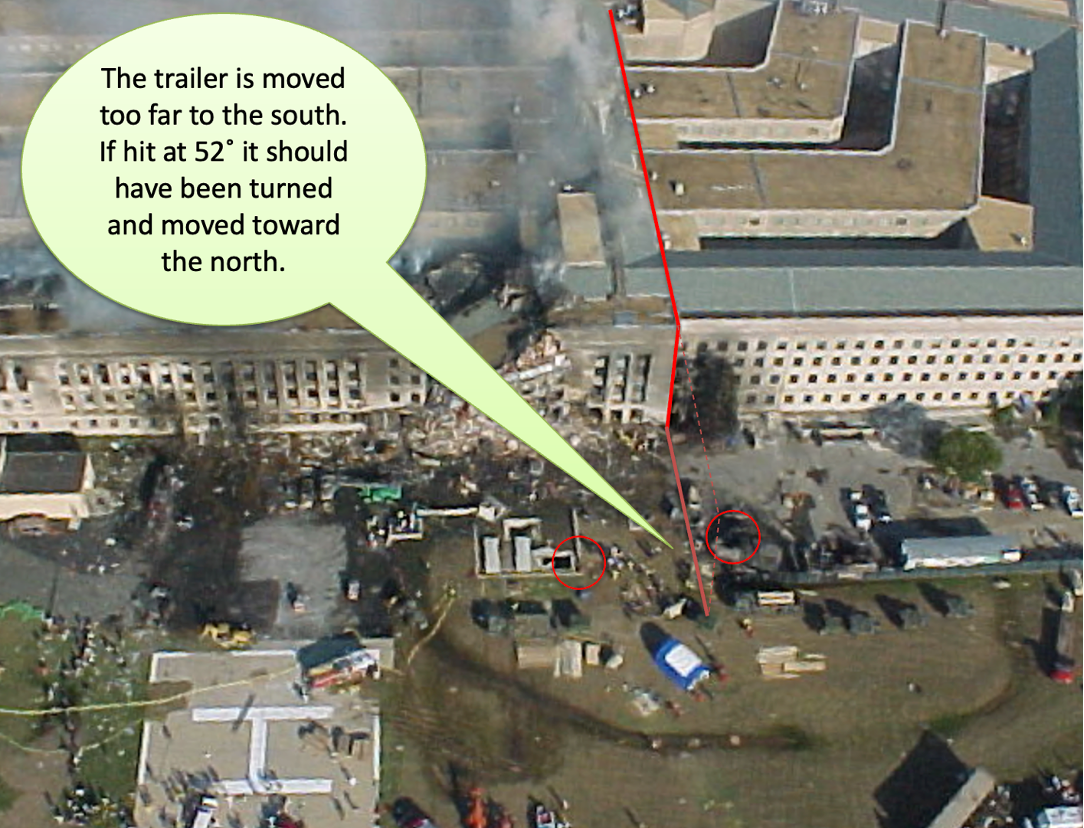
On the right side of this scene, we find a damaged generator trailer and damaged fence. The generator trailer is very far to the south relative to the requisite collision point of 43-foot-spaced engines, as shown in Figs. 20 and 21 below.
Fig. 20 – Generator shown by faint red dashed line to right of red circle
Fig. 21 – Aerial image shows generator trailer knocked far to the south
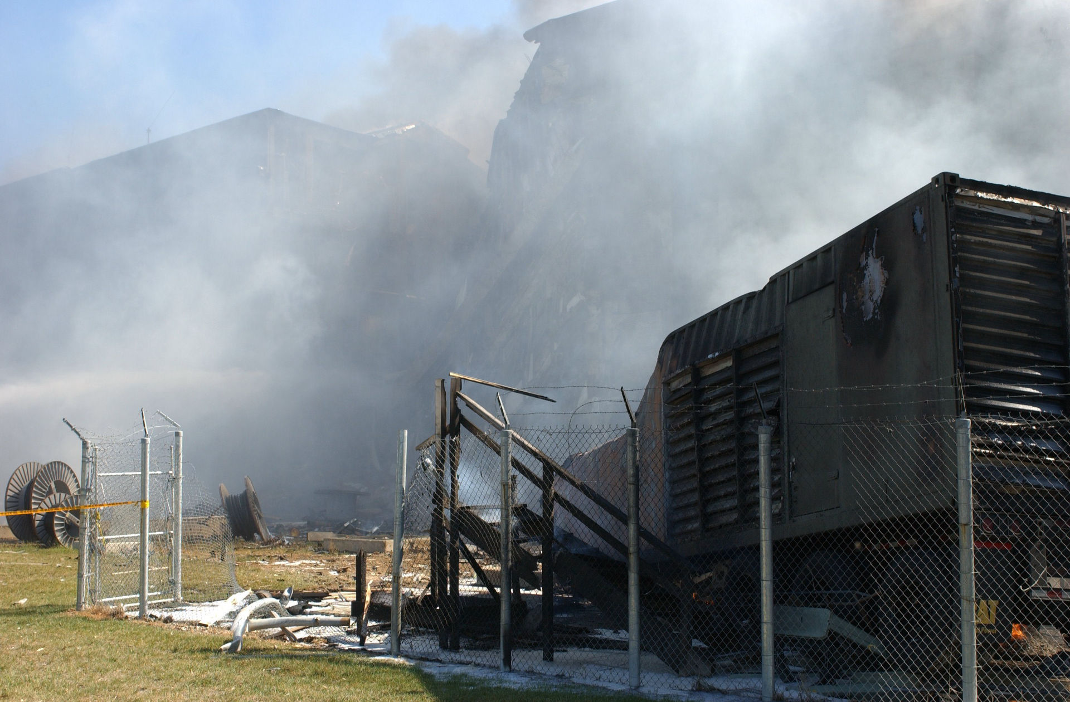
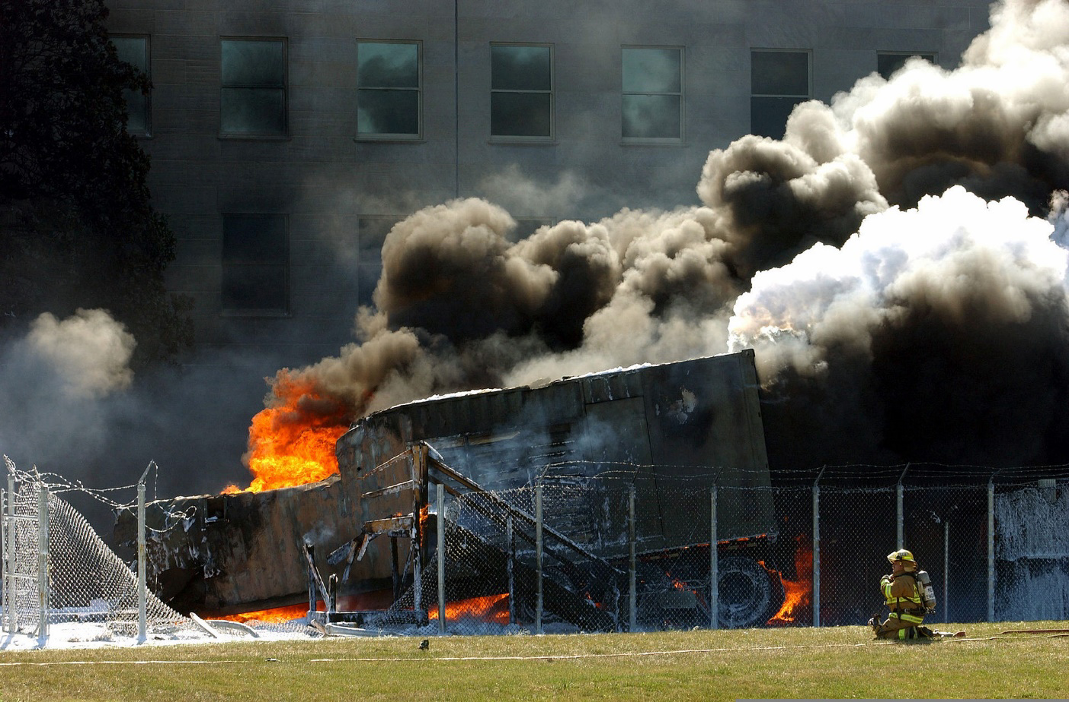
Most of the released photographs from the crime scene make it appear there is a cookie-cutter engine gouge carved out of the top of the generator trailer, such as that shown in Fig. 22 below.
Fig. 22 – The generator trailer gouge looks curved from this angle
However, the image in Fig. 23 below, taken from the lawn and showing the full side, reveals the damage to the generator was very long and linear. Without more information, interpreting such an image would be challenging.
Fig. 23 – A long stretch of generator trailer is missing in this view
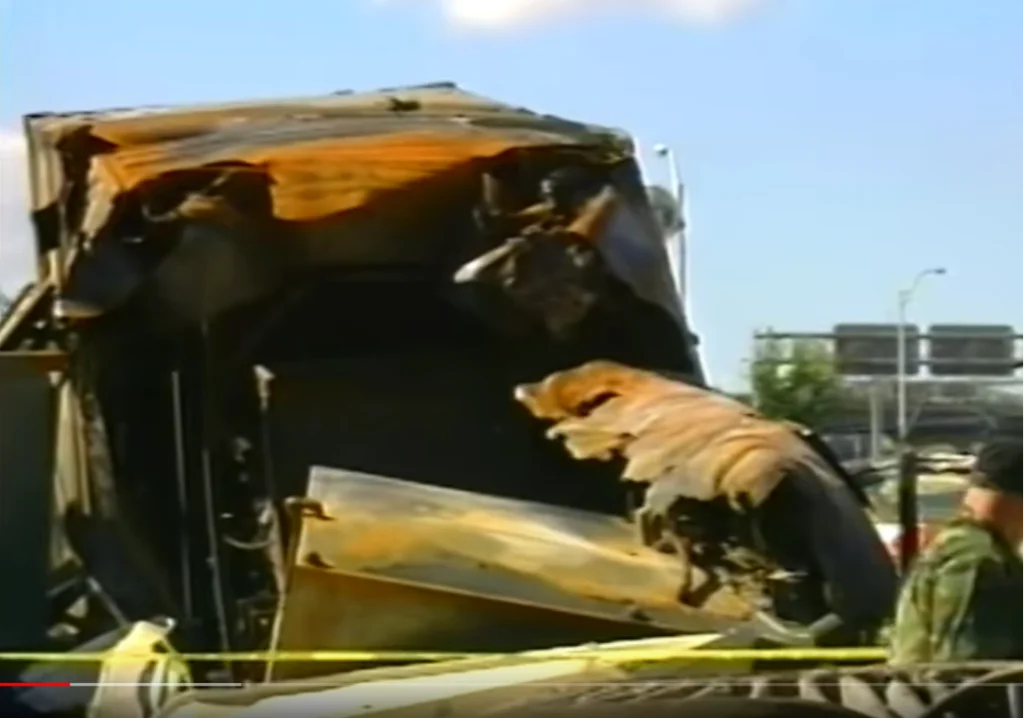
Fortunately, we can examine screen shots from film footage released under the Freedom of Information Privacy Act (FOIPA). In those screen shots, such as found in Fig. 24 and Fig. 25 below, we can see that there is much more going on than LPI describes. It looks as though the generator has exploded. The margins of the alleged impact side are curled and corrosively eaten away, as if from extreme heat and not from an impact made by an object. Portions of the generator closest to the building are completely blown away, and they are
not in line with the light pole path vector.
Fig. 24 – From this angle, the generator trailer looks blown up
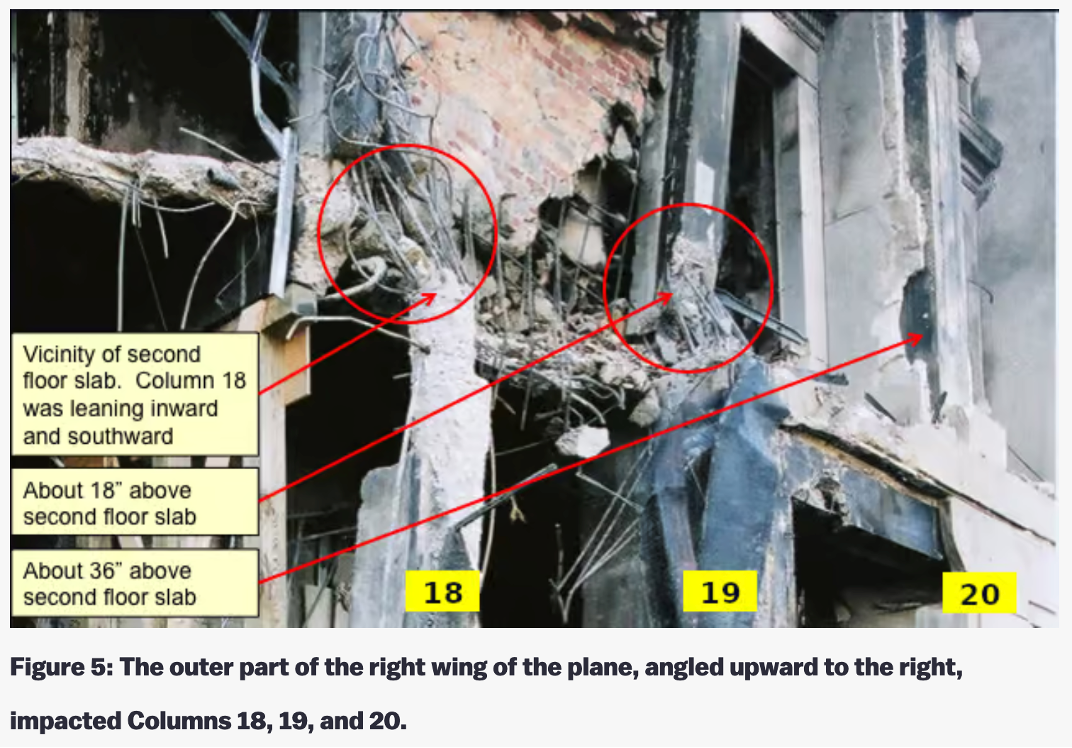
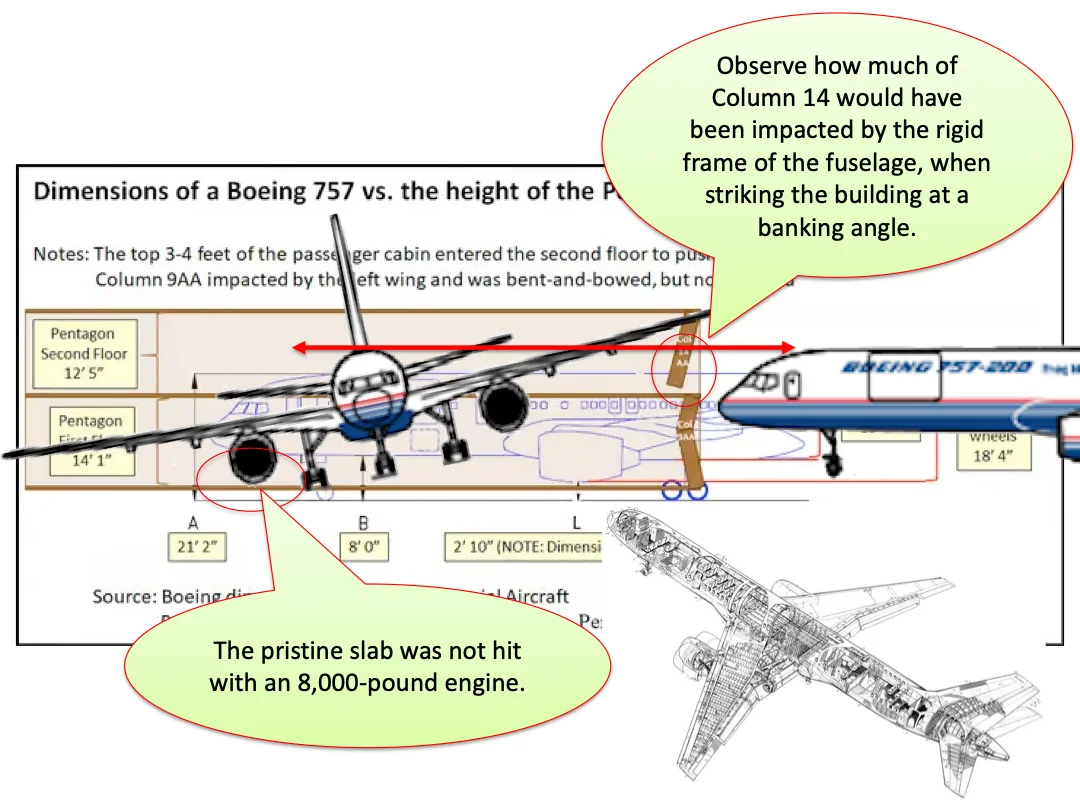
Though speculating as to what may have caused this corrosive scene is beyond the scope of this response paper, one thing is clear: to assume the generator trailer was impacted by a Boeing 757’s RB211 engine is premature. The hypothetical presence of a 500-mph, banking 757 is not congruent with the remnant physical evidence or with the scene itself. Since the existence of an undamaged Column 18 rules out impact with a large fixed wing,
we may surmise that something other than a 757 damaged the generator trailer.
Fig. 25 – Close-up generator screen shot from FOIPA-released video
To explain the leftward roll required for a 757 to have hit both the retaining wall and the generator trailer, LPI asserts that impact with the trailer induced both a leftward roll and a clockwise yaw. But consider the difference in impulse from a stationary 30,000-pound generator and a 757 weighing over 100,000 pounds and flying at 500+ mph. By what mechanism would the aircraft drop to the left? And could it do so within only 30 feet or so—the approximate distance it would take to travel between the front of the generator trailer and the retaining wall—when going at that speed? The estimated 5 to 10 ft drop would conservatively have to occur within 0.04 seconds.
Considering the conjecture of LPI’s proposed yaw, is that really what we observed in the 2001 photos? I submit that a few broken pieces of cladding around Column 12 are not sympathetic with a multi-ton impact of the aft of a jet at that speed. Additionally, we observe from aircraft crash scenes all over the world that the wings and tails are easily cleaved. So, to suggest that the reinforced tail or wings could somehow be “pulled in” around concrete floors and columns is not tenable.
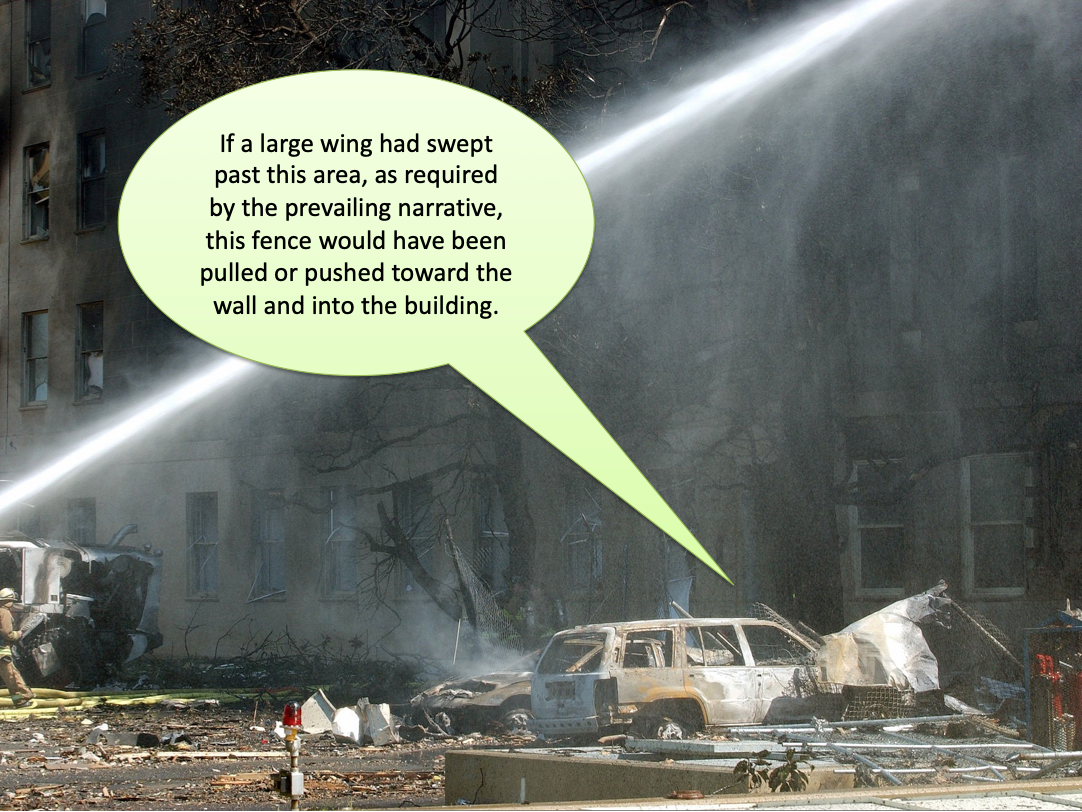
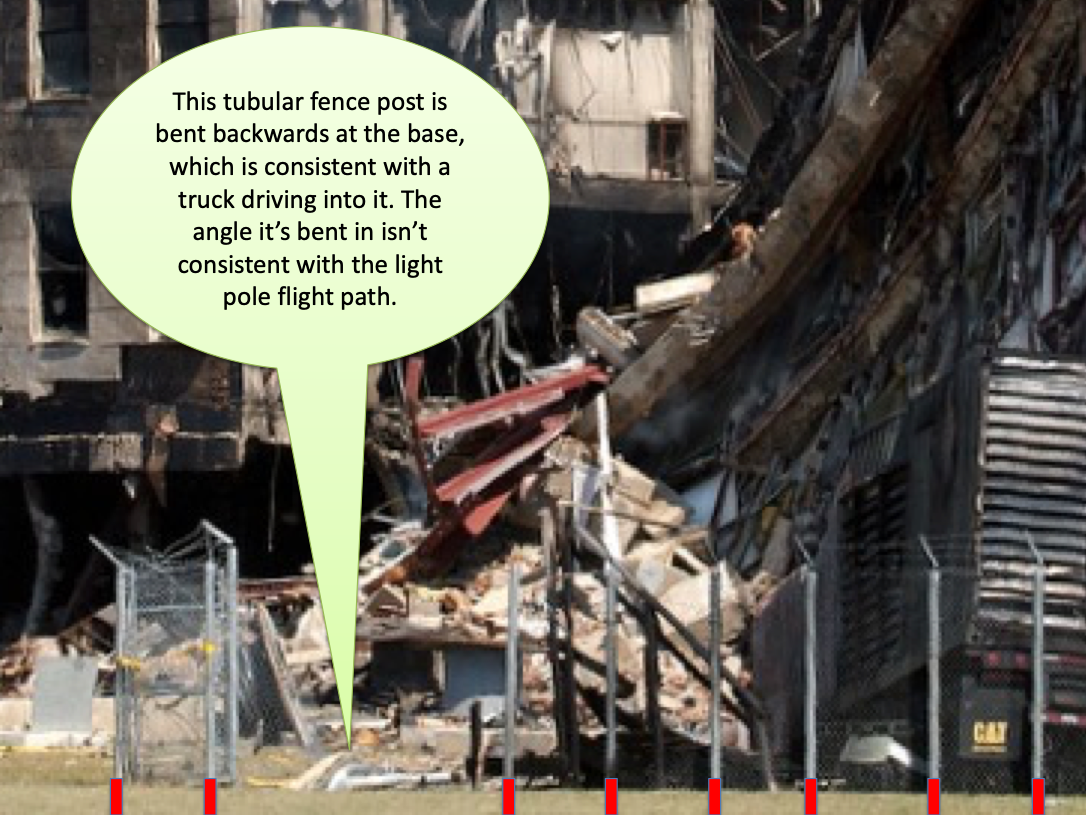
The damage pattern to the generator fence (see Fig. 22) is intriguing, as it clearly looks pushed directly toward the building. Fig. 26 shows that the fence post is bent cleanly at the ground, as might happen if a truck were to drive over it—perhaps
before the explosive event occurred. Whenever it happened, the damage to the fence is consistent with a large ground vehicle impact, like the truck shown in Fig. 27.
Fig. 26 – The fence post is bent directly toward the building
The view of the lawn by potential witnesses was largely concealed by the topography. If criminals controlled the scene before the attack and pre-selected a caravan of traffic to occupy the bridge, many things could have transpired on the lawn before unwanted witnesses arrived. True, we cannot be certain what knocked that fence down, but neither can the LPI authors. However, we
can say that a hypothetical vehicular run-in with the fence could also explain why the generator was knocked so far out of alignment.
Fig. 27 – A large truck could have been driven over the fence
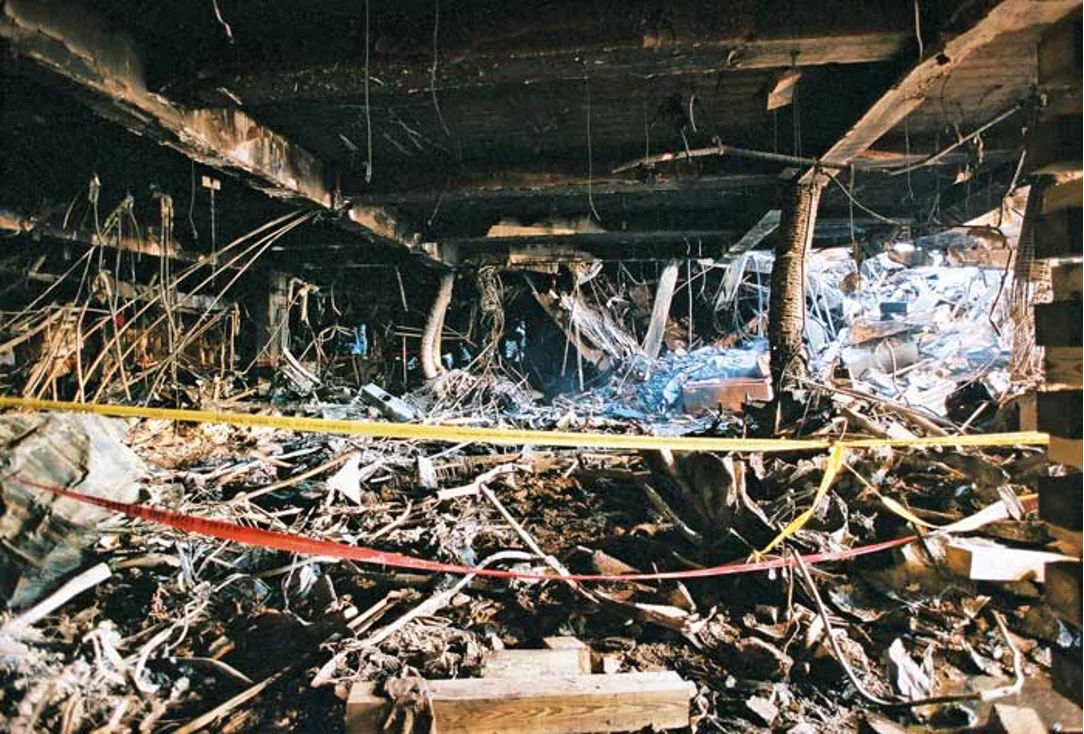
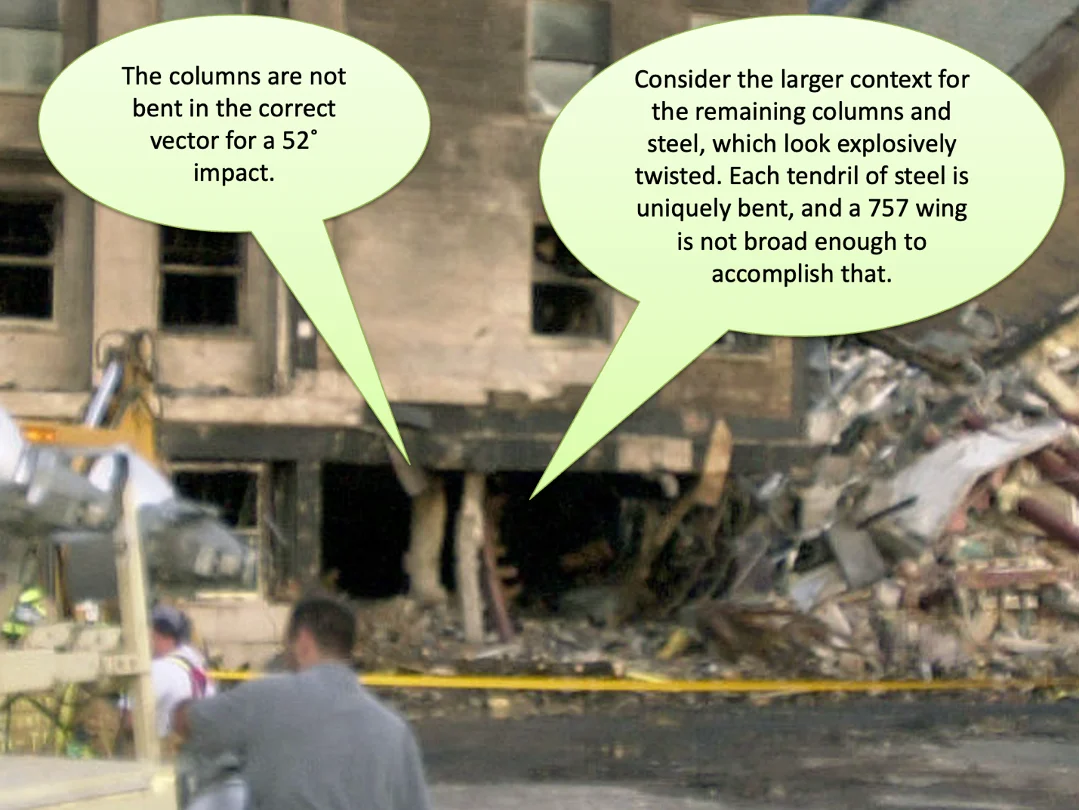
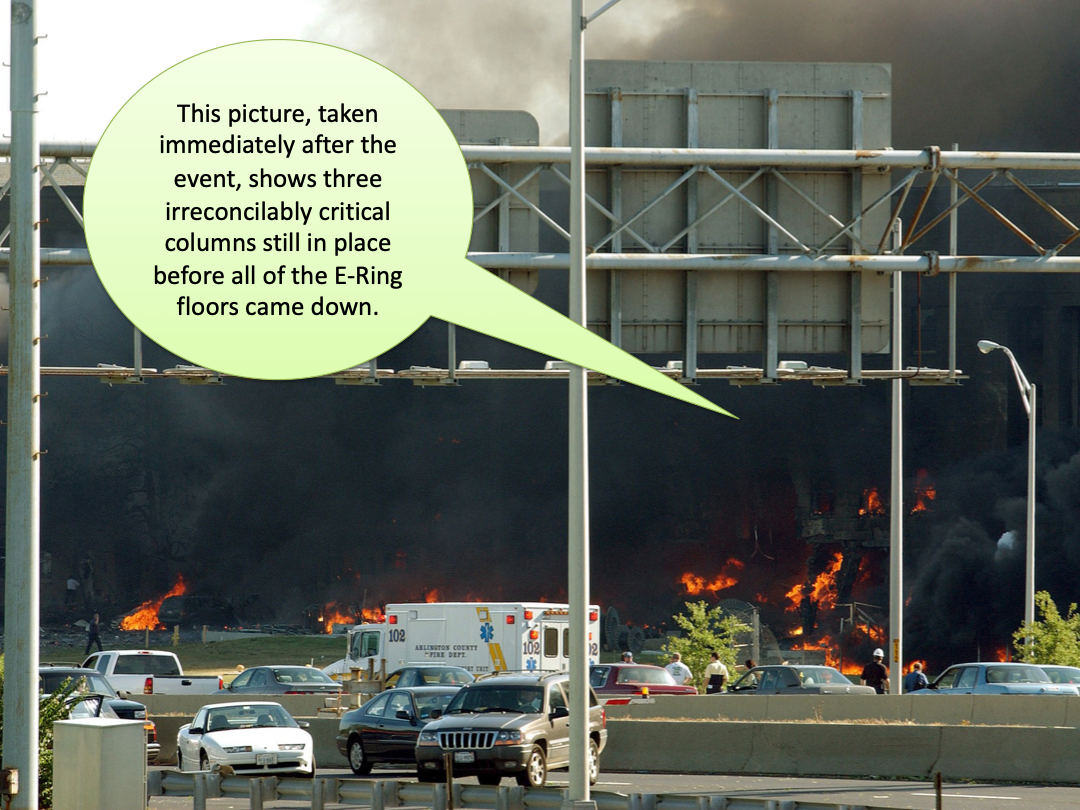
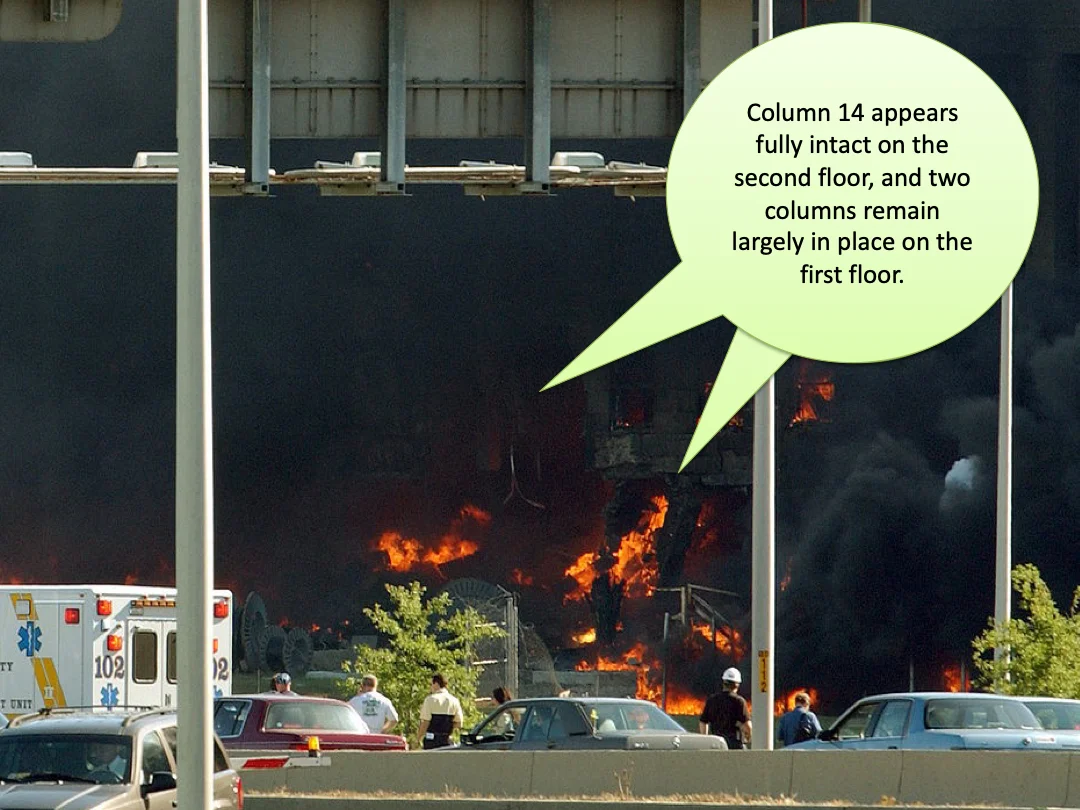
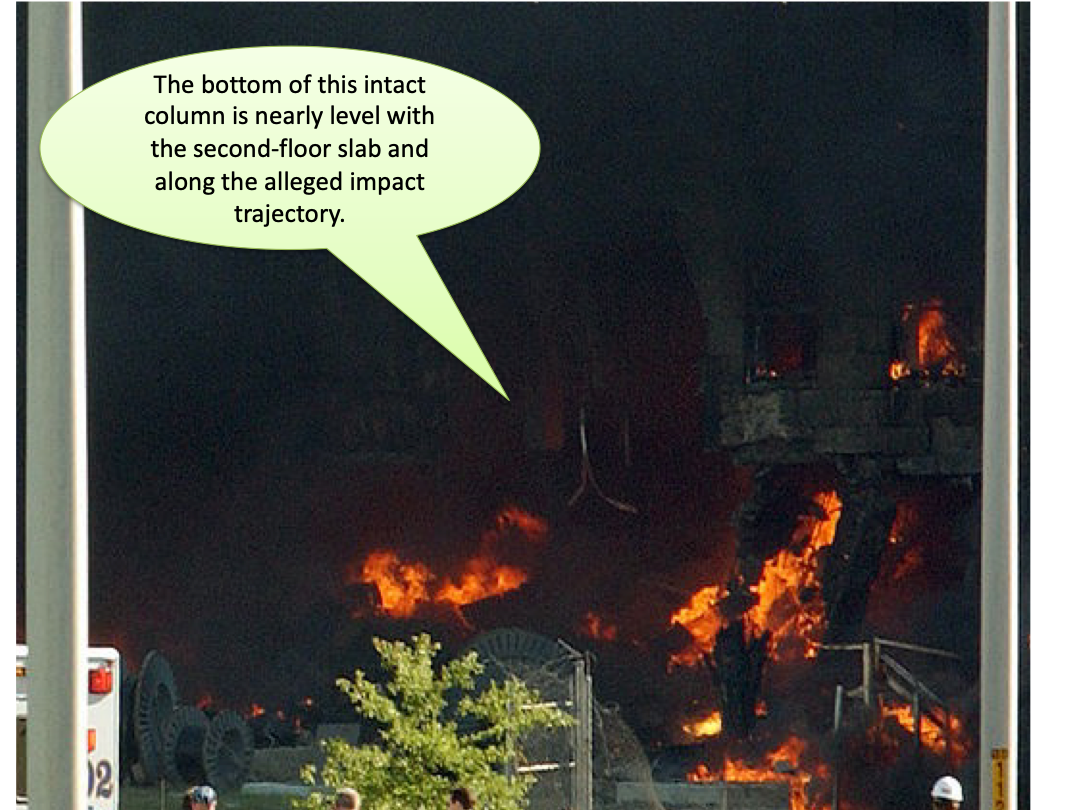
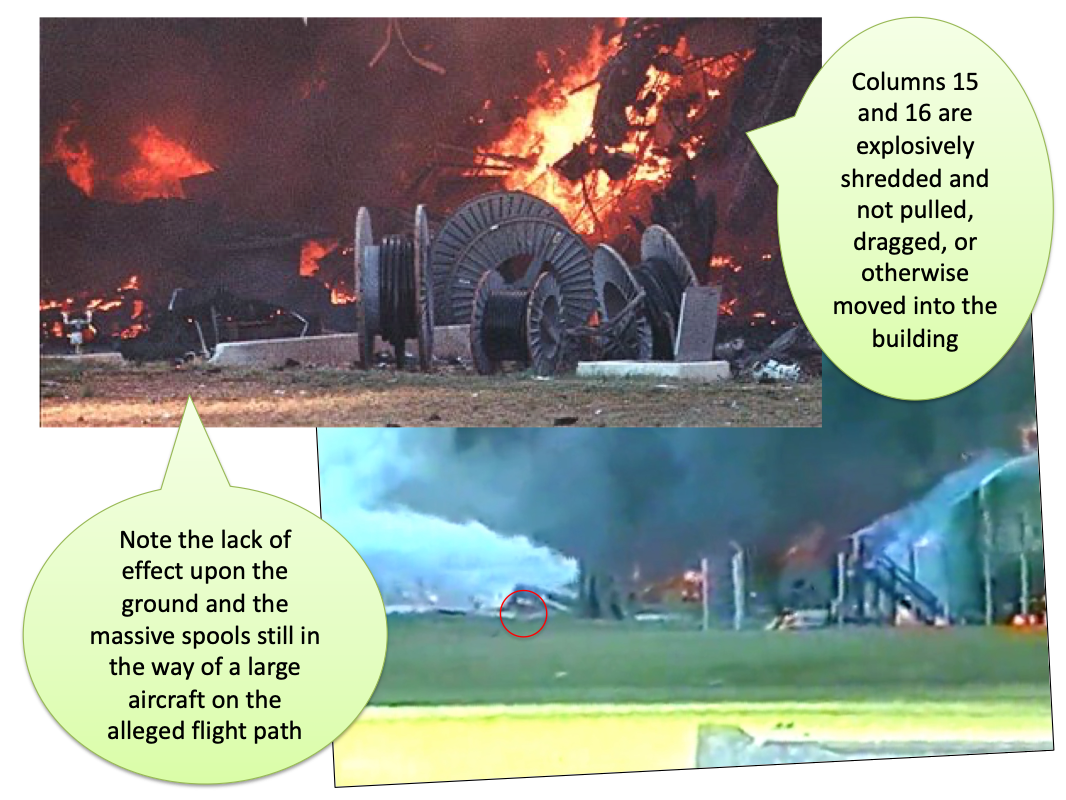
One need only look at World Trade Center 7’s failure to come down concurrently with WTC 1 to see that explosive plans can fizzle and must be amended on the fly. I suspect it was not the intention of the Pentagon perpetrators to leave intact columns in irreconcilable locations (see columns 9, 14, 15, 16, and 18 in Fig. 28 below).
Fig. 28 – This composite image shows how many components were left intact
Though the LPI authors have not made their case, they ask that claims of “trickery” be proved. I ask the same. However, the only way to prove anything is to accurately assess
all the information at hand. Ignoring or misinterpreting certain facts and photos may introduce logical fallacies.
Ideally, after all the evidence has been analyzed, we should be left with a credible, coherent, cohesive subset of information upon which to base our conclusions.
The information accepted and introduced by the LPI authors is not that subset.
For instance, when they introduce the notion of a Pentagon flyover at the end of their paper, they present readers with a false dichotomy. A plane
could have overflown the building while bombs went off inside and/or while a kinetic strike occurred from some other vector.
Too many credible eyewitness testimonies, including Pentagon police Sgt. William Lagasse and Sgt. Chadwick Brooks, do not reconcile with the assertion that AA77 hit the building along the light pole and generator path. The alternative flight pattern these numerous eyewitnesses vouch for is evidence of trickery and flyover by simple syllogism, for a large plane
could not fly to the north and then bank to achieve the damage that was done inside and outside the building.
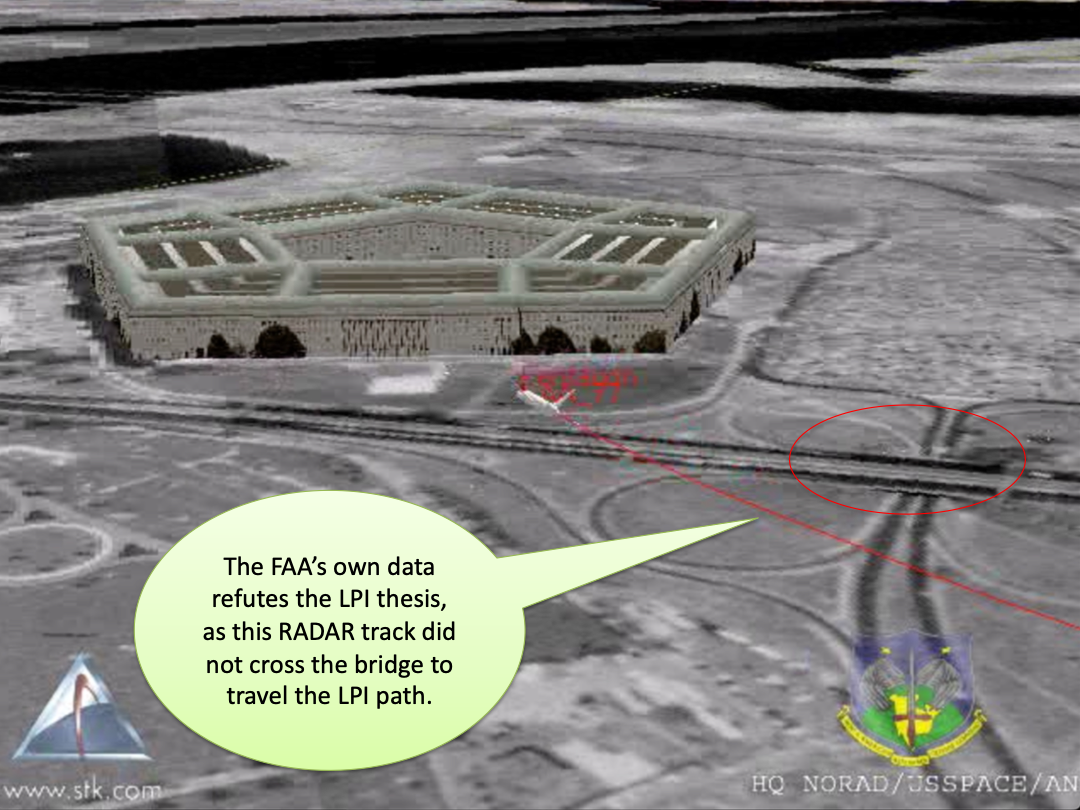
Even the US government’s own data from FOIA-released Air Force RADAR Evaluation Squadron (RADES) information places the transponder of the target to the north of the bridge, and therefore not in alignment with the ASCE/LPI trajectory. See Fig. 29 below.
Fig. 29 – Screen capture from RADES data shows an irreconcilable flight path
Conclusion
When information about any feature of an event categorically rules out claims that would otherwise follow from that feature, then it is time to abandon those claims.
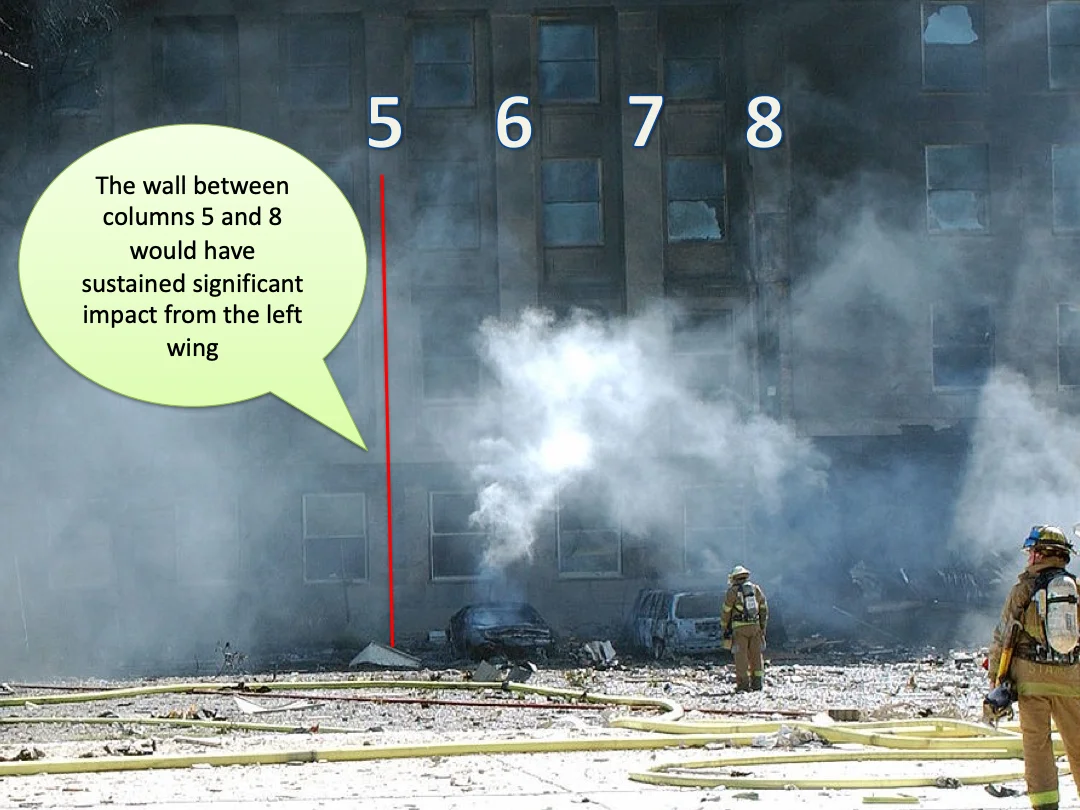
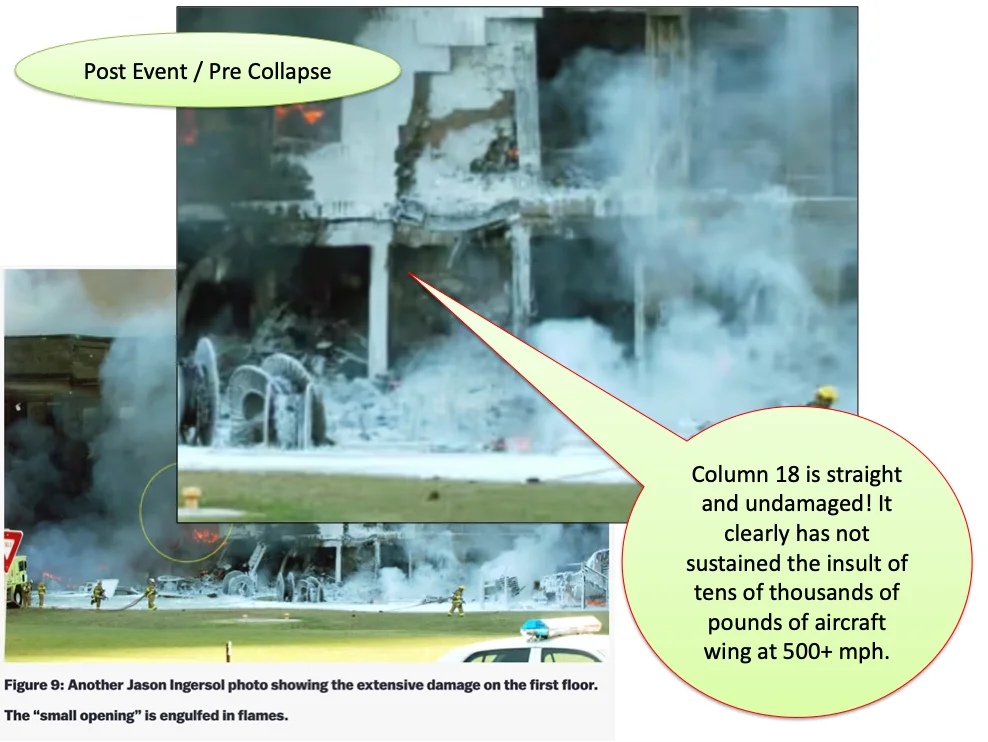
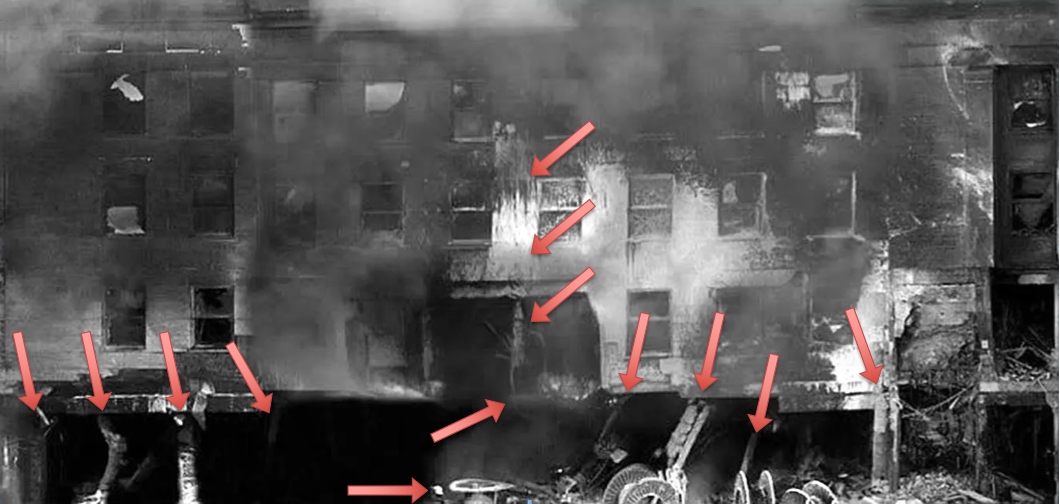
The blown-out fence at the north end of the opening refutes the claim that a large airplane wing transcended that space. The cleanly cut tree trunk found immediately after the explosive event refutes the belief that a plane ripped through the trunk. The columns that were deformed directly eastward, instead of to the northeast, refute the conclusion that impact from an object traveling to the northeast caused their damage. After the explosive event, but before collapse, the columns remaining in the E-Ring perimeter refute the narrative that over a hundred thousand pounds of airliner impacted the E-Ring wall. Column 18’s pristine condition is particularly incompatible with LPI’s hypothesis.
It cannot be the case that a large aircraft of any type hit the building along the purported trajectory and left Column 18 intact. The US government’s very own RADES data refutes the notion
that a large aircraft traveled over the bridge, through the generator, and into the building, as LPI suggests it did. These data points alone falsify LPI’s hypothesis.
Granted, we may never be able to prove
exactly what happened that day.
But by at least proving what could not have happened, we get a step closer to the truth. Given the incongruities between LPI’s preliminary conclusion and the verifiable data at hand, this author suggests researchers study all sources of primary evidence and all witness interviews before making any definitive determinations or declarations.
References
Brookman, Ronald H. (2012) ‘A Discussion of ‘Analysis of Structural Response of WTC 7 to Fire and Sequential Failures Leading to Collapse’ Journal of 9/11 Studies, October 2012.
Cole, John. (2023) ‘Discussion of “Spontaneous Collapse Mechanism of World Trade Center Twin Towers and Progressive Collapse in General” by Jia-Liang Le and Zdeněk P. Bažant’ Journal of 9/11 Studies, July 2023.
Němec, I., Trcala, M., Vala, J., & Vaněčková, A. (2018). A contribution to analysis of collapse of high-rise building inspired by the collapses of WTC1 and WTC2: Derivation of simple formulas for collapse upper speed and acceleration. Journal of Applied Mathematics and Physics, 6(12), 2666-2680.
Szuladzinski, Gregory et al. (2013). ‘Some Misunderstandings Related to WTC Collapse Analysis’ International Journal of Protective Structures, June 2013.
Author Information
While describing exactly what may or may not have impacted the Pentagon’s E-Ring wall in 2001 may never be possible, this paper argues that the conclusions reached in “Large Plane Impact Damage to the Wall of the Pentagon and Adjacent Objects” (hereafter, LPI) are based upon selective use of...

ic911.org

 well said.that seems to be her mindset indeed that just because the narrative explained to her isnt the one that she desires, the official government narrative must be true.