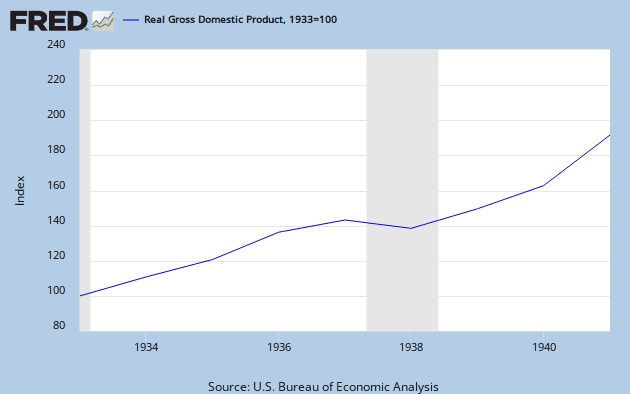
The Bad Frank completely misses FDR's real mistake. FDR and his Treasury Secretary, Henry Morgenthau, were major deficit hawks. [This is why FDR favored such high taxes: because he insisted on paying for government, rather than borrowing from, say, China. He was the opposite of "guns and butter" Bush 43, who borrowed to pay for his wars and tax cuts]. Anyway, in 1937 after only marginal economic improvements (and still dismal employment), FDR, worried about debt and inflation, decided to pull back, i.e., lower spending > balance the budget. Prior to this, the Fed tightened the money supply, refusing to soak up bad debt or pump money into a stalled economy, forcing more banks to fail -- leading to even greater catastrophe. (See Milton Friedman's excellent description of what happens when the Fed tightens the monetary supply at the wrong time)
But…FDR's goal was achieved: the deficit fell from 5.5% of GDP in '36 to 2.5% in '37.
The 1937 budget, aka austerity, suffocated fledgeling demand and prolonged the depression.
It took the greatest government spending program of all time to end the Depression: WWII. Had the government merely dumped the bombs and other war materials into the ocean, the result would have been the same: military Keynesianism, i.e., government pumps money into manufacturing, leading to and explosion of jobs and innovation. More importantly, people with jobs spend money. And what happens when people spend money? The capitalist must innovate and add even more jobs to capture that money.
Again: Government stimulated demand, and the capitalist engine jump-started to capture that demand. When there is no demand -- because the middle class doesn't get paid enough to consume, and they've run out of credit -- there is no reason to invest or add jobs. Giving tax cuts to millionaires will not lead to investment and job creation if there is no middle class demand.
Here is the lesson of WWII
Granted, the government spending necessary to boost war manufacturing resulted in a deficit over 100% of GDP -- but it was sufficient to prime the pump and jump start the economy. Once the economy started, we experienced the most sustained economic boom of modern times. Make no mistake, though: America needed an existential threat to prompt FDR and the budget hawks to finally start pumping real money into the economy.
Sadly, because of the noise machine, we still have not learned the correct lessons from the Great Depression.