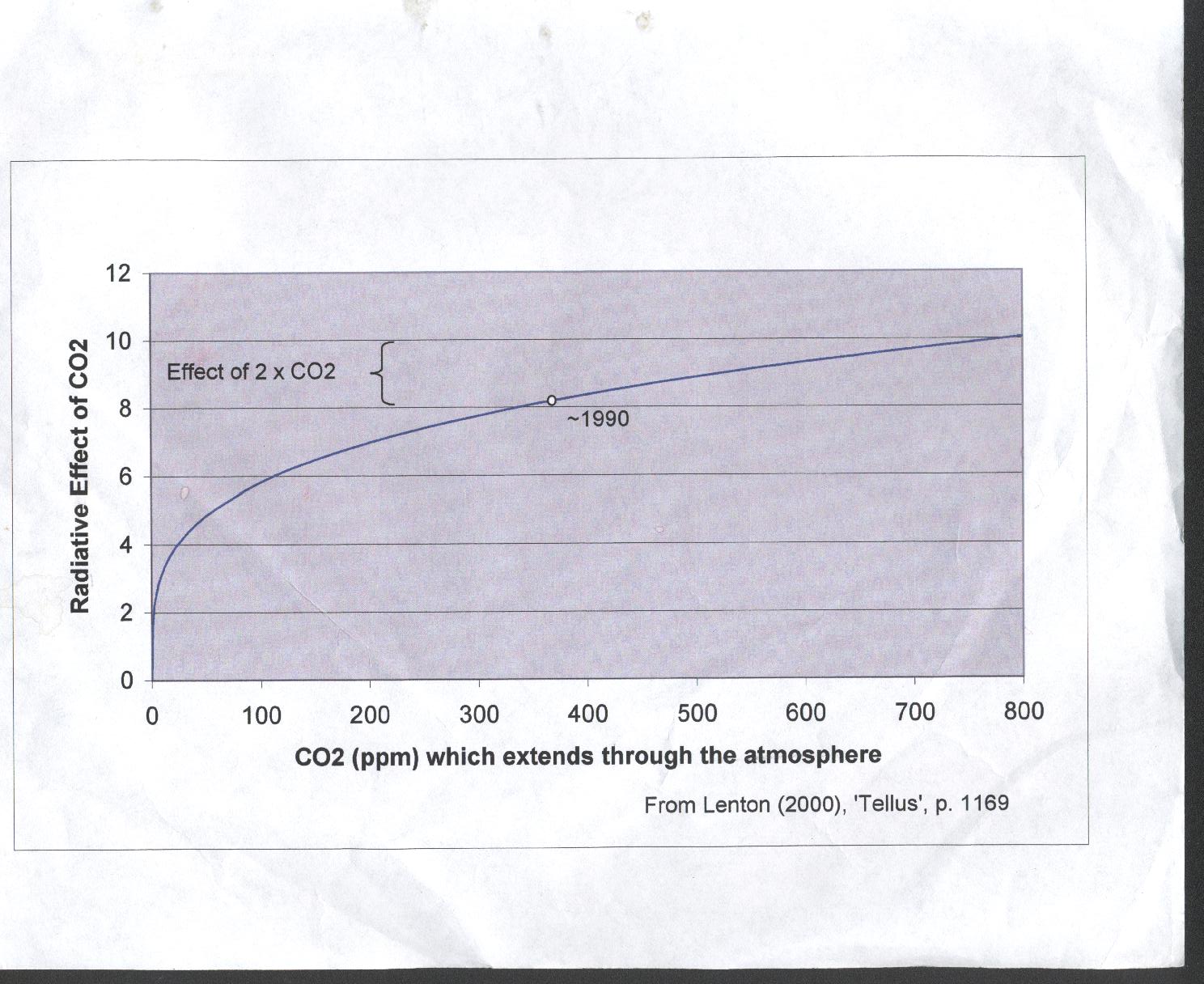
Absorbtion leads to radiative efficiency, radiative forcing, radiative effect and climate sensitivity.
According to the Beer-Lambert Law the proportion of radiation absorbed upon passing through a distance x of a medium is
1 − e^(−ax)
*
where a is a parameter that reflects the concentration of the absorber and its radiative efficiency. The parameter a is the product of two terms. One is the concentration ρ of the absorber and the other is a characteristic of the absorber α, called its radiative efficiency.
a is a parameter that reflects the concentration of the absorber and its radiative efficiency. The parameter a is the product of two terms. One is the concentration ρ of the absorber and the other is a characteristic of the absorber α, called its radiative efficiency.
When there are more than one greenhouse gas the value of a is
a = Σ αiρi*
*
where αi and ρi are the radiative efficiency and linear density of constituent i.
*Radiative forcing is the change in the energy input to the Earth's climate system over some period of time due to some external change. It is measured in watts per square meter (W/m²). It is a useful concept and leads to the definition of the climate sensitivity parameter λ, i.e.,
λ = ΔTs/ΔF*
*
where ΔTs is the change in the Earth's global mean surface temperature and ΔF is the radiative forcing.
radiative forcing is, to a reasonable approximation, a logarithmic function of CO2
ΔF=RF=beta*ln(CO2/CO2_ref)
Climate sensitivity*
s = dT(ln2/ln(2C/C))=dT and
s=λ = ΔTs/ΔF
RF=ΔF=beta*ln(CO2/CO2_ref)
Which yields,
s=λ = ΔTs/(beta*ln(CO2/CO2_ref))
rearranging,
ΔTs= s*(beta*ln(CO2/CO2_ref))
We make*adjust the constants so we have a doubling*and use
radiative effect= RE*
and*
RE_2-RE_1=Δ= ¥*ΔTs=¥*(T_2-T_1)
Δ=*λ*(£*ln(2*CO2_ref/CO2_ref))/ln(2)
to solve for s*£=*λ*£
s, or λ, is climate sensitivity
£ is a constant that was maintained when the form was adjusted to be "doubling". *It is simply a scaling factor.
This*
Δ= ¥*ΔTs=¥*(T_2-T_1)= λ*(£*ln(2*CO2_ref/CO2_ref))/ln(2)
¥*(T_2-T_1)= λ*(£*ln(2*CO2_ref/CO2_ref))/ln(2)
¥*ΔTs=¥*T_2-¥*T_1
= ((λ*£)/ln(2))*(ln(2*CO2_ref)-ln(CO2_ref))
suggesting
¥*T_2= ((λ*£)/ln(2))*(ln(2*CO2_ref))
¥*T_1= ((λ*£)/ln(2))*(ln(CO2_ref))
And with a litte effort, we can tie*radiative forcing, radiative effect and climate sensitivity together.
That just leaves tying %absorbtion and*radiative efficiency to*radiative forcing, radiative effect and climate sensitivity.
%absorbtion and radiative efficiency are related by
%absorbtion=1 − e^(−Σ(αiρi)x)
x is distance,*ρi is*concentration of the absorber and*αi is the radiative efficiency*of the absorber
Radiative forcing, radiative effect and climate sensitivity are related by
s=λ = ΔTs/ΔF is climate sensitivity
s=λ = ΔTs/(beta*ln(CO2/CO2_ref))
ΔF=RF=beta*ln(CO2/CO2_ref) is radiative forcing
RE is radiative effect, where
Δ= ¥*ΔTs=¥*(T_2-T_1)= λ*(£*ln(2*CO2_ref/CO2_ref))/ln(2)
£ and ¥ are scaling constants to make sure it all worked out.*These tie temperature in, along with anomoly, and relate £/(¥*ln(2)) to T,*λ*and CO2 as
£/(¥*ln(2))=T/(λ*ln(CO2_ref)).
All in all, it gives the ln function as a concequence of*%absorbtion=1 − e^(−ax), a consequence that will be quite a trick to back into.
This will be a consequence of how the (1-e^t) effect of thermal equilibrium which will tie black body radiation which will yield a poisson distribution. *This is a consequence of the normal distribution of quantum mechanics which, as is shown in queuing theory, yields the poisson distribution.
IanC's on a right track with the billiard ball thing.**Somewhere, I ran across a powerpoint that detailed the modes of oscilation for CO2. *
We might consider viewing the gas as a black body radiator.*At thermal equilibrium, they will emit at the same rate of absorbtion.
There are a few ways to get there, that's science, internally consistent.
Maybe just look up*Beer-Lambert Law.
And it all just seems like a bit too much work to show how it ties together such that, over small changes in CO2, like 300 to 380, the change is nearly linear.*
--_
Saturation, Nonlinearity and Overlap in the Radiative Efficiencies of Greenhouse Gases
http://www.atmos-chem-phys.net/9/5539/2009/acp-9-5539-2009.pdf*

You truly are batshit crazy aren't you. A country who's citizens are resorting to cannibalism is far from a successful one. Just wait till the board finds out this little post of yours!lmao