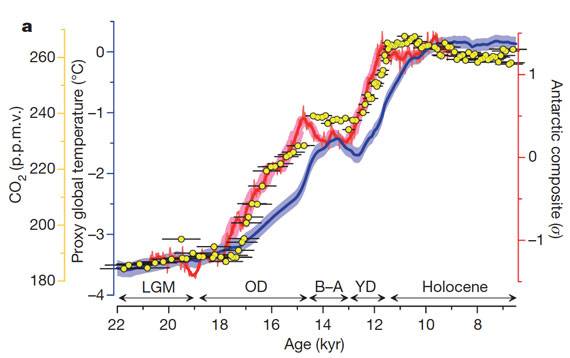
I disagree. When two different measurements or measurement methodologies give different results, the discrepancies need to be resolved. It is the essence of scientific debate. Further debate arises when said empirical data is used, in one for or another, as a basis for mathematical modeling of non-linear physical systems, like the thermal properties of the atmosphere.
Absolutely - I doubt anyone will disagree with that.
But to me it is a bit like the police investigating a murder in that they can use evidence to identitfy the murderer and murder weapon, without necessarily being able to dot every 'i' or cross every 't'.
We definitely need to understand more about thr heating of oceans, in particular.
But I don't personally feel that the link between CO2 and temperature can be considered theoretical or debatable at his point.
That is the 'modeling' part of my comment. It is entirely debatable that using a simple one or two linear parameter lab experiment is an appropriate basis for modeling a complex non-linear global circulation system.
I might also point out that it is debatable whether or not your legal system 'preponderance of evidence' metaphor is the best one to refer to. We start wandering into the subject of mathematical probabilities with the consequences of policies, and drift away from the science. My preferred method for pure empirical science based subjects is to use the Kent scale;
Kent’s Words of Estimative Probability[2]
Certain 100% Give or take 0%
The General Area of Possibility
Almost Certain 93%; Give or take about 6%
Probable 75%; Give or take about 12%
Chances About Even 50%; Give or take about 10%
Probably Not 30%; Give or take about 10%
Almost Certainly Not 7%; Give or take about 5%
Impossible 0; Give or take 0%
Link:
Words of estimative probability - Wikipedia, the free encyclopedia
Medicine tends to use a coarser version of this type of information analysis, and the legal system-yet another. When it comes to the policy side, the actuarial insurance model is an excellent tool for objectively combining the risks with cost/benefit. We get to ask ourselves how do the benefits of a policy, and the associated cost, compare with similar situtions we face. When I get on an airplane, do I insist on a 0% probability of crashing? (The cost being infinite) And how do these already arrived at decisions and policies relate to the new policy in question.
Anyway, that is where I stand on the subject.