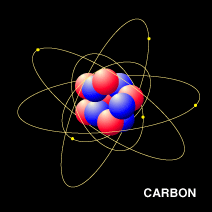
For all intents and purposes there are on earth a fixed number of carbon atoms. They all have to be someplace. Generally "someplace" includes the oceans, living tissue, underground, or in the atmosphere.*
...
To the degree that we don't do that, the climatic changes that we will have to adapt to will be more drastic.
That's a great picture. The bio-geological life of a carbon atom.
Can we paint a picture over a larger time scale, one that picks up the Carberiferoius period? How were the continents arranged? How much more carbon was in CO2 atmospheric gas and in vegitation? What was the predominant climate driver; sun; CO2? *What factors were responsible for Earth entering and exiting the period?
Can we get a picture of how solar energy is cycled in and out of carbon molecule forms? *Is CO2 the "ground state" for energy storage?
-------
CARBON
Life in the Beginning
"Life, as we know it, revolves around the chemical element carbon. In the early universe, as some stars reached the end of their life cycle, they exploded, and elements were ejected. One element in particular, carbon, proved to be a remarkable element and went on to play a dominant role in the origin and evolution of life. Its chemical properties allow it to bond with itself as well as a wide variety of other elements. This allowed it to build many different compounds of varing forms, shapes and complexities, and form nearly 10 million known compounds. Many thousands of these are vital to life processes."
-------
ENERGY
The Energy Story - Introduction
"Energy is one of the most fundamental parts of our universe.
We use energy to do work. Energy lights our cities. Energy powers our vehicles, trains, planes and rockets. Energy warms our homes, cooks our food, plays our music, gives us pictures on television. Energy powers machinery in factories and tractors on a farm.
Energy from the sun gives us light during the day. It dries our clothes when they're hanging outside on a clothes line. It helps plants grow. Energy stored in plants is eaten by animals, giving them energy. And predator animals eat their prey, which gives the predator animal energy."
-------
CARBONIFEROUS
The Energy Story - Chapter 8: Fossil Fuels - Coal, Oil and Natural Gas
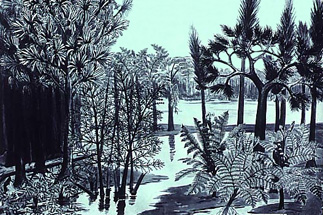
"There are three major forms of fossil fuels: coal, oil and natural gas. All three were formed many hundreds of millions of years ago before the time of the dinosaurs hence the name fossil fuels. The age they were formed is called the Carboniferous Period. It was part of the Paleozoic Era. "Carboniferous" gets its name from carbon, the basic element in coal and other fossil fuels.
The Carboniferous Period occurred from about 360 to 286 million years ago. At the time, the land was covered with swamps filled with huge trees, ferns and other large leafy plants, similar to the picture above. The water and seas were filled with algae the green stuff that forms on a stagnant pool of water. Algae is actually millions of very small plants.
Climate during the Carboniferous Period
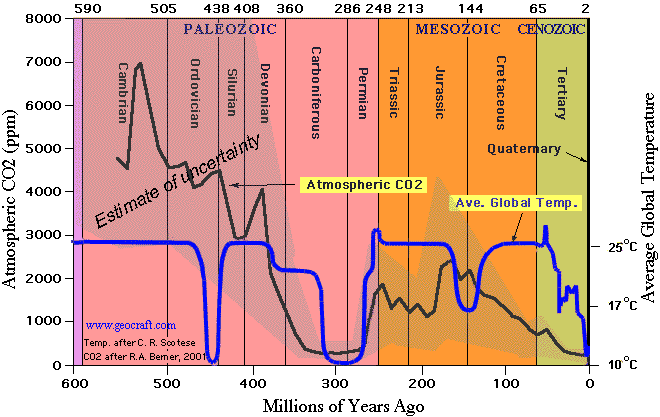
"North America was located along Earth's equator then, courtesy of the forces of continental drift. The hot and humid climate of the Middle Carboniferous Period was accompanied by an explosion of terrestrial plant life. However by the Late Carboniferous Period Earth's climate had become increasingly cooler and drier. By the beginning of the Permian Period average global temperatures declined by about 10° C."
"Average global temperatures in the Early Carboniferous Period were hot- approximately 20° C (68° F). However, cooling during the Middle Carboniferous reduced average global temperatures to about 12° C (54° F). As shown on the chart below, this is comparable to the average global temperature on Earth today!
Similarly, atmospheric concentrations of carbon dioxide (CO2) in the Early Carboniferous Period were approximately 1500 ppm (parts per million), but by the Middle Carboniferous had declined to about 350 ppm -- comparable to average CO2 concentrations today!
*Earth's atmosphere today contains about 380 ppm CO2 (0.038%). Compared to former geologic times, our present atmosphere, like the Late Carboniferous atmosphere, is CO2- impoverished! In the last 600 million years of Earth's history only the Carboniferous Period and our present age, the Quaternary Period, have witnessed CO2 levels less than 400 ppm."
Carboniferous - Wikipedia, the free encyclopedia
Geological history of Earth - Wikipedia, the free encyclopedia
The Carboniferous Period
-------
PANGEA
Prehistoric Life During the Carboniferous Period
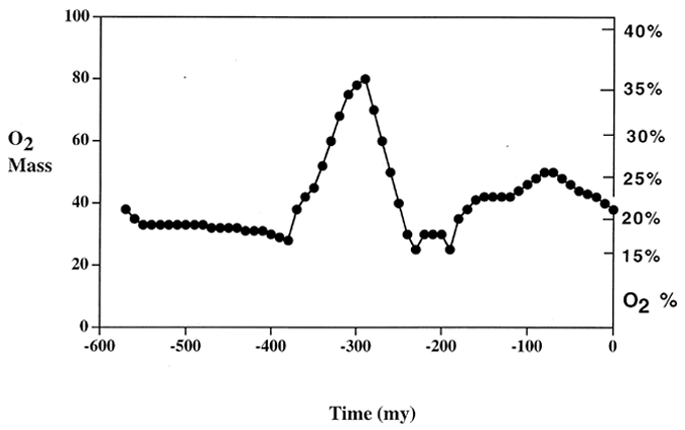
"Climate and geography. The global climate of the Carboniferous period was intimately linked with its geography. During the course of the preceding Devonian period, the northern supercontinent of Euramerica merged with the southern supercontinent of Gondwana, producing the enormous Pangea, which occupied much of the southern hemisphere during the Carboniferous. This had a pronounced effect on air and water circulation patterns, with the result that a large portion of southern Pangea wound up covered by glaciers, and there was a general global cooling trend (which, however, didn't have much effect on the coal swamps that covered Pangea's more temperate regions). Oxygen made up a much higher percentage of the earth's atmosphere than it does today, fueling the growth of terrestrial megafauna, including dog-sized insects."
-----*
ATMOSPHERE
Introduction - Summary
" Four main influences are known, and combining these gives quite a good match to the observations (orange curve in A). The known influences are: irregular El Niño fluctuations in the upwelling of deep cold waters in the tropical Pacific Ocean, which cool or warm the air for a few years (purple curve in B); sulfate smog particles emitted in volcanic eruptions, such as El Chichón in 1982 and Pinatubo in 1991, which bring temporary cooling (blue curve); a quasi-regular cycle in the Suns activity that changes the radiation received at Earth (green curve); and human ("anthropogenic") changes primarily emission of carbon dioxide from fossil fuels, but also other greenhouse gases and pollution such as smoke, and land-use changes such as deforestation (red curve). "
-----
OCEAN
http://www.terradaily.com/m/reports...e_change_linked_to_ocean_circulation_999.html
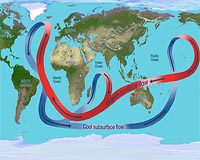
"Where are the main ingredients of climate? Not in the Earth's tenuous atmosphere, but in the oceans. The top few meters alone store as much heat energy as the entire atmosphere, and the oceans average 3.7 kilometers deep. Most of the world's water is there too, of course, and even most of the gases, dissolved in the water."
A "survey discovered eddies bigger than Belgium that plowed through the seas for months. "
""We may not be given a warning until the CO2 loading is such that an appreciable climate change is inevitable," a panel of experts explained in 1979. "The equilibrium warming will eventually occur; it will merely have been postponed.""
------
HOCKEY STICKS
The geologic time scale is tremendous. Carbon dioxide, oxygen, water, and temperature are balanced to support the life cycle.
The Carboniferous periid was 300,000,000 years ago. The time scale represented by the hockey stick graphs are 1,000 and 10,000 years.
The time scale of AWG is 100 years.
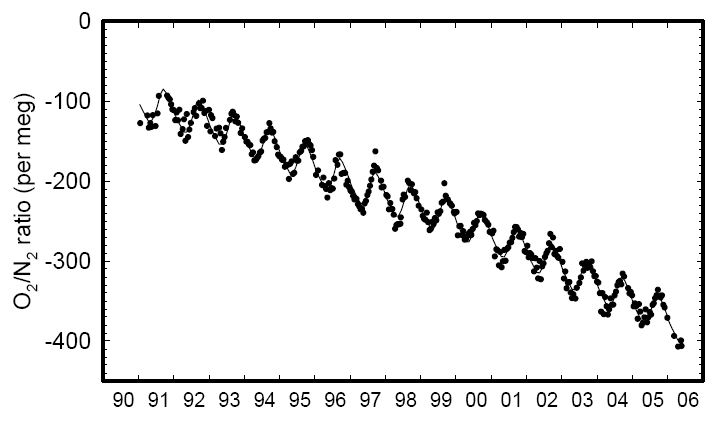
The long term climate engine is a combination of both atmosphere and ocean. * The continents have moved over 300 million years. The ocean currents have adjusted accordingly. *Dominant life forms have changed, from the dominant flora of the carboniferous, through the dinousors of the jurasic, to life as we know it today.*CO2, oxygen, and temperatures have changed over this geological history. *It has done so over spans of a million*years.
The rate of change of the last century is the concern. *