I asked this same question just yesterday. There are a lot of white racists here on U.S. Message Board and elsewhere who swear that black people in America are no longer discriminated against and the only discrimination presently occuring is against white people, white males predominantly.
When we've pointed to more than centuries of tried and true tactics as an example of the various ways that whites express their racism against Africa Americans, we're admonished that the things that we're complaining of happened "a long time ago" irrespective of the fact that the exact same offenses are still occuring today, thus I give you the white citizen's counsel....
The
Citizens' Councils (also referred to as
White Citizens' Councils) were an associated network of
white supremacist,
extreme right[1] organizations in the United States, concentrated in the
South. The first was formed on July 11, 1954.
[2] After 1956, it was known as the
Citizens' Councils of America. With about 60,000 members across the United States,
[3] mostly in the
South, the groups were founded primarily to oppose
racial integration of schools, but they also opposed voter registration efforts and integration of public facilities during the 1950s and 1960s. Members used intimidation tactics including economic boycotts, firing people from jobs, propaganda, and violence against citizens and civil-rights activists.
By the 1970s, following passage of federal civil rights legislation in the mid-1960s and enforcement of constitutional rights by the federal government, the influence of the Councils had waned considerably yet remained an institutional basis for the majority of white residents in Mississippi. The successor organization to the White Citizens' Councils is the St. Louis-based
Council of Conservative Citizens, founded in 1985.
[3] Republican politician and past Senate Majority Leader
Trent Lott of Mississippi was allegedly a member
[4] while North Carolina Senator
Jesse Helms and Georgia Congressman
Bob Barr were both strong supporters of the Council of Conservative Citizens;
David Duke also spoke at a fund raising event, while
Patrick Buchanan's campaign manager was linked to both Duke and the Council.
[5]
In 1996, a Charleston, SC, drive-by shooting by Klan members of three African American males occurred after a Council rally;
Dylann Roof, the perpetrator responsible for the
murder of nine Emanuel AME church members in Charleston in 2015, espoused Council of Conservative Citizens rhetoric in a manifesto.
[6]
Economic retaliation and violence

Clipping from
Citizens' Council newspaper, June 1961
Unlike the
Ku Klux Klan but working in unison, the White Citizens Council met openly, and was seen superficially as "pursuing the agenda of the Klan with the demeanor of the
Rotary Club."
[14] Although the White Citizens Council publicly eschewed the use of
violence,
[2] the economic and political tactics used against registered voters and activists embraced institutional violence. The White Citizens Council members
collaborated to threaten jobs, causing people to be fired or evicted from rental homes; they boycotted businesses, ensured that activists could not get loans, among other tactics.[7][12] As historian
Charles Payne notes, "Despite the official disclaimers, violence often followed in the wake of Council intimidation campaigns."
[14] Occasionally some Councils directly incited violence, such as
lynchings,
shootings,
rapes and
arson, as did
Leander Perez during the
New Orleans school desegregation crisis. In some cases, Council members were directly involved in acts of violence, such as
Nat King Cole being assaulted in
Birmingham or
Byron De La Beckwith murdering
Medgar Evers.
For instance, in
Montgomery, Alabama, during the
Montgomery Bus Boycott, at which Senator
James Eastland "ranted against the NAACP"
[15] at a large openly held Council meeting in the
Garrett Coliseum, a mimeographed flyer publicly espousing extreme racial White Citizens Council and Ku Klux Klan rhetoric was distributed, parodying the
Declaration of Independence and saying:
When in the course of human events, it becomes necessary to
abolish the Negro race, proper methods should be used. Among these are
guns,
bows and
arrows,
sling shots and
knives.
We hold these truths to be self-evident that all whites are created equal with certain rights; among these are life, liberty and the pursuit of dead
*******.
[15][16]
The Citizens' Councils used economic tactics against
African Americans whom they considered as supportive of desegregation and
voting rights, or for belonging to the
NAACP, or even suspected of being activists; the tactics included "calling in" the
mortgages of black citizens, denying loans and business credit, pressing employers to fire certain people, and boycotting black-owned businesses.
[17] In some cities, the Councils published lists of names of NAACP supporters and signers of anti-segregation petitions in local newspapers in order to encourage economic retaliation.
[18] For instance, in
Yazoo City, Mississippi in 1955, the Citizens' Council published in the local paper the names of 53 signers of a petition for school integration. Soon afterward, the petitioners lost their jobs and had their credit cut off.
[19] As Charles Payne puts it, the Councils operated by "unleashing a wave of economic reprisals against anyone, Black or white, seen as a threat to the status quo."
[14] Their targets included black professionals such as teachers, as well as farmers, high school and college students, shop owners, and housewives.
[12]
Medgar Evers' first work for the NAACP on a national level involved interviewing Mississippians who had been intimidated by the White Citizens' Councils and preparing
affidavits for use as evidence against the Councils if necessary.
[20] Evers was assassinated in 1963 by
Byron De La Beckwith, a member of the White Citizens' Council as well as the
Ku Klux Klan.
[21] The Citizens' Council paid his legal expenses in his two trials in 1964, which both resulted in hung juries.
[22] In 1994, Beckwith was tried by the state of Mississippi based on new evidence, in part revealed by a lengthy investigation by the
Jackson Clarion Ledger; he was convicted of first-degree murder and sentenced to life in prison.
[23]
Political influence
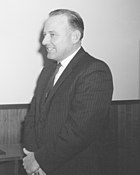
Joe D. Waggonner, Jr.
Many leading state and local politicians were members of the Councils; in some states, this gave the organization immense influence over state legislatures. In Mississippi, the
State Sovereignty Commission funded the Citizens' Councils, in some years providing as much as $50,000. This state agency, funded by the taxes paid by all citizens, also shared information with the Councils that it had collected through investigation and surveillance of integration activists.
[24] For example, Dr. M. Ney Williams was both a director of the Citizens' Council and an adviser to governor
Ross Barnett of Mississippi.
[25] Barnett was a member of the Council, as was Jackson mayor
Allen C. Thompson.
[26] In 1955, in the midst of the bus boycott, all three members of the
Montgomery city commission in Alabama announced on television that they had joined the Citizens' Council.
[27]
Numan Bartley wrote, "In
Louisiana the Citizens' Council organization began as (and to a large extent remained) a projection of the Joint Legislative Committee to Maintain Segregation."
[28] In Louisiana, leaders of the original Citizens' Council included
State Senator and
gubernatorial candidate
William M. Rainach,
U.S. Representative Joe D. Waggonner, Jr., the
publisher Ned Touchstone, and
Judge Leander Perez, considered the
political boss of
Plaquemines and
St. Bernard parishes near
New Orleans.
[29] After he left the editorship of the
Shreveport Journal in 1971,
George W. Shannon relocated to
Jackson, Mississippi, to work on
The Citizen, a monthly magazine of the Citizens' Council.
The Citizen halted publication in January 1979, by which time Shannon had returned to
Shreveport.
[30]
On July 16, 1956, "under pressure from the White Citizens Councils,"
[31] the
Louisiana State Legislature passed a law mandating racial segregation in nearly every aspect of public life; much of the segregation already existed under
Jim Crow custom. The bill was signed into law by governor
Earl Long on July 16, 1956 and went into effect on October 15, 1956. The act read, in part:
An Act to prohibit all interracial
dancing, social functions,
entertainments,
athletic training,
games,
sports, or contests and other such activities; to provide for separate seating and other facilities for white and negroes [lower case in original] ... That all persons, firms, and corporations are prohibited from sponsoring, arranging, participating in or permitting on premises under their control ... such activities involving personal and social contact in which the participants are members of the white and negro races ... That white persons are prohibited from sitting in or using any part of seating arrangements and sanitary or other facilities set apart for members of the negro race. That negro persons are prohibited from sitting in or using any part of seating arrangements and sanitary or other facilities set apart for white persons.
[31]
Another disposition they managed to pass was a public challenge law allowing two voters to challenge another voter to see if he was lawfully registered, disposition they used to purge the rolls of Black voters, in one parish,
Bienville, 95% of Black voters were purged.
[13] Similarly, they were involved in handing to the registers pamphlets such as
Voter Qualification Laws in Louisiana: The Key to Victory in the Segregation Struggle and making them participate to mandatory semonaries about preventing Black registration and purging Black voters.
[32]
Major
media outlets observed the support
George Wallace received from groups such as White Citizens' Councils. It has been noted that members of such groups had permeated the
Wallace campaign by 1968 and, while Wallace did not openly seek their support, nor did he refuse it.
[33]
School desegregation and the demise of the councils

A 1968 advertisement for
Jackson area schools operated by the Council
Throughout the last half of the 1950s, the White Citizens' Councils produced racist children's books that taught that
heaven (in the Christian conception) is segregated.
[34] The White Citizens' Council in Mississippi prevented school integration until 1964.
[35] As
school desegregation increased in some parts of the South, in some communities the White Citizens' Council sponsored "council schools," private institutions set up for white children, as these were beyond the reach of the ruling on public schools.
[36] Many of these private "
segregation academies" continue to operate today.
By the 1970s, as white Southerners' attitudes toward desegregation began to change following passage of federal civil rights legislation and enforcement of integration and voting rights in the 1960s, the activities of the White Citizens' Councils began to wane. The
Council of Conservative Citizens, founded by former White
Citizens' Council members,
[3] continued the agendas of the earlier Councils.
See also


.png)


