Rise of Islam
In the 7th – 9th century and the 11th – 15th century, Islam gave the Arabs a newfound zeal and desire to conquer. They expanded to the territories in the
Levant and
Egypt. The
Arab invasions led to the loss of Egypt, Syria, Palestine and for a short period of time, Crete, Sicily, Cyprus and Asia Minor. Though Asia Minor was recaptured and substantial parts of Syria and Mesopotamia either taken back or subjugated, Egypt remained firmly in Arab hands as did the rest of Palestine. The loss of Egypt was a major blow to the Byzantines since the province of Aegyptus had provided much of the Empire's manufactured goods and natural resources, especially grain, ever since the times of Roman Antiquity. Conversely the Arab acquisition of Egypt gave the
Ummayad and later
Abassid Caliphates huge resources, meaning that the Byzantines had to direct large amounts of resources to stave off constant Arab incursions into Asia Minor and Syria. When the
Fatimid Caliphate broke away from the Abassids the Byzantines were able to launch
successful offensives into Syria and Palestine, due to this division amongst their enemies.
The arrival of the Seljuks
Another possible explanation for the disintegration of the Byzantine Empire is the permanent settlement of
Anatolia by the
Seljuks, a
Turkish people between the 11th – 13th century.
It is worth remembering that the Byzantines had faced invasion in Asia Minor for centuries. In the 7th and 8th centuries, in particular, first the
Sassanid Persians and then the
Muslim Arabs launched major offensives into the region. Though the Arabs were successful in conquering many Byzantine territories during the
Byzantine-Arab Wars, they were ultimately unsuccessful in establishing themselves in western Anatolia or the
Balkans.
However, a period of civil war in the late 11th century enabled the Turks to make huge inroads into Byzantine territory. In many places, usurpers used mercenary Turkish troops to occupy strategic towns, only for those mercenaries to take the towns for themselves when the usurpers had departed. Thus by 1095, virtually the whole of Asia Minor, comprising about 70% of the Byzantine Empire, had been lost.
Although the three competent Komnenian emperors, especially
Manuel I Komnenos (r.1143–1180), may have had the power to expel the outnumbered
Seljuks, several factors combined to ensure that they never did so. Alexios was unable to derive much of the expected benefit from the
First Crusade, though it did at least help him to recover
Nicaea and western Asia Minor. It has even been argued that it was never in the interests of the Komnenoi to expel the Turks, as the expansion back into Anatolia would have meant sharing more power with the feudal lords, thus weakening their power. If this is so, it is a historical irony, as re-conquering Anatolia may have saved the Byzantine Empire in the long run.
No emperor after the Komnenian period was in a position to expel the Turks from Asia Minor, while the preoccupation of the Nicaean emperors with the attempt to recover Constantinople meant that resources were diverted away from Asia Minor and towards the west. The result was a weakening of the Byzantine defenses in the region, which when combined with insufficient resources and incompetent leadership lead to the complete loss of all the empire's Asian territory to the Turks by c.1400.
Crusades
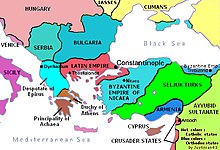

Map to show the partition of the empire following the Fourth Crusade, c.1204. The overall outcome of the Crusades leaving the Empire permanently weakened.
Part of the reason why the
Crusades were launched was to assist the weakening Byzantine Empire; the other reason was to re-open
Jerusalem to Christian Pilgrims. Both of these reasons stem from the arrival of the
Seljuk Turks whose newly found Islamic zeal and opportune timing resulted in a victory at
Manzikert in 1071 (which is still being debated over its importance, if any, in contributing to the empire's fall) and the fall of Jerusalem in 1076. Though the Crusades assisted Byzantium in driving back some of the Turks, it also opened up Byzantium to Latin aggression which was not always directed at Byzantium's enemies – most notably the
Fourth Crusade, which sacked Byzantium and reduced Imperial power to the
Nicaean Empire,
Trebizond and
Epirus. Much of the Nicaean Emperors' efforts went into combating the Latins – even after
Constantinople was returned to Byzantine rule, the Empire exerted much of its efforts into defeating its Latin neighbours, whose desires to liberate the Holy Land largely faded by 1291.
Civil Wars
A series of societal infighting also weakened the
Byzantine Empire's military power. There were two major civil wars during the late Byzantine Empire one in 1321 another in 1341. These Civil wars also severely diminished the Byzantines' military capabilities.
The civil war of 1321–1328 was led by a grandson of the Byzantine Emperor
Andronikos II who was supported by Byzantine
Magnates who often clashed with the centralized authority of Byzantine. The Byzantine civil war of 1321–1328 was inconclusive and ended with
Andronikos III being made coemperor with his grandfather. This civil war allowed the Turks to make notable gains in Anatolia and set up their capital in
Bursa 100 kilometers from
Constantinople the Byzantine's capital. After the initial conflict Andronikos III dethroned his grandfather and became emperor.
[6]
Following the death of Andronikos III in 1341 another civil war broke out which was to continue until 1347. When Andronikos III died he left his six-year-old son under the regency of
Anne of Savoy. The de facto leader of the
empire,
John Cantacuzenus, who was not only a close associate of the deceased emperor but an extremely wealthy landowner, wanted to become regent.
[7] However things did not go his way and he was declared emperor in
Thrace.
[8] This conflict had elements of
class warfare, in that the rich supported Cantacuzenus while the poorer folk supported the empress regent. The civil war of 1341–1347 saw exploitation of the
Byzantine Empire by the Serbs, whose ruler took advantage of the chaos to proclaim himself emperor of the Serbs and Greeks. The Serbian king
Stefan Uroš IV Dušan made significant territorial gains in Byzantine Macedonia in 1345 and conquered large swathes of
Thessaly and
Epirus in 1348.
[9] Although Dusan would die along with his dream of a Serbian Greek empire in 1355,
[10] Byzantium would still face a powerful Turkish state across the
Sea of Marmara. Luckily for Cantacuzenus he conquered Constantinople in 1347 and ended the civil war afterwards
[11] In order to secure his authority during the civil war Cantacuzenus hired Turkish mercenaries, these
mercenaries although they were of some use, in 1352 they seized
Gallipoli from the Byzantines.
[10] Although in 1354 the rogue mercenaries were defeated by
western crusaders [12] Turkish armies would eventually control many of the Byzantine Empire's once held territories. these two monumental civil wars severely diminished the Byzantine Empire's military strength and allowed its opportunistic enemies to make substantial gains into Byzantine territory.
Rise of the Ottomans
The arrival of the Seljuk Turks led to the rise of the
Ottomans, warriors that followed the Noble (Bey) Osman I, who carved out a small domain in north-western Asia Minor, raiding Byzantine lands and occupying country land that was poorly defended. Attempts by the Byzantine Emperors to drive back the Ottomans yielded little short term success – the excessive use of mercenaries led to much peasant resentment, giving the Ottomans support in the regions in Asia Minor. Following a number of civil disputes in the Byzantine Empire, the Ottomans subjugated the Byzantines as vassals in the late 14th century and attempts to relieve this vassal status culminated in the
Fall of Constantinople in 1453.
Structure of Byzantium
The Byzantine Empire's survival depended upon its administration and the logistics that enabled it to run the Empire. Though considered complex, its system was one more advanced than those practised by the Frankish Kingdoms in the West and one modelled by the Islamic Powers of the East. As the Empire evolved into an increasingly smaller and defensive state, the governing of the state changed as well. However, by the 14th century the burdens of running an Empire surrounded by many enemies became too much of a strain on Byzantium's increasingly smaller resources. By
c. 1350's, the Byzantines lost Thrace to the Ottomans; thereafter Constantinople became the government's primary administrative region.
Politics of Byzantium
The Byzantine Empire experienced numerous civil wars. The defeats in the 7th and 12th centuries to the Arabs and Turks respectively speaking were in no small part assisted by numerous internal conflicts. The situation became worse later in the 14th and 15th centuries where Byzantine Emperors were forced to fight their own grandchildren/children, as in the cases of Andronikus II and Andronikus III.
Society of Byzantium
The Military of the Byzantine Empire was often smaller than that of its opponents and thus relied more upon strategy rather than brute strength to achieve success.
[13][14] This was in part achieved by the logistics of the Byzantine administration which allowed it to utilize their troops as efficiently as possible. Taxes on the peasantry were collected at times of need so as to raise the supplies needed at the time.
[15] However, this bureaucratic system was exploited by the social elite
[15] whose increasing power challenged that of the Emperor. Whilst the
Theme system worked well to provide efficient military service, it led to the decentralization of power leading to disastrous civil conflicts in the 11th century.
Furthermore, as the taxation system became ever more of a burden on the peasantry, the lower classes of the Empire began to resent the state. This contributed to the loss of Asia Minor in the 11th and 14th centuries owing to the arrival of the Turks.
The structure of the military
Another major factor in the decline of the Byzantine empire may have been the disintegration of its traditional military system, the
'theme' system. Under this arrangement, the empire was divided into several regions which contributed locally raised troops to the imperial armies. The system provided an effective means of cheaply mobilizing large numbers of men, and the result was a comparatively large and powerful force – the army of the theme of Thrakesion alone had provided about 9,600 men in the period 902–936, for example. However, the demise of the system made the organization of the Byzantine armies less self-sufficient.
The Byzantine military did not immediately collapse following the disappearance of the theme system. In the 12th century, the Komnenian dynasty re-established an effective military
force.
Manuel I Komnenos, for example, was able to muster an army of over 40,000 men. This was sufficient to ensure the empire's continued status as a great power for the duration of the Komnenian period. However, the Komnenoi never provided for a future that saw their decisive leadership replaced by incompetence. After the deposition of
Andronikos I Komnenos in 1185, the dynasty of the Angeloi oversaw a period of military decline. From 1185 onwards, Byzantine emperors found it increasingly difficult to muster and pay for sufficient military forces, while the failure of their efforts to sustain their empire exposed the limitations of the entire Byzantine military system, dependent as it was on competent personal direction from the emperor. The culmination of the empire's military disintegration under the Angeloi was reached on 13 April 1204, when the armies of the
Fourth Crusade sacked Constantinople and dismantled the Byzantine Empire.
Despite the restoration under the
Palaiologoi, Byzantium was never again a great power on the scale of the past. By the 13th century, the imperial army numbered a mere 6,000 men, while the empire's territories had been reduced to little more than the lands immediately surrounding the Aegean sea.
Thus, it is possible to argue that the demise of the theme system was one of the most significant factors in the decline of the Byzantine empire. As one of the main institutional strengths of the Byzantine state, the theme system was never replaced by a viable long-term alternative. This left the empire lacking in underlying structural strengths. The result was an empire that depended more than ever before on the strengths of each individual emperor or dynasty. The collapse of imperial power and authority after 1185 revealed the inadequacy of this approach


