Navigation
Install the app
How to install the app on iOS
Follow along with the video below to see how to install our site as a web app on your home screen.
Note: This feature may not be available in some browsers.
More options
Style variation
You are using an out of date browser. It may not display this or other websites correctly.
You should upgrade or use an alternative browser.
You should upgrade or use an alternative browser.
Sodium batteries coming into their own
- Thread starter Old Rocks
- Start date

airplanemechanic
Diamond Member
- Nov 8, 2014
- 23,261
- 19,950
- 2,415
Yea, Li-Ion batteries are great for RC planes and such. The only problem is if they crash, you can have a fire. You never got that with the old Ni-Cad batteries of yesteryear. They were not super powerful but you couldn't kill them.

toobfreak
Tungsten/Glass Member
- Apr 29, 2017
- 102,983
- 110,332
- 3,615
Sodium batteries are not only non-flammable, but also less costly.
Hey Rockster, I got your sodium battery right here for ya.

Seriously, why sodium? I thought our futures all laid in aluminum batteries.

Sodium batteries are not only non-flammable, but also less costly. And now they are going to be used in an application that challenges standard lithium batteries. A 500 MW battery;


Deplorable Yankee
Diamond Member
Old Rocks
Diamond Member
- Thread starter
- #7

Like
Dislike
Sodium-Ion Battery EVs in Production in China
China is now producing several electric vehicles powered by sodium-ion batteries, marking a major step toward low-cost, lithium-free EVs.1. CATL & Changan – Changan Nevo A06 (Qiyuan A06)
In February 2026, CATL and Changan unveiled the world’s first mass-produced sodium-ion battery passenger EV, the Changan Nevo A06 (also marketed as Qiyuan A06) New Atlas+1.
- Battery: CATL’s Naxtra sodium-ion cell, energy density ~175 Wh/kg (highest in mass production for sodium chemistry) New Atlas.
- Range: ~400 km (248 mi) on China’s CLTC test cycle; CATL targets 500–600 km in future versions New Atlas+1.
- Performance: Retains >90% capacity at –40 °C, triple discharge power vs. LFP at –30 °C, stable down to –50 °C New Atlas+1.
- Market launch: Mid-2026 in China; part of CATL’s 2026 rollout plan for sodium-ion in passenger, commercial, and energy storage vehicles CarNewsChina.com+1.
Earlier in 2024, two small EV brands entered serial production with sodium-ion batteries:
- Yiwei (JAC/Volkswagen joint venture) – uses Hina Battery sodium cells electrive.com.
- JMEV EV3 (Jiangling Motors, Renault-owned) – uses Farasis Energy sodium cells electrive.com.
- Range: ~251 km (156 mi) CLTC; energy densities ~140–160 Wh/kg electrive.com.
These models are aimed at lower-cost, shorter-range segments.
- Tianxing II – CATL’s sodium-ion pack for light commercial vehicles, launched in 2026 CarNewsChina.com.
- Battery swapping & energy storage – sodium-ion packs are also being deployed in China’s battery-swapping network and grid storage CarNewsChina.com.
- Lower cost: ~30% cheaper than LFP; no lithium or scarce minerals CarNewsChina.com.
- Cold-weather performance: Superior to LFP in freezing conditions CarNewsChina.com+1.
- Safety: No fire risk in crush/puncture tests New Atlas.
- Supply chain resilience: Reduces reliance on lithium CarNewsChina.com.
CATL projects sodium-ion batteries could replace 30–40% of the global EV battery market in the long term CarNewsChina.com. In China, production is expanding across passenger, commercial, and energy sectors, with CATL’s Naxtra technology leading the passenger EV rollout.
Old Rocks
Diamond Member
- Thread starter
- #8
Like
Dislike
Gotion High-Tech’s High-Energy Sodium-Ion Batteries
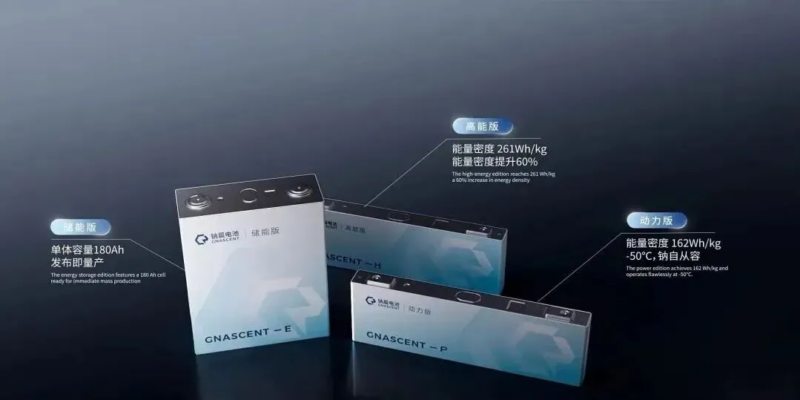
Gotion High-Tech, backed by Volkswagen Group, has launched its Gnascent sodium-ion battery brand, with a high-energy version achieving 261 Wh/kg — about a 60% improvement over conventional sodium-ion cells battery-tech.net+1. This makes it one of the most energy-dense sodium-ion offerings to date, targeting weight-sensitive applications such as light electric vehicles, drones, and other “low-altitude economy” uses battery-tech.net.Key Specifications
- High-Energy Version: 261 Wh/kg energy density, anode-free design, multi-stage pre-sodiation, self-isolating interface www.lifepo4batteryshop.com.
- Power Version: 162 Wh/kg, ultra-low-temperature discharge down to –50 °C for cold-weather commercial vehicles battery-tech.net.
- Energy Storage Version: 180 Ah single-cell, >20,000 cycles, 88% capacity retention at –40 °C battery-tech.net.
Technical Advantages
- Anode-free structure reduces material costs and boosts energy density www.lifepo4batteryshop.com.
- Multi-stage pre-sodiation lowers reaction energy barriers, improving cycling performance www.lifepo4batteryshop.com.
- Self-isolating interface enhances safety by preventing short circuits and thermal runaway www.lifepo4batteryshop.com.
- High-diffusion materials and electrolyte confinement improve low-temperature ion transport www.lifepo4batteryshop.com.
- Safety-tested: passed 8 mm steel nail penetration and sustained 400 °C heating without fire or explosion battery-tech.net+1.
Production & Commercialization
- GW-scale production lines already operational in Tangshan and Hefei battery-tech.net.
- Mass production planned for Q4 2026, leveraging existing GWh-level automated facilities freshfromchina.com+1.
- Target markets include grid, industrial, and residential energy storage, plus niche EV and drone applications battery-tech.net.
Market Context
The high lithium carbonate prices (~¥200,000 RMB/ton) have accelerated sodium-ion adoption, with global sodium battery shipments projected to reach 26.8 GWh in 2026 freshfromchina.com. Gotion’s high-energy sodium-ion is positioned to compete with lithium-ion in weight-sensitive segments while offering ~40% lifecycle cost advantage over LFP in energy storage freshfromchina.com.In summary: Gotion’s high-energy sodium-ion batteries combine record sodium-ion energy density, robust safety, and cold-weather performance with cost-effective manufacturing, making them a strong contender in the next generation of battery technology.
Old Rocks
Diamond Member
- Thread starter
- #9
"At its 15th Global Technology Conference, Gotion High-Tech, backed by Volkswagen Group, unveiled its new sodium-ion battery brand, Gnascent. The company introduced three specialized cell variants and confirmed that gigawatt-hour-scale production facilities are already operational in Tangshan and Hefei.
The High-Energy version achieves an energy density of 261 Wh/kg—approximately a 60 percent improvement over conventional sodium-ion cells—and is targeted at weight-sensitive applications such as light electric vehicles and drones. The Power version offers 162 Wh/kg and supports ultra-low temperature discharge down to –50 °C, addressing cold-weather performance needs for commercial vehicles and outdoor equipment. The Energy Storage model features a single-cell capacity of 180 Ah, a cycle life exceeding 20,000 cycles, and maintains 88 percent capacity at –40 °C. It has passed rigorous safety protocols including an 8 mm steel nail penetration test and sustained 400 °C heating without ignition.
Gotion High-Tech aims to deploy Gnascent batteries across grid-side, industrial and residential energy storage systems, while also exploring niche markets such as two-wheelers and start-stop power supplies. The technological foundation of Gnascent rests on more than 90 patents, covering cathode materials—layered oxides, polyanions and sodium manganese iron pyrophosphate—along with hard carbon anodes and tailored electrolyte additives. An “anode-less” design further reduces material costs and boosts overall energy density."
 battery-tech.net
The High-Energy version achieves an energy density of 261 Wh/kg—approximately a 60 percent improvement over conventional sodium-ion cells—and is targeted at weight-sensitive applications such as light electric vehicles and drones. The Power version offers 162 Wh/kg and supports ultra-low temperature discharge down to –50 °C, addressing cold-weather performance needs for commercial vehicles and outdoor equipment. The Energy Storage model features a single-cell capacity of 180 Ah, a cycle life exceeding 20,000 cycles, and maintains 88 percent capacity at –40 °C. It has passed rigorous safety protocols including an 8 mm steel nail penetration test and sustained 400 °C heating without ignition.
Gotion High-Tech aims to deploy Gnascent batteries across grid-side, industrial and residential energy storage systems, while also exploring niche markets such as two-wheelers and start-stop power supplies. The technological foundation of Gnascent rests on more than 90 patents, covering cathode materials—layered oxides, polyanions and sodium manganese iron pyrophosphate—along with hard carbon anodes and tailored electrolyte additives. An “anode-less” design further reduces material costs and boosts overall energy density."
Gotion Unveils Gnascent Sodium-Ion Batteries at GW Scale - Battery-Tech Network
Gotion High-Tech, backed by Volkswagen, launches Gnascent sodium-ion batteries—three variants up to 261 Wh/kg and GW-scale production in China.
battery-tech.net
Old Rocks
Diamond Member
- Thread starter
- #10
There will be many battery chemistries for different applications. Of course, that will offend you as anything that is new and better offends you.Hey Rockster, I got your sodium battery right here for ya.
View attachment 1256368
Seriously, why sodium? I thought our futures all laid in aluminum batteries.

Leo123
Diamond Member
- Aug 26, 2017
- 40,135
- 33,368
- 3,615
No batteries needed (except for starting and electric items) with fossil fuel vehicles which are more efficient. Besides, sodium is heavier than lithium and is much less efficient. Sodium batteries could be a good replacement for lead-acid batteries in fossil fuel vehicles and as stationary storage applications.
Last edited:
And? Their batteries for sale are basically the same as the LiFe batteries they have for sale.
Like
Dislike
Gotion High-Tech’s High-Energy Sodium-Ion Batteries
Gotion High-Tech, backed by Volkswagen Group, has launched its Gnascent sodium-ion battery brand, with a high-energy version achieving 261 Wh/kg — about a 60% improvement over conventional sodium-ion cells battery-tech.net+1. This makes it one of the most energy-dense sodium-ion offerings to date, targeting weight-sensitive applications such as light electric vehicles, drones, and other “low-altitude economy” uses battery-tech.net.
Key Specifications
- High-Energy Version: 261 Wh/kg energy density, anode-free design, multi-stage pre-sodiation, self-isolating interface www.lifepo4batteryshop.com.
- Power Version: 162 Wh/kg, ultra-low-temperature discharge down to –50 °C for cold-weather commercial vehicles battery-tech.net.
- Energy Storage Version: 180 Ah single-cell, >20,000 cycles, 88% capacity retention at –40 °C battery-tech.net.
Technical Advantages
- Anode-free structure reduces material costs and boosts energy density www.lifepo4batteryshop.com.
- Multi-stage pre-sodiation lowers reaction energy barriers, improving cycling performance www.lifepo4batteryshop.com.
- Self-isolating interface enhances safety by preventing short circuits and thermal runaway www.lifepo4batteryshop.com.
- High-diffusion materials and electrolyte confinement improve low-temperature ion transport www.lifepo4batteryshop.com.
- Safety-tested: passed 8 mm steel nail penetration and sustained 400 °C heating without fire or explosion battery-tech.net+1.
Production & Commercialization
- GW-scale production lines already operational in Tangshan and Hefei battery-tech.net.
- Mass production planned for Q4 2026, leveraging existing GWh-level automated facilities freshfromchina.com+1.
- Target markets include grid, industrial, and residential energy storage, plus niche EV and drone applications battery-tech.net.
Market Context
The high lithium carbonate prices (~¥200,000 RMB/ton) have accelerated sodium-ion adoption, with global sodium battery shipments projected to reach 26.8 GWh in 2026 freshfromchina.com. Gotion’s high-energy sodium-ion is positioned to compete with lithium-ion in weight-sensitive segments while offering ~40% lifecycle cost advantage over LFP in energy storage freshfromchina.com.
In summary: Gotion’s high-energy sodium-ion batteries combine record sodium-ion energy density, robust safety, and cold-weather performance with cost-effective manufacturing, making them a strong contender in the next generation of battery technology.
But you should invest heavily in the company.
toobfreak
Tungsten/Glass Member
- Apr 29, 2017
- 102,983
- 110,332
- 3,615
Of course, that will offend you as anything that is new and better offends you.
Sure Rocky, must be why I spent a large part of my life designing new technology. I have a house full of technology, my music system takes 16 components just to play music. I know a lot more about technology than you do climate, just that I know better than to just jump on something just because it is new. I need to see, test and evaluate it first and believe me, I have a trash can full of tools downstairs that don't work no more and all of them were battery-operated.
Old Rocks
Diamond Member
- Thread starter
- #14
Another ignorant fool that has never heard of the efficiency limitation of the Carnot Cycle. Energy density is measured in Wh/Kg. When a sodium battery has a higher energy density than a lithium battery, it will be lighter for a given amount of energy than a lithium battery. And there are sodium batteries that are now exceeding the present lithium batteries by 70%.No batteries needed (except for starting and electric items) with fossil fuel vehicles which are more efficient. Besides, sodium is heavier than lithium and is much less efficient. Sodium batteries could be a good replacement for lead-acid batteries in fossil fuel vehicles and as stationary storage applications.
Like
Dislike
New Sodium Battery Matches Lithium’s Energy Density
Recent breakthroughs in sodium-ion battery technology have brought them much closer to matching the energy density of lithium-ion batteries, opening the door to broader commercial use.Key breakthroughs
- Dual-cation sodium-lithium cells: Researchers at the University of Limerick’s Bernal Institute developed the first full-cell sodium-lithium battery, combining the sustainability of sodium with the high performance of lithium. This “dual cation” design could produce batteries with energy densities rivaling lithium-ion The Conversation.
- High-performance sodium vanadium phosphate cathode: A new cathode material boosts sodium-ion battery energy density by over 15%, reaching 458 Wh/kg — a significant leap from earlier sodium designs and now competitive with many lithium-ion chemistries news.sustainability-directory.com.
- Commercial sodium-ion cells: Hina’s sodium-ion battery, tested against Tesla’s LFP cells, showed high uniformity, strong power capability, and a design mirroring Tesla’s architecture. While still slightly below peak lithium NMC/NCA densities, it now matches LFP performance and is approaching cost parity EurekAlert!+1.
- All-solid-state sodium batteries: Advances in solid polymer electrolytes with additives like graphitic carbon nitride have improved ion conductivity and stability, enabling safer, scalable sodium batteries for grid storage and EVs Tech Xplore.
- Typical lithium-ion NMC/NCA: 240–350 Wh/kg
- Typical lithium-ion LFP: 140–190 Wh/kg
- New sodium-ion: 165–175 Wh/kg (CATL Naxtra) to 458 Wh/kg (vanadium phosphate) en.highstar.com+2
This means some sodium-ion designs now rival or exceed LFP energy density, and with further optimization could close the gap to premium lithium chemistries.
- Abundance & cost: Sodium is ~1,000× more abundant in the Earth’s crust and can be extracted from seawater Tech Xplore.
- Supply chain security: Less concentrated in a few regions, reducing geopolitical risks The Conversation.
- Safety & cold-weather performance: Less prone to thermal runaway and better low-temperature operation Chemical & Engineering News.
- Lower environmental impact: Mining and processing sodium is less energy-intensive and damaging than lithium ScienceDaily.
- Still lags behind high-end NMC/NCA lithium in peak energy density en.highstar.com.
- Cold-weather charging remains a challenge for some designs EurekAlert!+1.
- Manufacturing scale is smaller than lithium, so costs are still higher in some markets Notebookcheck.
With new materials like sodium vanadium phosphate and improved solid-state designs, sodium-ion batteries are poised to move from niche applications (stationary storage, low-range EVs) into mass-market EVs and grid storage by 2026–2027. If they can maintain or improve on lithium’s energy density while keeping costs low, they could become a major alternative — or even a complementary technology — to lithium-ion batteries The Conversation+2.
Old Rocks
Diamond Member
- Thread starter
- #15
About 2010, I started seeing battery powered tools. They were weak, and prone to failure. By 2015, we were starting to use battery powered impact wrenches in the place of pneumatic impacts because of the convenience, no hoses to drag through the machinery. When I retired in 2020, the battery powered impacts had replaced the 1/2" and 3/4" impacts at work. This was a steel mill, and our tools took a beating. Battery powered tools have come into their own and are the equal of the pneumatics, if you are willing to pay for the good tools.Sure Rocky, must be why I spent a large part of my life designing new technology. I have a house full of technology, my music system takes 16 components just to play music. I know a lot more about technology than you do climate, just that I know better than to just jump on something just because it is new. I need to see, test and evaluate it first and believe me, I have a trash can full of tools downstairs that don't work no more and all of them were battery-operated.
Leo123
Diamond Member
- Aug 26, 2017
- 40,135
- 33,368
- 3,615
Sodium batteries have lower energy density compared to lithium. They store less energy for a given volume. 2/3 the energy density of lithium-ion batteries. They are larger and heavier comparatively.Another ignorant fool that has never heard of the efficiency limitation of the Carnot Cycle. Energy density is measured in Wh/Kg. When a sodium battery has a higher energy density than a lithium battery, it will be lighter for a given amount of energy than a lithium battery. And there are sodium batteries that are now exceeding the present lithium batteries by 70%.
Like
Dislike
New Sodium Battery Matches Lithium’s Energy Density
Recent breakthroughs in sodium-ion battery technology have brought them much closer to matching the energy density of lithium-ion batteries, opening the door to broader commercial use.
Key breakthroughs
Energy density context
- Dual-cation sodium-lithium cells: Researchers at the University of Limerick’s Bernal Institute developed the first full-cell sodium-lithium battery, combining the sustainability of sodium with the high performance of lithium. This “dual cation” design could produce batteries with energy densities rivaling lithium-ion The Conversation.
- High-performance sodium vanadium phosphate cathode: A new cathode material boosts sodium-ion battery energy density by over 15%, reaching 458 Wh/kg — a significant leap from earlier sodium designs and now competitive with many lithium-ion chemistries news.sustainability-directory.com.
- Commercial sodium-ion cells: Hina’s sodium-ion battery, tested against Tesla’s LFP cells, showed high uniformity, strong power capability, and a design mirroring Tesla’s architecture. While still slightly below peak lithium NMC/NCA densities, it now matches LFP performance and is approaching cost parity EurekAlert!+1.
- All-solid-state sodium batteries: Advances in solid polymer electrolytes with additives like graphitic carbon nitride have improved ion conductivity and stability, enabling safer, scalable sodium batteries for grid storage and EVs Tech Xplore.
Advantages over lithium-ion
- Typical lithium-ion NMC/NCA: 240–350 Wh/kg
- Typical lithium-ion LFP: 140–190 Wh/kg
- New sodium-ion: 165–175 Wh/kg (CATL Naxtra) to 458 Wh/kg (vanadium phosphate) en.highstar.com+2
This means some sodium-ion designs now rival or exceed LFP energy density, and with further optimization could close the gap to premium lithium chemistries.
Limitations
- Abundance & cost: Sodium is ~1,000× more abundant in the Earth’s crust and can be extracted from seawater Tech Xplore.
- Supply chain security: Less concentrated in a few regions, reducing geopolitical risks The Conversation.
- Safety & cold-weather performance: Less prone to thermal runaway and better low-temperature operation Chemical & Engineering News.
- Lower environmental impact: Mining and processing sodium is less energy-intensive and damaging than lithium ScienceDaily.
Outlook
- Still lags behind high-end NMC/NCA lithium in peak energy density en.highstar.com.
- Cold-weather charging remains a challenge for some designs EurekAlert!+1.
- Manufacturing scale is smaller than lithium, so costs are still higher in some markets Notebookcheck.
With new materials like sodium vanadium phosphate and improved solid-state designs, sodium-ion batteries are poised to move from niche applications (stationary storage, low-range EVs) into mass-market EVs and grid storage by 2026–2027. If they can maintain or improve on lithium’s energy density while keeping costs low, they could become a major alternative — or even a complementary technology — to lithium-ion batteries The Conversation+2.
Sodium batteries challenges in developing stable, high-performance cathode and anode materials.
Currently sodium batteries are ideal for grit storage and some off grid applications. Sodium batteries only have potential for EVs due to their inferior energy density and larger size. This may or may not change in the future. In the meantime try to curb your potty mouth.
toobfreak
Tungsten/Glass Member
- Apr 29, 2017
- 102,983
- 110,332
- 3,615
Another ignorant fool that has never heard of the efficiency limitation of the Carnot Cycle. Energy density is measured in Wh/Kg. When a sodium battery has a higher energy density than a lithium battery, it will be lighter for a given amount of energy than a lithium battery. And there are sodium batteries that are now exceeding the present lithium batteries by 70%.
Look, Rockster, I don't think anyone is against better technology, I'm not sure why you try so hard to sell this or that. Me, if this sodium works out great, more power to it! (ahem). Just that the details don't really matter because if this is a leap in technology, the item will sell itself! You won't need to bribe or beat people over the head, they will WANT to buy it.
Market demand: when people saw the horseless carriage over riding stinky horses, they soon were forced to realize this was the future and people WANTED them. Thus came Henry Ford meeting the demand. And then there were the interstate highways.
If true, this is just the maturing of the EV technology--- a little too green for most these past 20 years, this just might do the trick. What defines a significant step forward? It might be batteries that are much lighter, much cheaper, much safer, hold higher electromotive pressure, deliver a higher current or do so longer.
Just as nascent technology tricked down to consumers from the Apollo space program, if this is a real leap in technology, one that really sticks and fills a genuine niche, no one will need to sell it, it'll take off on its own like wildfire.
toobfreak
Tungsten/Glass Member
- Apr 29, 2017
- 102,983
- 110,332
- 3,615
Really? Were you working in the production side of things or strictly in maintenance and repair?When I retired in 2020, the battery powered impacts had replaced the 1/2" and 3/4" impacts at work. This was a steel mill, and our tools took a beating.
Choice, it is all about choice. I can see battery tools for some situations just that around home here, I have plenty of cord. I can power up to 20 amps from 100 feet out or farther from an outlet with negligible voltage drop so, that is all I need. Thing is, batteries drain, batteries fail, batteries need replaced, batteries are expensive, batteries must be recharged--- I've never had a power cord fail (and if it did, it can be fixed or replaced by another in 30 seconds).Battery powered tools have come into their own and are the equal of the pneumatics, if you are willing to pay for the good tools.
You just plug it in and POWER ON.

Sunsettommy
Diamond Member
- Mar 19, 2018
- 16,509
- 14,257
- 2,400
About 2010, I started seeing battery powered tools. They were weak, and prone to failure. By 2015, we were starting to use battery powered impact wrenches in the place of pneumatic impacts because of the convenience, no hoses to drag through the machinery. When I retired in 2020, the battery powered impacts had replaced the 1/2" and 3/4" impacts at work. This was a steel mill, and our tools took a beating. Battery powered tools have come into their own and are the equal of the pneumatics, if you are willing to pay for the good tools.
Using a battery powered jigsaw was the difference between life or death for me in 2010 when I was cutting the 3" PVC white pipe when I saw arcing going on the 8" long blade which caused me to remove it to see that I was cutting into a power cable that was illegally installed right under the main irrigation pipe which was only 1 1/2 foot deep, if I was using the old hand saw I would have died right then the battery powered saw had given me just enough resistance in the plastic body and handle.....
It was a 230 volt 40 amp wire for an irrigation timer that only needed just 2 amps to work effectively. I reported it to the City's electrical department who went to investigate and boy were they shaken as they thought I should have died with that much power melting the sawblade through the arching. Then they got very angry as that was a massive code violation which was reported then they disconnected the wire at the sources and ran a new power line and the pipe that was laid in 3 feet deep as code requires that was appropriate for the Times set up and also installed a device that automatically shuts it down a Ground Fault device at the power source.
I still remember several electricians staring at me for weeks afterwards.

My workmate was electrocuted that required hospitalization at a job in another park around 2002 time which he barely survived.
I was employed as an Irrigation Specialist for 20 years doing virtually everything required for the job even laid out some irrigation designs to correct bad design done years earlier in my parks I was assigned to.
Using battery powered hand tools especially the Jigsaw and the drill saved me a lot of work, was able to recharge my spare battery right in the truck while I worked in the parks all day.
toobfreak
Tungsten/Glass Member
- Apr 29, 2017
- 102,983
- 110,332
- 3,615
I was cutting the 3" PVC white pipe when I saw ~~~ that I was cutting into a power cable that was illegally installed right under the main irrigation pipe which was only 1 1/2 foot deep,
Ah gee, must have been built by the same contractors who built Three Mile Island.
Similar threads
- Replies
- 0
- Views
- 65
- Replies
- 11
- Views
- 192


New Topics
-

-
 Does the Klan really still exist and which one is the real one and they quickly disappear
- Started by Mortimer
- Replies: 2
-
-


Latest Discussions
-
-

-
 I'm a Trump supporter, but I think a few of the democrazies ideas are OK
- Latest: Cellblock2429
-
