A simple thought, set out in numbered points.
1) An industrial economy requires broadly dispersed wealth in order to generate the consumer demand necessary for prosperity. Without that, inventory cannot be sold, and the economy breaks down.
Agreed, assuming that the imbalance between what is produced and the incomes derived from production are too far out of balance
2) The main method used in a capitalist economy to distribute wealth is wages paid for work. Although some wealth is dispersed by other methods, wages for work is the way that the vast majority of wealth distribution takes place.
Yes, but that formula is getting further and further out of balance as the decline in unionism and foolish free trade p[olicies have stagnated wages, and as the FEDEERAL government's social services have been picking up the slack.
3) As long as production requires full employment, and as long as wages are kept high through such means as labor unions and worker protection laws, distribution of wealth in a capitalist economy works reasonably well.
Or not.
IF unionism gained far more control than it has EVER HAD, it is possible that the imbalance could go the other way. In that case DEMAND exceeds SUPPLY, thus causing
REAL inflation.
OR conversely, if there is no mechanism to increase the amount of specie in circulation? Then when DEMAND excedes SUPPLY that means REAL SHORTAGES OF GOODS AND SERVICES (think the Soviet Union as an example of that)
4) However, over time a capitalist economy shows a trend of replacing labor with automation. We have seen this happen in both the agricultural and manufacturing sectors. As agriculture was mechanized, displaced farm workers moved into the factories. As manufacturing has been mechanized (and outsourced), displaced factory workers have moved into the service industries.
Yes
5) With advanced computer and artificial-information technologies, it becomes increasingly possible to automate service industries, too. Already many sales clerks, grocery clerks, legal assistants, typists, bank tellers, and customer-service telephone agents have been replaced by computerized, automated services.
Yes
6) If all three sectors of the economy, farming, manufacturing, and services, become highly automated, we will see a permanent reduction in the number of paid jobs. Those three sectors are all of the economy there is. While there will certainly be some jobs that cannot be automated or aren't worth automating, the number of remaining jobs will be drastically reduced.
Right again
7) See point number 3. A capitalist economy's way of distributing wealth, wages for work, depends on full employment. If we no longer have full employment due to automation, a capitalist economy will break down in a permanent depression.
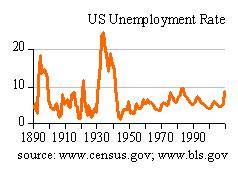
Not immediatly. WE go though a GUILDED AGE first. WE went though one of those around 1890 before UNIONS brought the supply and demand back into some kind of balance.
And now, thanks to FREE TRADE and TECHNOLOGY, we've moved back into a GUILDED AGE, where the supply side (read capital) have far more of the worlds aggregate wealth, than is healthy for a consumer diven economic system
8) The only way to restore prosperity under those circumstances when labor has become far less necessary to create wealth, and so no longer serves to distribute wealth, is to render today's privately-owned publicly-traded corporations into publicly-owned operations, and distribute the profits to the people as an owner's share.
It is NOT the only way we can restore balance.
What you are proposing is to NATIONALIZE (read steal) the means of production and impose a SOCIALIST system.
There are far better ways to fix this system in my opinion. Ways that don't nationalize the means of production.
Profit sharing is a damned good way, for example. STronger Unions would help, and sensible TRADE policies would also do much to correct the problems we face, today, too.
Thus: socialism is inevitable.
No it isn't.
Socialism comes with its own problems. Problems that are build right into that system, too.
Most obvious of the problem of socialism is that it centralizes bothy WEALTH and POWER into far too few hands.
AS power corrupts regardless of what economic system or what system of governance we employ,
any system which centralizes both government power and control of the nation resources is BOUND to become inefficient.