Well you must be one of the few people who think that CO2 isn't pollution. It is, by the way, you're just deluding yourself.
A plastic bag in a supermarket isn't pollution. But in the pacific ocean it is.
CO2 is in the air, in it's normal amounts it isn't pollution. When there's too much of it, it is pollution. It's a simple concept, one that high school kids are often able to pick up and understand. Maybe once you've graduated from high school you'll understand. Maybe.
ok going with that, what is too much? Do you have any knowledge on how much is too much? Seems like you're off course captain. You should first learn how much is too much if you wish to make that claim. BTW, CO2 is not a pollutant. We exhale it. comprehende?
Too much is more than there should be. Too much is when the climate starts to change because we've put more up there. Too much is when we're having an impact when we shouldn't be.
Listen, if you're going to keep going with this silly "we exhale CO2 therefore it's not a pollutant" then we're not going to be able to talk. You have to understand what stuff is to be able to talk about a complex issue, instead of either A) just taking the piss and B) being extremely ignorant.
Some things are fact.
Let's try some basic English
pollution: definition of pollution in Oxford dictionary (American English) (US)
"The presence in or
introduction into the environment of a substance or thing that has
harmful or
poisonous effects:"
More CO2 into the atmosphere is harmful because it increases the greenhouse effect.
Carbon dioxide - Wikipedia, the free encyclopedia
Something basic for you
"Carbon dioxide is an important
greenhouse gas. Burning of carbon-based fuels since the
industrial revolution has rapidly increased its concentration in the atmosphere, leading to
global warming. It is also a major cause of
ocean acidification since it dissolves in water to form
carbonic acid.
[7]"
"Carbon dioxide dissolves in the ocean to form
carbonic acid (H2CO3),
bicarbonate (HCO3−) and
carbonate (CO32−). There is about fifty times as much carbon dissolved in the oceans as exists in the atmosphere. The oceans act as an enormous
carbon sink, and have taken up about a third of CO2 emitted by human activity.
[52]"
"As the concentration of carbon dioxide increases in the atmosphere, the increased uptake of carbon dioxide into the oceans is causing a measurable decrease in the pH of the oceans, which is referred to as
ocean acidification. "
"This reduction in pH affects biological systems in the oceans, primarily oceanic
calcifying organisms. These effects span the
food chain from
autotrophs to
heterotrophs and include organisms such as
coccolithophores,
corals,
foraminifera,
echinoderms,
crustaceans and
mollusks. Under normal conditions, calcium carbonate is stable in surface waters since the carbonate ion is at
supersaturating concentrations. However, as ocean pH falls, so does the concentration of this ion, and when carbonate becomes undersaturated, structures made of calcium carbonate are vulnerable to dissolution.
[53] Corals,
[54][55][56] coccolithophore algae,
[57][58][59][60]coralline algae,
[61] foraminifera,
[62]shellfish[63] and
pteropods[64] experience reduced calcification or enhanced dissolution when exposed to elevated CO2"
So, the biggest impact so far is in the oceans. We're basically polluting so much that the oceans are experiencing ocean acidification, which is destroying ocean eco systems, destroying food chains, and basically having an extremely negative effect on what is there.
Ocean acidification - Wikipedia, the free encyclopedia
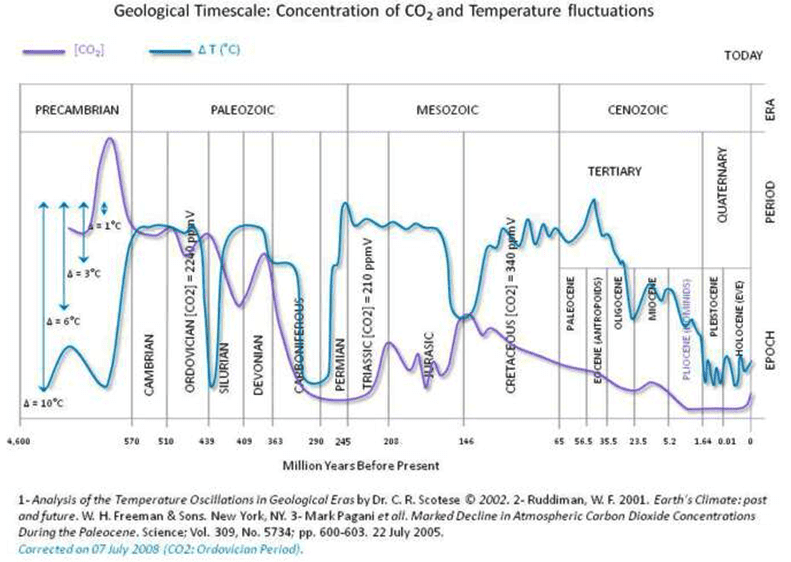
"Current rates of ocean acidification have been compared with the greenhouse event at the Paleocene–Eocene boundary (about 55 million years ago) when surface ocean temperatures rose by 5–6 degrees
Celsius. No catastrophe was seen in surface ecosystems, yet bottom-dwelling organisms in the deep ocean experienced a major extinction. "
"The current acidification is on a path to reach levels higher than any seen in the last 65 million years,
[39] and the rate of increase is about ten times the rate that preceded the Paleocene–Eocene mass extinction. "
The Earth has become more stable recently. This has allowed the development of human beings. Before the Earth would be trying to regulate itself and would go up and down and cause mass extinctions and temperature fluctuations which would take leading creatures and kill them off to be replaced by other creatures.
Humanity has increased because of this stability. We're changing this stability. We're destroying it. What do you think will happen to the leading creatures?