You do not see it because you are just like her. She found an easy life. Skating. She has cost people money and even lives with the funds sent to the green scam and not to people who need it. Enslavement and passed around at night by fellow slave laborers are a fitting punishment.The unfounded hate the right has for this girl is terrifying to behold.
Navigation
Install the app
How to install the app on iOS
Follow along with the video below to see how to install our site as a web app on your home screen.
Note: This feature may not be available in some browsers.
More options
Style variation
You are using an out of date browser. It may not display this or other websites correctly.
You should upgrade or use an alternative browser.
You should upgrade or use an alternative browser.
Poor Greta Thunberg, so disappointed. See why.
- Thread starter Robert W
- Start date

JoeB131
Diamond Member
You do not see it because you are just like her. She found an easy life. Skating. She has cost people money and even lives with the funds sent to the green scam and not to people who need it. Enslavement and passed around at night by fellow slave laborers are a fitting punishment.

Sunsettommy
Diamond Member
- Mar 19, 2018
- 16,416
- 14,149
- 2,400
Just as expected you have NO counterpoint to offer, just be a typical brain-dead climate cultist who doesn't know shit about it.
Sunsettommy
Diamond Member
- Mar 19, 2018
- 16,416
- 14,149
- 2,400
The unfounded hate the right has for this girl is terrifying to behold.
The unfounded love you have for a halfwit who doesn't know shit about the science and has damaged science research promoted ugly socialism is terrifying to behold.
Sunsettommy
Diamond Member
- Mar 19, 2018
- 16,416
- 14,149
- 2,400
See this man can't make any counterpoints because he is too addled by the climate cult baloney to understand his shortcomings of the topic.

Mac-7
Diamond Member
- Oct 9, 2019
- 90,987
- 68,632
- 3,565
WINNING!!!The Intergovernmental Panel on Climate Change, the U.N.' most often cited global alarmist group has admitted that their long predicted four to five degree warming by the year 2100 is unlikely to happen in real life.
WASHINGTON — President Trump took a victory lap late Saturday after a prominent international climate change panel backed off using some of the most aggressive doomsday estimates after determining that they were not the most plausible outcomes.
The United Nations-backed Intergovernmental Panel on Climate Change (IPCC) had quietly adjusted its modeling frameworkof a 4–5°C warming by 2100 last month. That framework had underpinned a myriad of other analyses predicting terrifying consequences for greenhouse gas emissions.
The mistake these doomsday prophets keep making is setting a date for the destruction. If they kept their predictions pinned to vague futere times, they could get away with it more or less forever.
JoeB131
Diamond Member
Just as expected you have NO counterpoint to offer, just be a typical brain-dead climate cultist who doesn't know shit about it.
No, I just realized that arguing with climate deniers is kind of a waste of time.See this man can't make any counterpoints because he is too addled by the climate cult baloney to understand his shortcomings of the topic.
You ignore evidence right before your eyes.
I'm 64 years old. I remember when "Chicago Winter" really used to mean something bad.
Now we are lucky to get a sprinkling of snow.

- Jan 27, 2017
- 23,004
- 29,775
- 2,415
The unfounded hate the right has for this girl is terrifying to behold.
Skeerdy cat
Sunsettommy
Diamond Member
- Mar 19, 2018
- 16,416
- 14,149
- 2,400
No, I just realized that arguing with climate deniers is kind of a waste of time.
You ignore evidence right before your eyes.
I'm 64 years old. I remember when "Chicago Winter" really used to mean something bad.
Now we are lucky to get a sprinkling of snow.
You replied to official sea ice claims, and you skated.....

Just as expected you have NO counterpoint to offer, just be a typical brain-dead climate cultist who doesn't know shit about it.
JoeB131
Diamond Member
I'll take the word of real scientists before some crank on the internet who listens to too much hate radio.You replied to official sea ice claims, and you skated.....
Just as expected you have NO counterpoint to offer, just be a typical brain-dead climate cultist who doesn't know shit about it.
Sunsettommy
Diamond Member
- Mar 19, 2018
- 16,416
- 14,149
- 2,400
I'll take the word of real scientists before some crank on the internet who listens to too much hate radio.
You replied to official sea ice claims, and you skated..... You skated two more times now.
Just as expected you have NO counterpoint to offer, just be a typical brain-dead climate cultist who doesn't know shit about it.
It is clear you don't know anything as what I posted are from official sources which you wouldn't where they are.
JoeB131
Diamond Member
You replied to official sea ice claims, and you skated..... You skated two more times now.
Nope, I just listen to real scientists. Like these guys.
The Arctic is warming faster than anywhere else on the planet, and as a result, sea ice in the Arctic Ocean is decreasing. Sea ice loss has far-reaching effects on the planet because the ice helps regulate Earth’s climate, influences global weather patterns, and affects ocean circulations. Sea Ice Today began as a way to make sea ice science and analysis more relevant and accessible. In combination, NASA data and NSIDC expertise provide easy-to-use resources and tools to increase our understanding of climate change in the Arctic.
Since 2007, this site has been a go-to source for blog-like insights, analysis, and data visualization tools that communicate how sea ice has been changing from year to year. We receive over two million page visits a year and our content is used by a wide range of users including journalists, the general public, academics, and scientists alike. Our analyses focus primarily on sea ice extent, which is a measurement of the area of ocean where there is at least some sea ice. In the Arctic, the annual minimum sea ice extent occurs in September and the annual sea ice maximum extent occurs in March. In the Antarctic, the minimum extent occurs in February and the maximum occurs in September. When compared with previous years and decadal averages, these periods when the annual extremes occur are particularly important indicators of how much ice is being lost over time.
This website is funded by NASA and managed by NSIDC that provides the latest satellite data and scientific analyses of sea ice conditions in the Arctic and around Antarctica. Sea Ice Today was originally known as Arctic Sea Ice News & Analysis (ASINA) from 2007-2024, when we rebranded as Sea Ice Today.
Sunsettommy
Diamond Member
- Mar 19, 2018
- 16,416
- 14,149
- 2,400
Nope, I just listen to real scientists. Like these guys.
The Arctic is warming faster than anywhere else on the planet, and as a result, sea ice in the Arctic Ocean is decreasing. Sea ice loss has far-reaching effects on the planet because the ice helps regulate Earth’s climate, influences global weather patterns, and affects ocean circulations. Sea Ice Today began as a way to make sea ice science and analysis more relevant and accessible. In combination, NASA data and NSIDC expertise provide easy-to-use resources and tools to increase our understanding of climate change in the Arctic.
Since 2007, this site has been a go-to source for blog-like insights, analysis, and data visualization tools that communicate how sea ice has been changing from year to year. We receive over two million page visits a year and our content is used by a wide range of users including journalists, the general public, academics, and scientists alike. Our analyses focus primarily on sea ice extent, which is a measurement of the area of ocean where there is at least some sea ice. In the Arctic, the annual minimum sea ice extent occurs in September and the annual sea ice maximum extent occurs in March. In the Antarctic, the minimum extent occurs in February and the maximum occurs in September. When compared with previous years and decadal averages, these periods when the annual extremes occur are particularly important indicators of how much ice is being lost over time.
This website is funded by NASA and managed by NSIDC that provides the latest satellite data and scientific analyses of sea ice conditions in the Arctic and around Antarctica. Sea Ice Today was originally known as Arctic Sea Ice News & Analysis (ASINA) from 2007-2024, when we rebranded as Sea Ice Today.
LOL, the decline stopped years ago, as per the OFFICIAL data:
September 2025 Arctic Ice Beats Expectations
Excerpt:
These are predictions as of August 20 for the September 2025 monthly average ice extent reported by NOAA Sea Ice Index (SII). This post provides a look at the 2025 September monthly averages comparing MASIE and SII datasets. (19 year average is 2007 to 2025 inclusive).
LINK
It is much lower than it was in 1990, which I freely agree.
The warming is mostly during the winter as the Summer temperature is barely changed.
JoeB131
Diamond Member
The problem isn't ice extent, it's ice depth, and that is still thinning.LOL, the decline stopped years ago, as per the OFFICIAL data:
September 2025 Arctic Ice Beats Expectations
Excerpt:
These are predictions as of August 20 for the September 2025 monthly average ice extent
Per NASA.
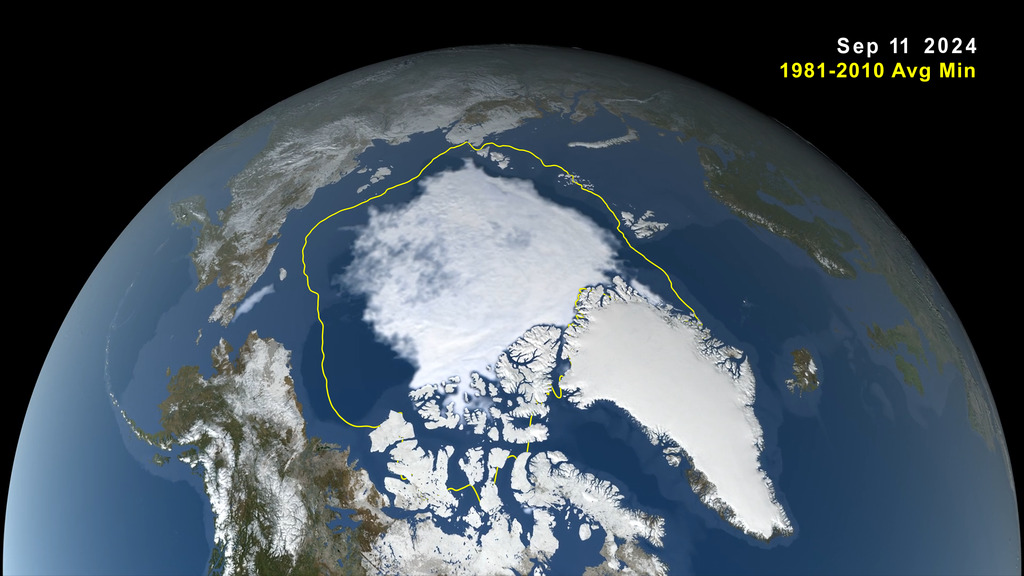
Arctic Sea Ice Near Historic Low; Antarctic Ice Continues Decline - NASA
Arctic sea ice retreated to near-historic lows in the Northern Hemisphere this summer, likely melting to its minimum extent for the year on Sept.11, 2024,
 www.nasa.gov
Arctic sea ice retreated to near-historic lows in the Northern Hemisphere this summer, likely melting to its minimum extent for the year on Sept.11, 2024, according to researchers at NASA and the National Snow and Ice Data Center (NSIDC). The decline continues the decades-long trend of shrinking and thinning ice cover in the Arctic Ocean.
The amount of frozen seawater in the Arctic fluctuates during the year as the ice thaws and regrows between seasons. Scientists chart these swings to construct a picture of how the Arctic responds over time to rising air and sea temperatures and longer melting seasons. Over the past 46 years, satellites have observed persistent trends of more melting in the summer and less ice formation in winter.
Sunsettommy
Diamond Member
- Mar 19, 2018
- 16,416
- 14,149
- 2,400
The problem isn't ice extent, it's ice depth, and that is still thinning.
Per NASA.
Arctic Sea Ice Near Historic Low; Antarctic Ice Continues Decline - NASA
Arctic sea ice retreated to near-historic lows in the Northern Hemisphere this summer, likely melting to its minimum extent for the year on Sept.11, 2024,
Arctic sea ice retreated to near-historic lows in the Northern Hemisphere this summer, likely melting to its minimum extent for the year on Sept.11, 2024, according to researchers at NASA and the National Snow and Ice Data Center (NSIDC). The decline continues the decades-long trend of shrinking and thinning ice cover in the Arctic Ocean.
The amount of frozen seawater in the Arctic fluctuates during the year as the ice thaws and regrows between seasons. Scientists chart these swings to construct a picture of how the Arctic responds over time to rising air and sea temperatures and longer melting seasons. Over the past 46 years, satellites have observed persistent trends of more melting in the summer and less ice formation in winter.
Your source is the propaganda laced NASA, they should be tossed aside.
LOL, you didn't actually refute my chart at all, here is a much better report done by the NOAA with actual scientists who are the one directly monitoring the ice headed by Dr, Meiers team who runs SII which was represented in the chart I posted.
Arctic Report Card 2025
LINK
Meanwhile there is absolutely no evidence that a decline of Sea ice is bad for the Polar region.

JoeB131
Diamond Member
Make up your mind.Meanwhile there is absolutely no evidence that a decline of Sea ice is bad for the Polar region.
Either loss of ice isn't happening or it isn't a bad thing if it's happening
Dear God. . . Thanks for sending that guy to USMB and spreading the word to a dozen others to save the world from ourselves.
If it reaches seven others. . . You can even call that a success!
Funny, you can say the same about your diatribes about abortion.

DGS49
Diamond Member
Political scoundrels the world over use fear of catastrophe to induce their subjects to remain submissive in the face of avoidable hardships. Global Warming is just one of the arrows in the figurative quivers of Leftists, but the costs of succumbing to this fraudulent scam are worse than the predicted event, even if it does occur as advertised.
I wonder how Greta's parents produced such an awful person.
I wonder how Greta's parents produced such an awful person.
Sunsettommy
Diamond Member
- Mar 19, 2018
- 16,416
- 14,149
- 2,400
JoeB131 sure has a memory problem here,
I have already admitted that the current sea ice level is much lower now than it was in 1990, LINK
There is no evidence that it is a bad thing as it has been far less ice for periods of time in the earlier interglacial period even to none at all in the summer which I have posted many times to be ignored heck even Dr. Meier who is the head of the SII sea ice database said so based on published papers.
You have yet to make a case that it is bad for the region.
Make up your mind.
Either loss of ice isn't happening or it isn't a bad thing if it's happening
I have already admitted that the current sea ice level is much lower now than it was in 1990, LINK
There is no evidence that it is a bad thing as it has been far less ice for periods of time in the earlier interglacial period even to none at all in the summer which I have posted many times to be ignored heck even Dr. Meier who is the head of the SII sea ice database said so based on published papers.
You have yet to make a case that it is bad for the region.
JoeB131
Diamond Member
There is no evidence that it is a bad thing as it has been far less ice for periods of time in the earlier interglacial period even to none at all in the summer which I have posted many times to be ignored heck even Dr. Meier who is the head of the SII sea ice database said so based on published papers.
You have yet to make a case that it is bad for the region.
It's bad for the planet, you dumbass.
If the hot air from the equator isn't cooled off by shifting to the poles, then it just keeps getting hotter.
Similar threads


- Replies
- 119
- Views
- 1K


- Replies
- 12
- Views
- 652


- Replies
- 3
- Views
- 270
New Topics
-
 Gavin Newsom pleads for Trump’s help as crack appears on Garden Grove chemical tank
- Started by Doc7505
- Replies: 4
-
Democrats worry they’ve been caught in an anger trap with Trump
- Started by Doc7505
- Replies: 3
-
-

-
 Authorities: New Chicago police chief sold guns from investigations
- Started by excalibur
- Replies: 4


