Mere parsimony is not economy. Expense, and great expense, may be an essential part in true economy.
Edmund Burke
YES you moron. The US government was in debt before John Maynard Keynes was born.
With
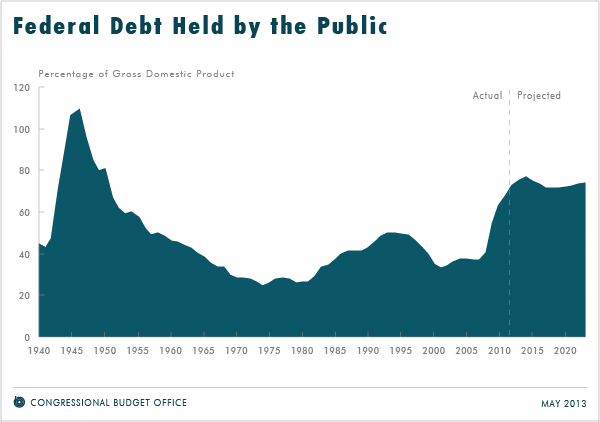
one brief exception, the federal government has been in debt every year since 1776. In January 1835, for the first and only time in U.S. history, the public debt was retired, and a budget surplus was maintained for the next two years in order to accumulate what Treasury Secretary Levi Woodbury called a fund to meet future deficits. In 1837 the economy collapsed into a deep depression that drove the budget into deficit, and the federal government has been in debt ever since.
Whenever a demagogue wants to whip up hysteria about federal budget deficits, he or she invariably begins with an analogy to a households budget: No household can continually spend more than its income, and neither can the federal government. On the surface that, might appear sensible; dig deeper and it makes no sense at all. A sovereign government bears no obvious resemblance to a household. Let us enumerate some relevant differences.
1. The US federal government is 221 years old, if we date its birth to the adoption of the Constitution. Arguably, that is about as good a date as we can find, since the Constitution established a common market in the US, forbade states from interfering with interstate trade (for example, through taxation), gave to the federal government the power to levy and collect taxes, and reserved for the federal government the power to create money, to regulate its value, and to fix standards of weight and measurement-from whence our money of account, the dollar, comes. I dont know any head of household with such an apparently indefinitely long lifespan. This might appear irrelevant, but it is not. When you die, your debts and assets need to be assumed and resolved. There is no day of reckoning, no final piper-paying date for the sovereign government. Nor do I know any household with the power to levy taxes, to give a name to and issue the currency we use, and to demand that those taxes are paid in the currency it issues.
The federal government is the issuer of our currency. Its IOUs are always accepted in payment. Government actually spends by crediting bank deposits (and credits the reserves of those banks); if you dont want a bank deposit, government will give you cash; if you dont want cash it will give you a treasury bond. People will work, sell, panhandle, lie, cheat, steal, and even kill to obtain the governments dollars. I wish my IOUs were so desirable. I dont know any household that is able to spend by crediting bank deposits and reserves, or by issuing currency. OK, some counterfeiters try, but they go to jail.