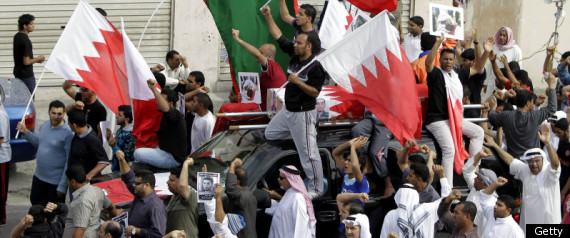
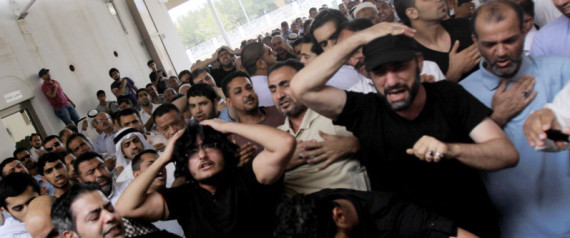
Liz, a Shi'ite in her late 20s, is afraid to leave her house. She says that the last time she went out, government-hired thugs stopped her car at one of the many checkpoints that litter Manama, the capital of Bahrain. They pulled her out, asked for her identity card and tried to ascertain one thing: whether she was Sunni or Shi'ite.
"It's pure racial profiling," she says a few days later, sitting in her family's living room in Al'Ali, a Shi'ite village north of Manama. "Your name could lead to your arrest if it's a Shia name." Her brother, an IT engineer, asks not to be named for fear of retribution. The last time he went out, thugs pulled him over, with his wife and child in the car. "They hauled me out, asked, 'Are you Sunni or Shia?'" he says. "My dearest friend since childhood is a Sunni. Now he won't even speak to me. He's a former roommate, and now he treats me like a stranger." Anytime he speaks to Sunnis now, he says, "it's like there's an invisible shield between us."
An increasingly bitter sectarian divide is eroding the social fabric of the island kingdom, the result of a crackdown by the ruling Sunni government on Shi'ite antigovernment protesters. The government's new, highly effective strategy of divide and rule has sought to split the country along sectarian lines, making it harder for protesters to organize a credible national opposition movement. "The most successful revolutions in the region have been in Egypt and Tunisia, and that's because protesters have been able to unite people from different backgrounds," says Jane Kinninmont, senior research fellow for the Middle East and North Africa Program at Chatham House. "Division in conflict is a powerful tool."
So far, at least 25 Shi'ites have been killed, hundreds injured and hundreds more activists, high-profile bloggers and political leaders arrested by Bahraini government forces in violent predawn raids. Opposition-party headquarters have been torched, Shi'ite citizens shot at random by security forces. The crisis has polarized the two sects Sunnis, the wealthier ruling class, vs. Shi'ites, who comprise the 70% majority. In February, demonstrators from both groups had said they were united. "No Sunni, no Shia," they chanted. They waved banners that read, "We are one." That unity has dissipated.
"The Bahraini regime has increasingly adopted an us-vs.-them attitude, seeing Shias as intent on subverting the country," says Shadi Hamid, research director at the Brookings Doha Center and a fellow at the Saban Center for Middle East Policy. "By repeating the same narrative over and over, more Sunnis start believing it, and more Shias feel they are being painted as enemies." The biggest factor in the split is propaganda spread by state-controlled media, namely flagship network Bahrain TV. The regime also continues to jail opposition journalists and independent bloggers, has placed strict visa restrictions on foreign reporters and shuttered the newspaper of opposition party al-Wefaq.