aris2chat, et al,
The "Appendix 2" was assembled for Alan Dershowitz's book --- "A Case for Israel." Dershowitz was both a Harvard and Yale Law Professor
(Developmental History , as well as Constitutional Law and Civil Rights Law). He also acts as an individual political commentator. Most notably, he was a member of the
Nelson Mandela Legal Team, way back when.
Like many advocates of a professional calibre, when they makes mistakes of fact, they are usually a big mistake. There is no one correct perspective for the overall controversy. And it is not even correct to think of it in terms of an Israeli-Arab conflict, or a dispute between the Jewish people and that of the Palestinians. There is so much more to it than that. But, most people don't have the peripheral mental capacity to capture the entire landscape of the dispute. The dispute and conflict takes leaps or shifts in direction based on the triggers that stimulates the key players that change over time. On the 60th Anniversary of the Partition Plan [
GA/RES/181(II)], a former Ambassador to America and at the time the Chair to the Saudi National Security Council) made a revelation.
Israel's Liaison to Its Neighbors: Saudi Prince Bandar
Aluf Benn Mar 02, 2007
In late 2000 the efforts focused on the Palestinian track. Following the failure of the Camp David summit and the outbreak of the intifada, Bandar tried to pressure Yasser Arafat to accept the Clinton Initiative. In retrospect the prince considers Arafat's failure to accept the offer as criminal.
Today, depending on the who you accept as an authority, the thumbnail view of the Arab Palestinian Complaint is that
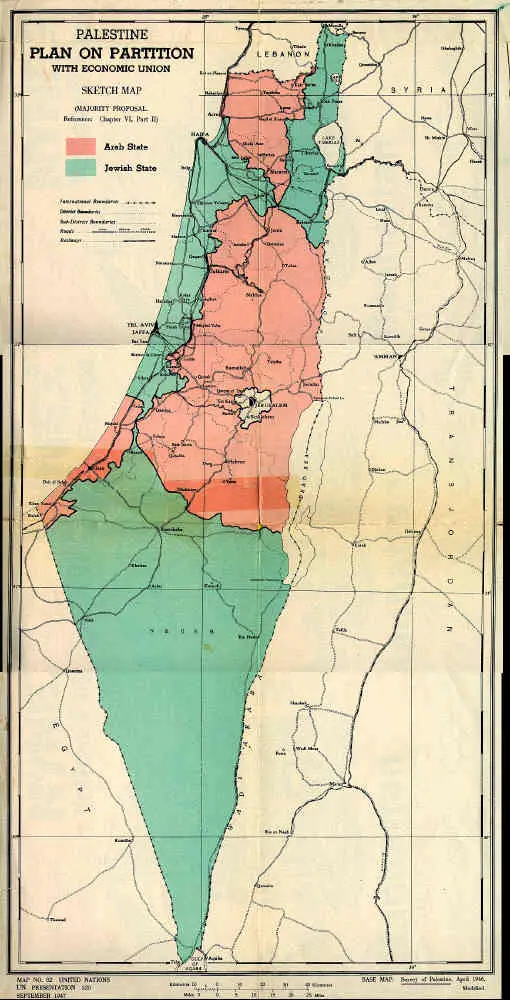
(Once Upon a Time) Israel took control of the territory outlined in
Part II. - Boundaries - Section B, Partition Plan (Jewish State) and nearly 50% of the territories allocated to the
Part II. - Boundaries - Section A, Partition Plan (Arab State), a total of 15,025,000 dunum. And in process of taking control and defending the Section B territory, the Israelis forcibly evicted several hundred thousand indigenous property owners; denying them the undefined "Right of Return."
aris2chat, montelatici, et al,
As has been explained many times to you, the Partition Recommendation was not based solely on "Land Ownership" as the basis for sovereignty; or the allocation for a Jewish State should a Provisional Government exercise self-determination and follow the "Steps Preparatory for Independence."
It was not some Arab based real-estate deal. Nor was it contested in the ways associated with peaceful disputes.
>>Land owned by the Jews in 1948 9%
Land owned by the Arabs in 1948 10%
Land owned by the state and leased on a limited basis to people to use: 81%
80% of the land was initially given to the Palestinians and became what is Jordan today (yep, ethnically there is zero deference between the Jordanians and the so called Palestinians). The remaining 20% is what got divided up in the Mandate so that Jews ended up with a mere 10% of the land and the Palestinians 90%. This was not good enough for the Arabs so in 1948 5 Arab countries launched a war to try and wipe out the Jews- they failed. However, Egypt stole land from the palestianins (Gaza) and Jordan stole land intended for the Palestinians (the West Bank)- the Arabs gave 0% of the land intended for the Palestinians to the Palestinians!<<
Christians and Muslims owned more than 90% of the land prior to partition in 1946.
Table 2. Survey of Palestine page 566.
View attachment 67832
A Survey of Palestine Volume 2 | Berman Jewish Policy Archive @ Stanford University
(COMMENT)
While this argument has been made many time before, it never answered the UN Open Topic of the "Question of Palestine."
Just as you have often pointed-out that so many members recognize the 1988 State of Palestine, so it was the case that a majority of the UN Member Nations; including the United States the Soviet Union, France and Australia.
The decision making process was based on the anticipated future needs of the Jewish People
(including aspects not considered by the Arab to be of any consequence morally or rationally); and still allocated more than three-quarters of the original territory covered under the Mandate of Palestine to Arab Sovereignty. The Hashemite Kingdom of Jordan
(alone) was more that 77%.
The persistent defiance presented by the Arab Nations
(Arab League and Arab Higher Committee), including Egypt, Syria, Iraq, and Saudi Arabia denounced the recommended Partition Plan and voted as a bloc against GA Resolution 181 (II) with the open threat to use force to oppose implementation. This was done prior to any of the Arab subterfuge and nonsense that their acts of aggression were justified to restore order.
Ownership has nothing to do with "sovereignty." Theoretically the Arabs could have owned 100% of the land, and still not effect sovereignty. In fact, this was the case for a 1000 years prior to the Ottoman Empire/Republic of Turkey renouncing all rights and title over the territory in question.
While your argument might be able to convince those that don't understand the way Sovereignty was obtained up through the first half of the 20th Century, but surely, they cannot roll back the clock and merely pretend they have certain rights which they declined, rejected or were ineffective in implementation.
Most Respectfully,
R
Maybe you can summarize and put in simple words about the land ownership and distribution, I'm sure most did not read "Land Ownership in Palestine, 1880-1948"
http://www.wordfromjerusalem.com/wp-content/uploads/2008/11/the-case-for-israel-appendix2.pdf
(COMMENT)
The importance of the land distribution is not in the question of who owns how much of what, but which constituents can make the best contribution to the health and wealth of the economy; providing the best base for government revenue (a concept that was well beyond the understanding of the Arab Palestinian). There is little question that the table that our friend "montelatici" periodically republishes that asserts that the Arabs of Palestine owned so very much more land actually made any significant local, regional, or national contribution to Arab prosperity or nationalism. IN CONTRAST, is is important to note the
Survey of Palestine Volume 2 Anglo-American Committee of Inquiry, prepared between the middle of December, 1945
(several months after the UN Charter was approved), and the end of January, 1946.
This shows the deposits held by banks and credit cooperative societies at the end of October 1945. Depending if you look at the
Urban Population Figures or the
Rural Settled Population Figures, you will notice that the Jewish had a slightly marginal majority population in the dense Urban environment; while the Arabs had an overwhelming majority in the Rural environment. YET, the monetary deposits speaks volumes as to which contributes to the economy more. Basically, the claim is that In 1947, the UNSCOP recommended a partition in the territory formerly under Mandate
(approved by the General Assembly), giving 55% to the Jewish population
(≈ 31% of the EoY 1946 total) and 45% to the Palestinian population
(≈ 69% of the EoY 1946 total).
(WHAT DOES THE PICTURE SAY?)

The POINT is that you cannot merely judge the entire case on one aspect; but on the broader view. In WWII, the phrase was "The Big Picture." And in this case, The Big Picture looks at the Arab for the entire region and compares their success to that of the very small --- minority Jewish Population and their successes and their human development.
The "Big Picture" looks as the notion that, in democracies
(and generally we are not talking about Arab League Nations), the greatest concern is that the majority will tyrannise and exploit diverse smaller interests and the minorities (in this case the Jewish Population). The Big Picture and duty of the Allied Powers is to INSURE that rights of the Jewish Minority that have suffered under the tyranny of Oppressors, worldwide, are not made subject public vote merely to please an Arab Majority. It is as
Friedrich Nietzsche has suggested, the political function of the Allied Powers
(having defeated the Axis Oppressors) to protect the rights of the Jewish Minority. It is the Functional duty and fiduciary responsibility explicitly and precisely to protect the Jewish minority from oppression by the Arab majorities and former allies of the Axis Powers. Remembering that the smallest minority on Earth --- even the Jewish People are individuals having the right of self-determination and deserving the protection of the Oppression of Regional Arab Islamic radicalism and terrorist such as that exhibited by the Hostile Arab Palestinian.
It is beyond the hand of the Majority Controlled UN subcommittees that selectively attempt to focus upon Israel as:
Central African Republic (often there are armed clashes between muslims and christians)
Libya (civil war)
Nigeria (war against islamist militants)
Somalia (war against al-Shabaab islamist militants)
It is just as important that the Allied Powers protect the Jewish Minority from the oppression of the Selective enforcement by the UN -- while those same spineless UN Commissions make no critical condemnations of:
HAMAS
Quds Force
Palestinian Islamic Jihad
Hezbollah Network
Hezb-e-Islami Gulbuddin (HIG) (since 1977)
Hezb-e Islami Khalis (HIK) (since 1979)
And this is just a sample of the Big Picture which most of the Arab Middle East Community uses it influence to oppose.
It would be interesting for the pro-Arab Palestinians to point out the Arab or Islamic State in the Region which is more successful, productive and development than the Israel which has been under continuous assault by Arab and Islamic Forces, Jihadist, Islamic Radicals, Terrorists and other Arab Asymmetric Anti-Semitic activities.
Most Respectfully,
R