ISIS actually evolved out of Al Queda, and they aren't really doing anything different from each other. ISIS is a younger group that has learned to use modern technology to its advantage. Most crucially, ISIS is in total control of large swaths of territory and has a huge source of funding from the territory it holds. Of course Al Queda and ISIS are competitors, but it's possible that one day Al Queda may merge with ISIS.
This doesn't in any way suggest that they are theologically sophisticated. We also know that AQI (the founding entity of ISI and later ISIS) was threatened by bin Laden with excommunication due specifically due to its tactics and the US Army's intelligence center's subsequent analysis of the two groups showed large theological and methodological divisions between the two. I also find it interesting that you would hinge your basis on these two groups since Osama bin Laden had no formal scholarly religious education and specifically eschewed formal religious training in favor of his personalized style of Islamic branding.
ISIS is led by a devout Muslim cleric and thousands of Muslims are flocking to its message because they believe ISIS represents true Islam, and the desire to live a purely ISLAMIC life.
Since you have said this over and over again and seem so confident in yourself, I challenge you to a formal discussion in the new formal discussion forum on the issue where you can finally support your stance in more detail instead of simply defending yourself with the use of personal attacks and thread abandonment.
Ayatollah Khomeini has the status of prophet (imam) among Shia Muslims.
No he doesn't. There are only 12 imams within Jafari Islam and the Imam is only believed to return as the Mahdi in the last days. Khomeini doesn't claim to be the Mahdi, nor is he believed to be by his followers. In terms of physical religious leaders, shias follow what are called Majaji or grand ayatollahs, of which there are over 60 in the world currently living and of which Khamenei is hardly the most popular in terms of religious followers. As far as Khomeini is concerned, Shias are not allowed theologically speaking to adopt the ideas of a Marja who is dead.
He was a man who studied and preached Shia Islam for decades of his life and was the Shai "pope" before he came to power.
Likening anyone to the Shia "pope" is to not understand how Shiism works. Marja are theologically required to have differing views from one another in order to maintain diversity within the faith and in order to ensure theological discourse. The most popular modern Marja to exist was Khoei, and his successor today (Al Sistani) is much more popular theologically speaking than the Iranian government.
Once again, these are pretty basic concepts, and the fact that you don't seem to be aware of them is rather telling when it comes to the robustness of your own acclaimed religious knowledge.
You discount and distort reality. Khomeini was the head cleric in Iran and was deposed by the Shah, which was the biggest mistake the Shah made. There were other head clerics but he was the main one.
After he came to power and died he was given the label "imam" or saint.
Only by his own followers, and this in no way theologically puts him on par with the 12 imams of Jafari Shiism, nor does it change the reality that most of the theological power within 12er shiism is held in Qom and Najaf, not Tehran.Your attempt to brand him as some sort of Shia pope is intellectually dishonest and ignores the traditional theological power structures within the faith.
As far as Bin Laden's knowledge of Islam you seemed to have skipped the formative years of his life where he and Zawahiri STUDIED ISLAM AT THE MUSLIM BROTHERHOOD, and then branched off on their own Jihad in Afghanistan and elsewhere.
Studying Islam isn't the same as having a formal Islamic scholarly credentials. His thesis was that Muslims didn't need such formal education and he himself eschewed it, as did one of his main influences: Sayyid Qutb who likewise never completed formal religious training. Bin Laden was never considered to be a formal Islamic scholar.
So you see, you're the ignorant arrogant one here. You didn't know that Bin Laden attended an Islamic school known to produce many radicals and terrorist groups and their leaders, and you still still claim that Khomeini isn't considered an Imam in Iran. Now run along before you embarass yourself more:
Ruhollah Khomeini - Wikipedia the free encyclopedia
Khomeini was noted by many for his mystique. Before the revolution he benefited from the widespread circulation of a
Hadithattributed to the Imam
Musa al-Kazim who is said to have prophesied shortly before his death in 799 that
'A man will come out from
Qom and he will summon people to the right path. There will rally to him people resembling pieces of iron, not to be shaken by violent winds, unsparing and relying on God.'
[214]
Khomeini was the first and only Iranian cleric to be addressed as "Imam", a title hitherto reserved in Iran for the
twelve infallible leaders of the early Shi'a.
[215] He was also associated with the
Mahdi or 12th Imam of Shia belief in a number of ways. One of his titles was
Na'eb-e Imam (Deputy to the
Twelfth Imam). His enemies were often attacked as
taghut and
Mofsed-e-filarz (corrupters of the earth), religious terms used for enemies of the Twelfth Imam. Many of the officials of the overthrown Shah's government executed by Revolutionary Courts were convicted of "fighting against the Twelfth Imam". When a deputy in the
majlis asked Khomeini directly if he was the 'promised Mahdi', Khomeini did not answer, "astutely" neither confirming nor denying the title.
[216]
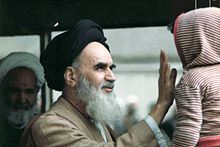
Khomeini and child
As the revolution gained momentum, even some non-supporters exhibited awe, called him "magnificently clear-minded, single-minded and unswerving."
[217] His image was as "absolute, wise, and indispensable leader of the nation"
[218]
The Imam, it was generally believed, had shown by his uncanny sweep to power, that he knew how to act in ways which others could not begin to understand. His timing was extraordinary, and his insight into the motivation of others, those around him as well as his enemies, could not be explained as ordinary knowledge. This emergent belief in Khomeini as a divinely guided figure was carefully fostered by the clerics who supported him and spoke up for him in front of the people.
[219]


