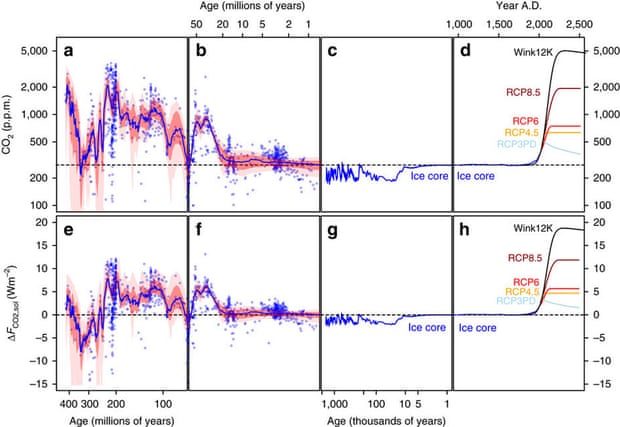
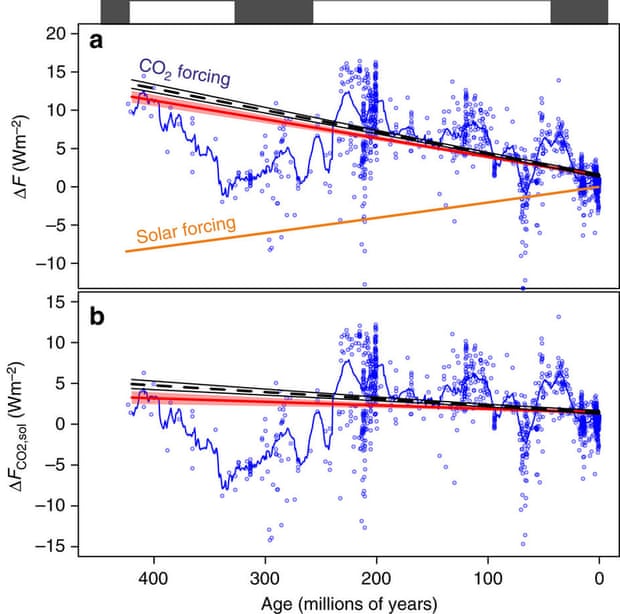
Changes in atmospheric carbon dioxide and in the combined solar and carbon dioxide forcing over the past 420 million years. Illustration: Foster et al. (2017); Nature Communications.
The study relates to a scientific conundrum known as the “
faint young sun paradox” – that early in Earth’s history, solar output was 70% less intense than it is today, and yet the planet was warm enough to have a liquid ocean. A stronger greenhouse effect due to higher carbon dioxide levels in the atmosphere may be one explanation.
Over time, solar output has grown stronger, and atmospheric carbon dioxide levels have fallen due to an effect known as
“weathering” of rocks and an increase in plant life. The authors of this study found that over the past 420 million years, the slow heating of the sun and slow decline of the greenhouse effect have roughly offset each other, leading to a fairly stable long-term global climate.