A team led by Northrop, maker of the B-2 Spirit stealth bomber and drone aircraft, beat out another led by Boeing Co., the world's largest aerospace company, and Lockheed Martin Corp., the world's largest defense contractor, for the award as part of the U.S. Air Force's Long Range Strike Bomber, or LRS-B, program. The $21.4 billion initial contract -- the most significant since the F-35 Joint Strike Fighter award more than a decade ago -- was disclosed on Tuesday evening with the Defense Department daily contract announcements. Defense Department and Air Force leaders later discussed the agreement during a press conference at the Pentagon. Defense Secretary Ashton Carter said the bomber will "deliver capabilities across the full range of military operations against the most technologically advanced opponents."
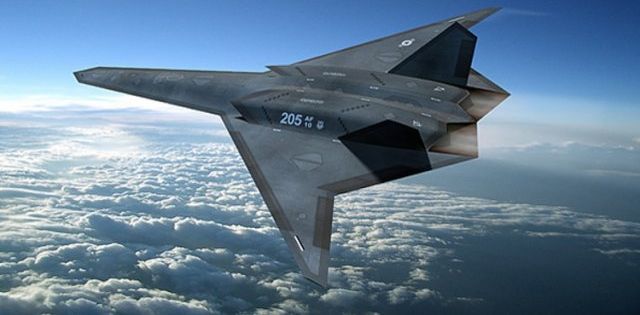
A conceptual image of the proposed Long Range Strike Bomber, or LRSB.
The next-generation bomber will be designed to fight through surface-to-air missiles, as well as electronic and information attack. It will also accommodate lasers and directed-energy systems, hypersonic missiles and other new and emerging technologies. Air Force Secretary Deborah Lee James said the new bomber will allow the service to "launch from the continental United States airstrikes that would be able to strike any location in the world." Air Force Chief of Staff Gen. Mark Welsh said, "The LRS-B will provide our nation tremendous flexibility as a dual-capable bomber and the strategic agility to respond and adapt faster than our potential adversaries."
The Air Force currently has 158 bombers, including 76 B-52 Stratofortresses, 63 B-1 Lancers and 20 B-2 Spirits, yet with the exception of the latter, many of the planes are susceptible to precision-guided weapons developed by China, Russia, Iran and North Korea. The existing bombers are also aging. Three generations of airman have flown the B-52 in combat, from Vietnam to Afghanistan, and the newest B-52 is more than a half-century old. The service has said it wants to buy between 80 and 100 new bombers at no more than $550 million apiece to replace its aging fleet of B-52 Stratofortresses made by Boeing Co. and a least a portion of its B-1 fleet.
MORE