global warming aka (climate change) is like a cult and people like Al Gore and Obama who have no training in climate, weather.. they just spew that so many scientist say this and call other people stupid names like flat earthers and deniers are the Cult leaders...Like Jim Jones
what's scary is people actually follow people like this no questions asked...
Really? So, what do the real scientists have to say, Staph? Well, here is what the American Geophysical Union has to state, and it has more climate scientists in it's membership than any other scientific organization in the world;
AGU Position Statement: Human Impacts on Climate
AGU Position Statement
Human Impacts on Climate
Adopted by Council December 2003
*Revised and Reaffirmed December 2007
The Earth's climate is now clearly out of balance and is warming. Many components of the climate systemincluding the temperatures of the atmosphere, land and ocean, the extent of sea ice and mountain glaciers, the sea level, the distribution of precipitation, and the length of seasonsare now changing at rates and in patterns that are not natural and are best explained by the increased atmospheric abundances of greenhouse gases and aerosols generated by human activity during the 20th century. Global average surface temperatures increased on average by about 0.6°C over the period 19562006. As of 2006, eleven of the previous twelve years were warmer than any others since 1850. The observed rapid retreat of Arctic sea ice is expected to continue and lead to the disappearance of summertime ice within this century. Evidence from most oceans and all continents except Antarctica shows warming attributable to human activities. Recent changes in many physical and biological systems are linked with this regional climate change. A sustained research effort, involving many AGU members and summarized in the 2007 assessments of the Intergovernmental Panel on Climate Change, continues to improve our scientific understanding of the climate.
During recent millennia of relatively stable climate, civilization became established and populations have grown rapidly. In the next 50 years, even the lower limit of impending climate changean additional global mean warming of 1°C above the last decadeis far beyond the range of climate variability experienced during the past thousand years and poses global problems in planning for and adapting to it. Warming greater than 2°C above 19th century levels is projected to be disruptive, reducing global agricultural productivity, causing widespread loss of biodiversity, andif sustained over centuriesmelting much of the Greenland ice sheet with ensuing rise in sea level of several meters. If this 2°C warming is to be avoided, then our net annual emissions of CO2 must be reduced by more than 50 percent within this century. With such projections, there are many sources of scientific uncertainty, but none are known that could make the impact of climate change inconsequential. Given the uncertainty in climate projections, there can be surprises that may cause more dramatic disruptions than anticipated from the most probable model projections.*
With climate change, as with ozone depletion, the human footprint on Earth is apparent. The cause of disruptive climate change, unlike ozone depletion, is tied to energy use and runs through modern society. Solutions will necessarily involve all aspects of society. Mitigation strategies and adaptation responses will call for collaborations across science, technology, industry, and government. Members of the AGU, as part of the scientific community, collectively have special responsibilities: to pursue research needed to understand it; to educate the public on the causes, risks, and hazards; and to communicate clearly and objectively with those who can implement policies to shape future climate.
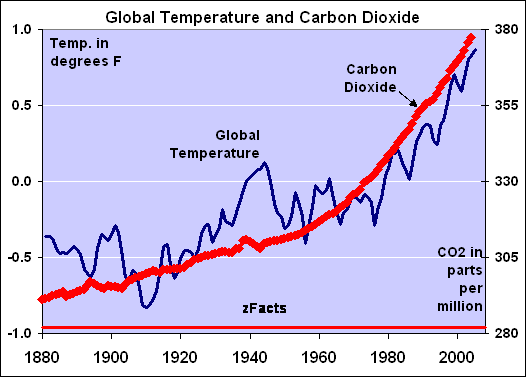
It seems that a common trait amongst denialists is to be focused on people and not on the actual climate. It matters not what Al Gore says when the reality of temp, co2, and time is
and
Those are really what has occured.
The single best predictor of people's future behavior is their past behavior. *And seeing as anthropogenic means people, it doesn't take a climatologist to get that temp and co2 are *moving in one direction, up. What someone said has no impact on that. He can be accurate and precise or completely wrong in the reporting, it changes nothing.
The temp has a 100 year history of increase, with an accelerated rate in the last half. Anything that has continued for 100 years can be expected to continue, all other things being equal.
What is really of more interest to me now is in this sentence, "
Warming greater than 2°C above 19th century levels is projected to be disruptive, reducing global agricultural productivity".
There are a few more specific issues here. *
The first is that, in general, while the global mean changes by 2C, the average temp at different latitudes changes by varying degrees. *A 1C change for half the planet and a 3C change for the other half is a 2C mean change. *And the impact is different across latitudes.
The second is that variability is expected to increase across longitudes. *And that variability amplifies the effect of the latitude differences.
The last issue is the biology in response to the climate changes. *Plants, our food crop, was discovered over thousands of years. Of all the diversity in biology, only a small fractiom serves our food basket. This food basket has been furthe developed over the course of the centuries, with large leaps occuring since the early 1900s. *The food crops are tuned to the environment, very specifically, in terms of both timing and resiliance to pests. *As the climate changes, so changes the timing of water and temperature, as well as the onset of pests.*
The best predictor of environmental changes, in the future, are the environmental chamges of the past. That predicts the future. *And that accurate prediction gets our behavior ahead of the game, in being proactive rather than reactive. *I wear a seatbelt because others have been in accidents and seatbelts predict survivability. Sure, a few people, oddly drunk, walk away from an accident unscathed, but the rare occurance isn't a predictor. *The typical occurance is the predictor. And, prudence demands that the consequence times the probability is the measure of appropriate action. *Large consequence times small probability plus modest consequence times large probability far outweighs small probability of small consequense. *We don't sit around hoping to get lucky.
Al Gore and models aside, the questions that remain for me is what have been the consequences of past climate change on more local climate and how has our food basket respond to changes in climate and disease. *
What, specifically, does the history of crop development in the 1900s tell us about crop resilience? *How well have crops responded to seasonal variability? And, are all the farmers, in the midwest, prepared to move to Canada?
None of that is dependent on the accuracy and precisionnof Al Gore, in bringing attention to the matter. *And seeing as many people need to get a traffic ticket, before they will wear a seatbelt, I'm hardly surprised if he highlighted the high consequence, low probability scenario.




 They're acting like they know something we do NOT. Like we're completely fucked if we do not. Our defense department says it is the worse thing we face...Think about that for a second...


