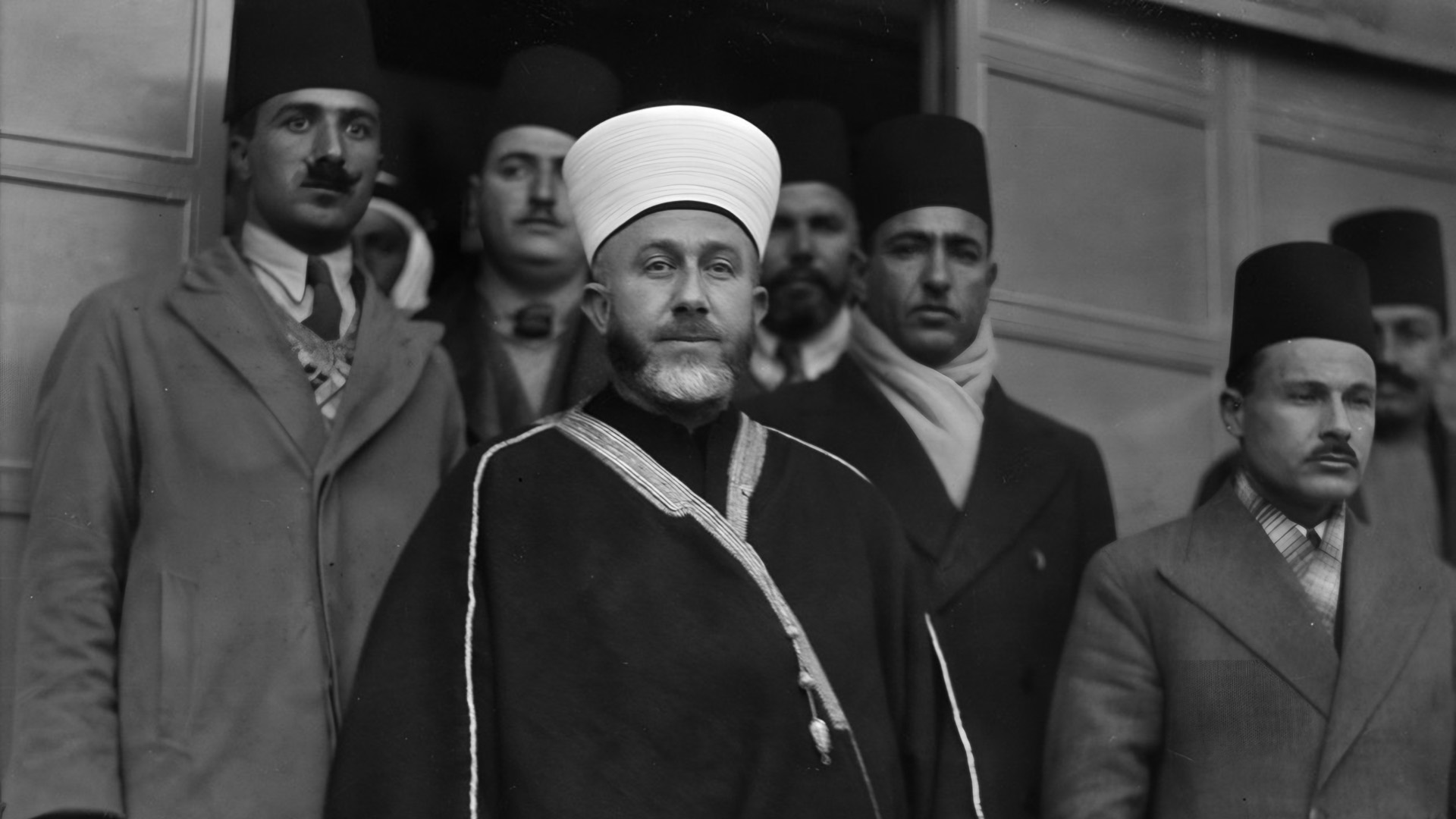
MOST ARABS, "PALESTINIANS" SUPPORTED HITLER
____
Palestine Reliving Old Story of War.
George S. Bush.
The Detroit Free Press.
The Windsor Daily Star, May 17, 1948, p. 14.
During World War II,
most Arabs played ball with Hitler. The Grand Mufti had himself a grand old time in Berlin. The Jews co-operated wholeheartedly in the war against the Axis.
____
Ben Gavriel, M., Y.: Israel, Wiedergeburt eines Staates. R. Oldenburg, Publishers, volume 4, Germany, 1957, p.61
..
In Baghdad, Rashid All's revolution was taking place; in Syria, the Vichy French were gaining ground; and in Jordan, dozens of soldiers and officers deserted daily from the British-supported Arab Legion. Nevertheless, no Jewish formations were established; instead, a
"Palestine Regiment" was founded, consisting of 33,000 Jewish and 9,000 Arab volunteers, the majority of whom soon deserted. This regiment was deployed for auxiliary services on all fronts, but the Jews did not relent in their demand for the establishment of Jewish front-line formations. It wasn't until 1944 that Churchill succeeded in breaking the bitter resistance of the British authorities in Jerusalem and Cairo to the plan. A Jewish Brigade was formed, mostly from Haganah units, which fought in various theaters of war, while units of Jewish paratroopers fought mainly in Hungary, Yugoslavia and Slovakia. (Half of them, including some girls, were captured and killed by the Germans.)
In Palestine, Haganah members were formed into a kind of gendarmerie to protect Jewish Settlements were also trained for guerrilla warfare in the event of a retreat of the English troops - while other groups under the command of the later General Wingate of of Burma were assembled into the soon-to-be-famous "Night Commandos." These later developed into the Palmach, the elite unit of the Haganah and later of the regular army...
_____
The American Mercury. Vol. 77. (1953). United States: American Mercury, p.14
They saw in Stalin another Hitler coming to save them from the dangers of Zionism.
When Hitler persecuted the Jews ,
Arabs rejoiced. They adorned their houses and ships with Hitler's pictures and the Swastika flag.
____
Kurzman, D. (1970). Genesis 1948; the First Arab-Israeli War. United States: World Publishing Company, p.37.
Like
most Arabs , Bahjat had deeply sympathized with the Nazis during World War II
____
Eidelberg, P. (1994). Demophrenia. Colombia: Prescott Press, p.43
...
Arabs supported Hitler. The Zionists formed the Jewish Brigade which fought alongside Britain and the United States...
____
Evan, G. (2000). Winds of life : the destinies of a young Viennese Jew, 1938-1958. United States: Ariadne Press, p.211.
My expenence was still too vivid in my mind, and I could not ignore what was going on or what might happen in our immediate future.
To me the danger the Germans presented was real. It seemed clear enough, and not much imagination was needed to guess what would transpire if the Germans overran Egypt and reached Palestine.
The Arabs of Egypt and
most Arabs in Palestine waited to receive the Germans with open arms. Haj Amin el Husseini, the ex-Mufti of Jerusalem , was in Berlin and was a good friend of Hitler. He organized the Mosiems of Bosnia to fight on the German side and his anti-Western propagandizing was well known. Arabs would have worked hand in hand with Hitler's death squads to kill Jews just as the Croats, the Ukrainians, people of the Baltic states, and others did, some even surpassing their masters' cruelties.
For me the time had come to join the British army. Never again , I promised myself, were the Nazis going to get me without a rifle in my hand. I would not go into hell as sheepishly as before. I did not feel like a hero, and I felt both happiness and fear. Only recently I had turned 19, and it seemed exciting to become a British soldier. On the other hand, there was that fear of war's consequences. Perhaps it was not so much the dying I was afraid of, but the possibility of becoming an invalid. I remembered men I had seen in Vienna who had lost both legs in World War I. They sat on little wooden platforms with small ball ...
____
Bloom, J. B. (2005). Out of Step: Life-story of a Politician : Politics and Religion in a World at War. South Africa: Jack Bloom, p.111
The Arab-Nazi link is well established, extending well beyond the Mufti of Jerusalem and Adolf Hitler.
Most Arabs aligned themselves with the Nazis , who inspired political movements such as the Ba'ath parties of Syria and Iraq..
____
Karpin, M. (2007). The Bomb in the Basement: How Israel Went Nuclear and What That Means for the World. United Kingdom: Simon & Schuster, pp. 19-20.
As Iran continues to develop its nuclear program and explicitly denounces Israel, Michael Karpin's The Bomb in the Basement provides important context for the ongoing tensions in the Middle East. After Israel won its war of independence in 1948, founding prime minister David Ben-Gurion realized...
books.google.com
...Ben-Gurion with a deep anxiety, which remained with him throughout his life. In December 1936, at a meeting with his close friends in Jerusalem, he said: "The danger we face is not rioting, but extermination. The attackers will not be only the Arabs of Palestine, but also the Iraqis and Saudi Arabians, and they have warplanes and artillery. We have to prepare seriously to constitute a substantial force in this country, capable of standing up to a massive offensive." His friends looked at him as if he had lost his mind. Others attributed his prophesy of doom to a transient mood. But Ben-Gurion meant what he said, and indeed, his forecast was fulfilled almost entirely twelve years later, immediately after he declared the independence of the State of Israel. And this fear of extermination lasted even after the victory in the War of Independence and led Ben-Gurion to his decision to develop the Israeli nudear option.
AT THE BEGINNING of World War II, the Zionist leadership had no doubt that the British government headed by Winston Churchill, Zionism's greatest friend in Britain, would give the Jews their national home in Palestine. The Jews were allies. There were thousands of Jews in the British forces. The
Palestinian Arabs supported Hitler, and the Mufti of Jerusalem, al-Husayni, had been received as an ally in Nazi Berlin.
In 1943, a committee of British cabinet ministers recommended the partition of Palestine between the Jews and the Arabs. Churchill called their report "a very nice piece of work." Zionist leaders were quite confident that immediately after the war, Churchill would force his opinions on the cabinet and Parliament, and the way to Jewish independence would be clear.
____
Spector, I. (2009). Loud and Clear: The Memoir of an Israeli Fighter Pilot. United States: Voyageur Press, p.153.
A recently retired Israeli Air Force general and its second-highest-scoring fighter ace, Iftach Spector is one of Israel’s living legends. He was the leader of the flight that attacked the USS Liberty in 1967. After the 1967 and 1973 wars, in which he commanded a squadron of fighter-bombers, he...
books.google.com
10.
Toledano.
The Twenty-three of the Boat. Spring 1941, Nazi forces built up in the West African desert. A Vichy French regime was established in Syria and Lebanon.
Most Arabs leaned to Hitler and Mussolini. A German takeover of the Middle East meant Jewish annihilation, and the end of any hope of a revival of the nation. The British needed troops for special operations. Twenty-three commandos were sent to demolish oil refineries at Tripoli, Lebanon, a vital source offuelfor Vichy and the Luftwaffe there. On May 18, 1941, the boat Sea Lion, under the command of Zvi Spector, went to sea. The boat never arrived. The crew vanished without a trace. Their fate remains unknown.
____
Ziedenberg, G., history, G. Z. M. (2011). Blockade: The Story of Jewish Immigration to Palestine. United States: AuthorHouse, p. 164
Blockade is the heroic story of Jewish immigration to British Mandate Palestine from 1933 to 1948.It is a saga of blockades, shipwrecks, rescues, exiles, and imprisonment. The many ships and boats that participated in this struggle are detailed from the tiny sailboats to the ill fated Struma to...
books.google.com
British foreign policy regarding Jewish immigration to Palestine was focused on appeasing the Arabs and safeguarding their strategic interests. As Rommel and his Panzer units approached Egypt and then perhaps Palestine, the Yishuv reacted. Tens of thousands of Jews volunteered to fight with the British to defend British Palestine. In contrast scant numbers of Arabs volunteered, most of who soon deserted after receiving monetary allowances.
Palestinian Arab contributions to the British war effort were the bare minimum. Indeed, Husseini, the Grand Mufti of Jerusalem, spent most of the war years in Hitler's company in Berlin.
Most Arabs in the area strongly supported the German cause, including such future luminaries as Anwar Sadat. As far as strategic concerns, most British officials, excepting a few like Churchill, could never grasp the fact that the Jews could form a state and defend themselves. A more forward looking British administration might have realised that the future Jewish state that they could not conceive of would eventually be a strategic asset to defend British and Western interests.
___
Partners Together in This Great Enterprise. (2011). (n.p.): Xulon Press, p.408.
When the war begin,
most Arabs backed Germany. Throughout the war, the Mufti was a friend and guest of Hitler.
___
Countering Challenges To Israel's Legitimacy.
By A. M. Dershowitz. Jerusalem Center for Security and Foreign Affairs. Sep. 2011.
— in 1947 the United Nations attempted to solve the problem once and for all by proposing a final partition of Palestine. The Palestinians were offered nearly the same deal they had rejected in 1937 (with the exception of the barren Negev). This was despite
the fact of Palestinian and widespread Arab support for the Nazis and despite Winston Churchill’s warning that Nazi support meant the Arabs were “owed…nothing in a postwar settlement.”
____
Grand Mufti al-Husseini: Britain’s Deadliest Enemy?
Prime Minister Winston Churchill labeled Haj Amin al-Husseini, the Grand Mufti of Jerusalem, as such.
This article appears in: July 2012.
By Blaine Taylor.
Prime Minister Winston Churchill labeled Haj Amin al-Husseini, the Grand Mufti of Jerusalem, as such.

warfarehistorynetwork.com
Like
all Palestinians and most Arabs, Haj Amin al-Hussaini not only looked forward to an Axis Pact victory in World War II but also saw it as a means of defeating what he believed was a joint British-Jewish conspiracy to foist an Israelite homeland on the Middle East that would be to the detriment of his own people.
____
Exposing the myth of the Arab bystander to the Holocaust.
The myth that the Arabs were innocent bystanders to the Nazi Holocaust is unfortunately widely accepted at face value.
By Shimon Ohayon, The Jerusalem Post , January 26, 2014.
The myth that the Arabs were innocent bystanders to the Nazi Holocaust is unfortunately widely accepted at face value

www.jpost.com
The
Arab masses and leadership gleefully welcomed the Nazis taking power in 1933 and messages of support came from all over the Arab world, especially from the Palestinian Arab leader, Mufti Haj Amin al-Husseini, who was the first non-European to request admission to the Nazi party.
____
Steininger, R. (2018). Germany and the Middle East: From Kaiser Wilhelm II to Angela Merkel. Germany: Berghahn Books, p.47.
For over a century, the Middle East has weathered seemingly endless conflicts, ensnaring political players from around the world. And perhaps no nation has displayed a greater range of policies toward, and experiences in, the region than Germany, as this short and accessible volume demonstrates...
books.google.com
For over a century, the Middle East has weathered seemingly endless conflicts, ensnaring political players from around t...

dokumen.pub
Most Arabs admired Hitler as the Führer of Greater Germany and applauded his anti – Jewish policy…
_____
Lockdown University. Transcript.
Lyn Julius. Germans and Nazis in the Middle East. Jul 11, 2024.
Lockdown University is a webinar series and online community providing free access to dynamic educational content.

www.lockdownuniversity.org
...And
most Arabs across the Middle East and even in North Africa wanted the Nazis to win the war. Throughout the Middle East, public opinion was mostly pro-German....


 they won the 2010 election in Ukraine under Yanukovych that's why NATO and the EU staged a coup, then we had GLADIO that NATO terror group riddled with Nazis who even waged a terror war on their own people in Europe to create tension and establish ever more draconian laws.