My God we are more doomed than ever

Ice increases because its getting colder not warmer. Natural changes in the climate are slow. IN their minds everything causes the climate and we have to give them control of our lives. They can shove it
Lordy, lordy, when does the dumb fuckery stop? LOL You fools are such a hoot with your climate nonsense. All you ever do is post lies with zero proof.

1757358434102.webp
 
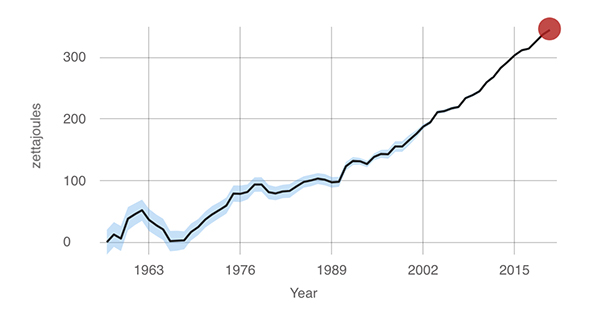
The ocean temperature is stable
Ah well, some idiots just cannot refrain from posting lies with zero backing. At least EMH finds other liars to refer to.

Ocean Warming​

LATEST MEASUREMENT:
December 2024
372 (± 2) zettajoules
since 1955

 
But it will again as it always has. If it didn't it would eventually take over the southern hemisphere. The point is, that when is DOES melt, the climate religionists will claim its due to AGW. They're probably saying it's our fault that the ice is again building up. :)

They'll never acknowledge that our planet has gone through many climate changes and climate shifts in his long history and will surely continue to do just that without any help from humankind whatsoever.

The Anazazi disappeared from our area more than five hundred years before the Industrial Revolution. I suppose it was all those ceremonial and cooking fires they lit that caused excessive CO2 that caused the extreme drought conditions, etc. that made them leave their ancestral homes?

The AGW people won't even talk about things like that. They can't even blame the cows as those didn't arrive in North America for more than a hundred years after the Anazazi left.
LOL There are some years when the ice add mass, but the vast majority of years, it is losing mass in Antarctica;

The Antarctic Ice Sheet has experienced significant changes in ice mass over the last 50 years, with a notable increase in mass gain detected between 2021 and 2023. This period saw the Antarctic Ice Sheet grow for the first time in its history, reversing trends in critical glacier basins like Totten, Moscow, Denman, and Vincennes Bay. The mass gain was driven by anomalous precipitation, which has been a rare occurrence in the region.

NASA


The Antarctic Ice Sheet plays a major role in global sea-level rise, contributing to the increase in sea level by about 0.4 millimeters per year. This increase is attributed to the melting of the ice sheet, which has been losing mass at an average rate of about 136 billion tons per year. The loss of ice mass is primarily due to the warming of Earth's surface and ocean, which affects the ice sheets' stability and mass.


SciTechDaily


The data from NASA's GRACE and GRACE-FO satellites has been crucial in monitoring these changes, providing insights into the ice sheet's response to climate change and its implications for global sea-level rise.


NASA+3


NASA
NASA SVS | Antarctic Ice Mass Loss 2002-2023


SciTechDaily
Antarctica’s Astonishing Rebound: Ice Sheet Grows for the First Time in ...


View all


NASA
NASA SVS | Antarctic Ice Mass Loss 2002-2023
The mass of the Antarctic ice sheet has changed over the last decades. Research based on observations from the Gravity Recovery and Climate Experiment (GRACE) satellites (2002-2017…
https://svs.gsfc.nasa.gov
 
LOL There are some years when the ice add mass, but the vast majority of years, it is losing mass in Antarctica;

The Antarctic Ice Sheet has experienced significant changes in ice mass over the last 50 years, with a notable increase in mass gain detected between 2021 and 2023. This period saw the Antarctic Ice Sheet grow for the first time in its history, reversing trends in critical glacier basins like Totten, Moscow, Denman, and Vincennes Bay. The mass gain was driven by anomalous precipitation, which has been a rare occurrence in the region.
NASA
The Antarctic Ice Sheet plays a major role in global sea-level rise, contributing to the increase in sea level by about 0.4 millimeters per year. This increase is attributed to the melting of the ice sheet, which has been losing mass at an average rate of about 136 billion tons per year. The loss of ice mass is primarily due to the warming of Earth's surface and ocean, which affects the ice sheets' stability and mass.
SciTechDaily
The data from NASA's GRACE and GRACE-FO satellites has been crucial in monitoring these changes, providing insights into the ice sheet's response to climate change and its implications for global sea-level rise.
NASA+3

NASA
NASA SVS | Antarctic Ice Mass Loss 2002-2023

SciTechDaily
Antarctica’s Astonishing Rebound: Ice Sheet Grows for the First Time in ...


View all


NASA
NASA SVS | Antarctic Ice Mass Loss 2002-2023
The mass of the Antarctic ice sheet has changed over the last decades. Research based on observations from the Gravity Recovery and Climate Experiment (GRACE) satellites (2002-2017…
https://svs.gsfc.nasa.gov
If that was true the ice would be gone. The Earth has been here for a lot of years. Yes, in recent years there has been more ice melt than ice growth on average. But we have been measuring that sort of thing for a very short time in the grand scheme of things.

None of the AGW so-called scientific models have produced accurate information yet. Smart people observe that they just keep moving the goal posts as prediction after prediction fails.

I don't think we need to worry that Antarctica is going to thaw out any time soon.
 
LOL There are some years when the ice add mass, but the vast majority of years, it is losing mass in Antarctica;

The Antarctic Ice Sheet has experienced significant changes in ice mass over the last 50 years, with a notable increase in mass gain detected between 2021 and 2023. This period saw the Antarctic Ice Sheet grow for the first time in its history, reversing trends in critical glacier basins like Totten, Moscow, Denman, and Vincennes Bay. The mass gain was driven by anomalous precipitation, which has been a rare occurrence in the region.
NASA
The Antarctic Ice Sheet plays a major role in global sea-level rise, contributing to the increase in sea level by about 0.4 millimeters per year. This increase is attributed to the melting of the ice sheet, which has been losing mass at an average rate of about 136 billion tons per year. The loss of ice mass is primarily due to the warming of Earth's surface and ocean, which affects the ice sheets' stability and mass.
SciTechDaily
The data from NASA's GRACE and GRACE-FO satellites has been crucial in monitoring these changes, providing insights into the ice sheet's response to climate change and its implications for global sea-level rise.
NASA+3

NASA
NASA SVS | Antarctic Ice Mass Loss 2002-2023

SciTechDaily
Antarctica’s Astonishing Rebound: Ice Sheet Grows for the First Time in ...


View all


NASA
NASA SVS | Antarctic Ice Mass Loss 2002-2023
The mass of the Antarctic ice sheet has changed over the last decades. Research based on observations from the Gravity Recovery and Climate Experiment (GRACE) satellites (2002-2017…
https://svs.gsfc.nasa.gov

Are you just copy/pasting AI answers? ... HAW HAW HAW HAW HAW HAW HAW HAW HAW ... and you call others stupid ...

Man that's lame ...
 
The warmers will never answer the following question:

at what water temperature does coral "bleach?"

Start the Jeopardy! music
 
Good God, the Withrow moraine is a lot farther south of the Arctic Circle than 200 miles.


"Two million years ago the Pleistocene epoch began and Ice age glaciers invaded the area. They scoured the Columbia River Plateau, reaching as far south as the middle of the Waterville Plateau highlands above the Grand Coulee and south to the head of Moses Coulee. In some areas north of the Grand Coulee they were as much as 3 km (10000 feet) thick."


2 million years ago, North America was 40-100 miles further north than today... and North American Ice Age still had 4-5 million cubic miles of ice...
 
Back
Top Bottom