"Given the widely noted increase in the warming effects of rising greenhouse gas concentrations, it has been unclear why global surface temperatures did not rise between 1998 and 2008. We find that this hiatus in warming coincides with a period of little increase in the sum of anthropogenic and natural forcings. Declining solar insolation as part of a normal eleven-year cycle, and a cyclical change from an El Nino to a La Nina dominate our measure of anthropogenic effects because rapid growth in short-lived sulfur emissions partially offsets rising greenhouse gas concentrations. As such, we find that recent global temperature records are consistent with the existing understanding of the relationship among global surface temperature, internal variability, and radiative forcing, which includes anthropogenic factors with well known warming and cooling effects."
"Mainstream climate scientists have traditionally answered the "no warming since 1998" claim in two ways. One is by pointing out that 1998 saw the strongest El Nino conditions on record, which transfer heat from the oceans to the atmosphere, warming the planet. So while you may not see a temperature rise if you start the series in 1998, you do see one if you begin with 1997 or 1999.
The second answer is to point out that temperatures will naturally vary from year to year, and to point to the consistent upward trend seen when long-term average temperatures are used rather than annual figures."
"Results indicate that net anthropogenic forcing rises slower than previous decades because the cooling effects of sulfur emissions grow in tandem with the warming effects greenhouse gas concentrations. This slow-down, along with declining solar insolation and a change from El Nino to La Nina conditions, enables the model to simulate the lack of warming after 1998"
This paper confirms all I've said the past 4-5 years.
.
"This work suggests that rising sulfur emissions have been offsetting the impact of rising greenhouse gases. Sulfur dioxide is an aerosol which cools the planet by reflecting some of the sun's energy back into space."
Between the sulfur emissions and "grand minimum" we're having from the sun=negative forcing pushing against the positive. You need a strong positive to warm the earth.
"The effect also explains the lack of global temperature rise seen between 1940 and 1970: the effect of the sulfur emissions from increased coal burning outpaced that of carbon emissions, until acid rain controls were introduced, after which temperature rose quickly."
I think if we can get china and India to put sulfur controls on there coal plants and the sun back to the avg of 1950-2000---that 2020 or maybe 2030 could raise as much as .3c/decade.
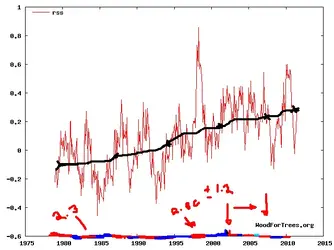
In my opinion looking at the data from RSS, Uah, Noaa, GISS the avg baseline has rised by about .12 to .15c since 1998. Take away the noise of the enso and you will see this clearly. You don't count 1998 as you don't count 2008 as they're clearly two major natural short term swings.
This paper makes a lot of logical science that the ipcc doesn't went to touch with there one way of thinking. I believe there has been a raise as 2002-2007 was very stable within the enso between -1 to +1 no big swings. Neutral as hell. If anything a warm neutral overall. 1999-2001 and 2008-2009 have been strong nina's. 1991-1993 a big volcano went off.
In my opinion---2002-2007 will one day to be seen as a period of built up heat in the middle of two giant nina events. It is the baseline that is what we must watch. The black line is that.
If the sun puts out(a nice round number) 200 and the changes within the natural balancing of all the other natural patterns is 15 as I said for x...Then 5 is the surplus as our z.
Wirebender what is z? Anyone know z? Of course you could put a t or any other kind of variable to call for the negative forcing the developing world is putting out.
So constant 200,
200+15+5+t=223
So x=15
z=5
T=?
t=223-220
t=3
3 negative forcing between the solar minimum and sulfur lowers the surplus of positive from 5 to now 2.
Of course these are numbers out of my ass just to get the point, but below are some real ones.
Looking at my graph the number of forcing from green house gases must have raised alot to make it keep warming since 2002? I say this because from 1997-2002 the forcing for co2 was .24 watts/meter^2, but as I said in another post surfur would have to be as I found it as .11watts/meter^2 and the grand minimum has done .18watts/meter^2, which my friends is up to 2007. That is -.29 watts/meter^2 against .24watts/meter^2 for co2 and green house forcing. They found a net balance of .13 watts/meter^2 as of 2007. You can bet your ass that co2 forcing has went up big time. In the baseline going up at the rate it is going---I'd say it is around .4 watts/meter^2, which is a wild ass guess, but hey some time science works like this as I said in my other post.
So lets say y is .13 watts/meter^2 for net balance as of 2007.
Z=-.29
T=?
-.29+t=.13
t=.13+.29
t=.42 watts/meter^2
So for the co2 and green house forcing to balance the equation to give us .13watts/meter^2 it would need to be .42 watts/meter^2 NOW or of course higher.
Into my reasoning as this is part of it.
http://www.usmessageboard.com/3837044-post5.html
Numbers and data come from this paper.
http://www.usmessageboard.com/envir...ing-countrys-are-stopping-global-warming.html
Of course .42 is right around what you would need to off set the negatives. If things stayed the same with the co2 and green house forcing---we would have a negative=cooling world of -.05 watts/meter^2 in the overall energy balance with this high of a negative combined up to 2007 of -.29 or (-.11+(-18))