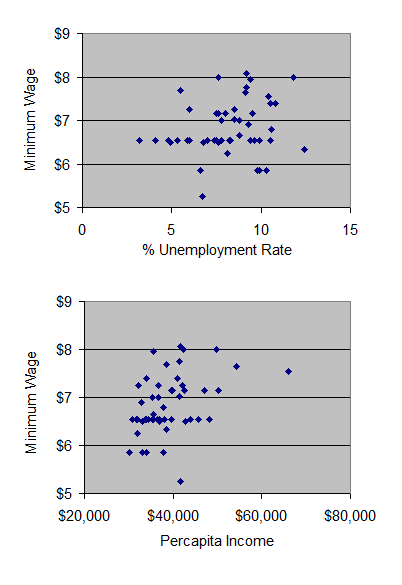
Shackled Nation, I’m unconcerned with the affects of US major cities’ destructions affecting the stock markets I’m unconcerned because in such a case the stock markets will (correctly be) a lesser concern to our nation.
The only logical reason to radically modify the federal minimum rate would be due to a radical change of the U.S. dollar’s purchasing power. I’m unconcerned with a radical modification of the U.S. dollar’s purchasing power’s affect upon the minimum wage rate. In such a case our minimum wage rate will (correctly be) a lesser concern to our nation.
Other than refusing to further discuss both of these scenarios and I never made any comparisons between them.
did give you a reason why radically more is detrimental when I wrote,
“We do not want a (minimum rate) modification that brings the updated minimum rate within too close a proximity of the median rate and/or would radically modify the median rate.
We want to grant consideration to the lowest income earners while leaving sufficient differentiation between the minimum and the median rates so as to encourage a competitive labor market among all types of tasks”.
You’re incorrectly arguing more of anything beneficial is always necessarily more beneficial; that ain’t necessarily so.
Respectfully Supposn
For the final time, I am talking about raising minimum wage when there is no change in the cost of living. That is why I keep repeating the common economic term real wage. Why would the only logical reason to alter minimum wage to a higher amount be if the dollar's purchasing power decreased? Who is to say the current relation of the wage to purchasing power is correct? How is it that you know $100 an hour in our current economy is not the correct rate?
No, I am not arguing that high minimum wage is good, I am arguing a higher minimum wage will be even worse, consistent with my position that any minimum wage is harmful. Your explanation was bogus, to put it flatly. What is sufficient differentiation between the minimum and the median rates? How does having such a differential make the labor market more competitive? Now are arguing that having a smaller differences in prices will increase competition. That is the exactly opposite of how the market works. Prices that are closer to being the same are not more competitive, they are less competitive. You also admit certain jobs will not exist because of minimum wage. How is that increasing competition? It prevents unskilled workers from being competitive by offering lower wages to employers. That is the one key competitive quality they have, and they are prevented from using it.
I want to know specific affects of what you think would happen if the rate were higher in real terms, not nominal terms. Here is my proposition. There would be lower productivity and high unemployment. Because employers do not have infinite supplies of money to pay workers, they would have to hire less workers. They would only hire the most skilled workers. Unskilled workers and even semiskilled workers would find no work. Productivity would decline because there are idle resources made idle because of government intervention. Without minimum wage, they would not be idle. The type of unemployment it would create, then, is an unfavorable unemployment.
That is my analysis of what would happen. Do you agree? If not, provide your analysis. Your previous answer did not answer the question well at all. Again you made blanket statements with no reasoning behind them. You did not say what would happen, you simply said we had to maintain the correct "differential" between wage rates (which is a completely unsupported claim that makes no logical sense). The fact you have such difficulty with this question is quite amusing. It reveals for all to see the absurdity of the minimum wage.
Finally, you keep bringing up that median wages will be reduced if there are more lower paid jobs because no minimum wage exists. But you fail to exist there will be more jobs, thus an increase in purchasing power. You cannot get your head out of the insane idea of looking only at aggregates. Here is an example to demonstrate why median wage means absolutely nothing in this conversation.
You have two economies. In one economy, there are 1 million people working. The economy is at virtually full employment. Everyone in the economy is paid $10 an hour. Thus, the median wage is $10 an hour. In the second economy, there are only 100 people working. There is a 50% unemployment rate. Each person makes $15 an hour. In this economy, the median wage is $15 an hour. According to your analysis, the second economy would be more favorable because it has a higher median wage. But looking soley at the aggregate ignores 1)how many people are actually working 2) the quality of work, and 3) how many people are prevented from or not working.
It is an utterly useless statistic. Let us look at a more complex example. In an economy there are 3 jobs that pay $8 an hour (the minimum wage) 5 jobs that pay $10 an hour, and 5 jobs that pay $20 an hour. The median wage in this case is $10 an hour. The average wage is $13.38 an hour. In this economy there is 10% unemployment. Now say that minimum wage is abolished, and 8 new jobs are added. these jobs only pay $5 an hour, below the previous minimum wage. The median wage in this case is now $8 an hour. The average wage rate is $10.19. But the economy is not worse off. Now unemployment is only 3%. More people are employed. Your analysis of wage rates would only matter if the number of jobs remained the same. The number of jobs will not remain the same, but
increase. Wages do not rise and fall together. They are individual prices for the services of individual people. The fact that the median rate is lowered does not mean that all wages will fall. It only means that lower paying jobs now exist, and there is nothing wrong with that.