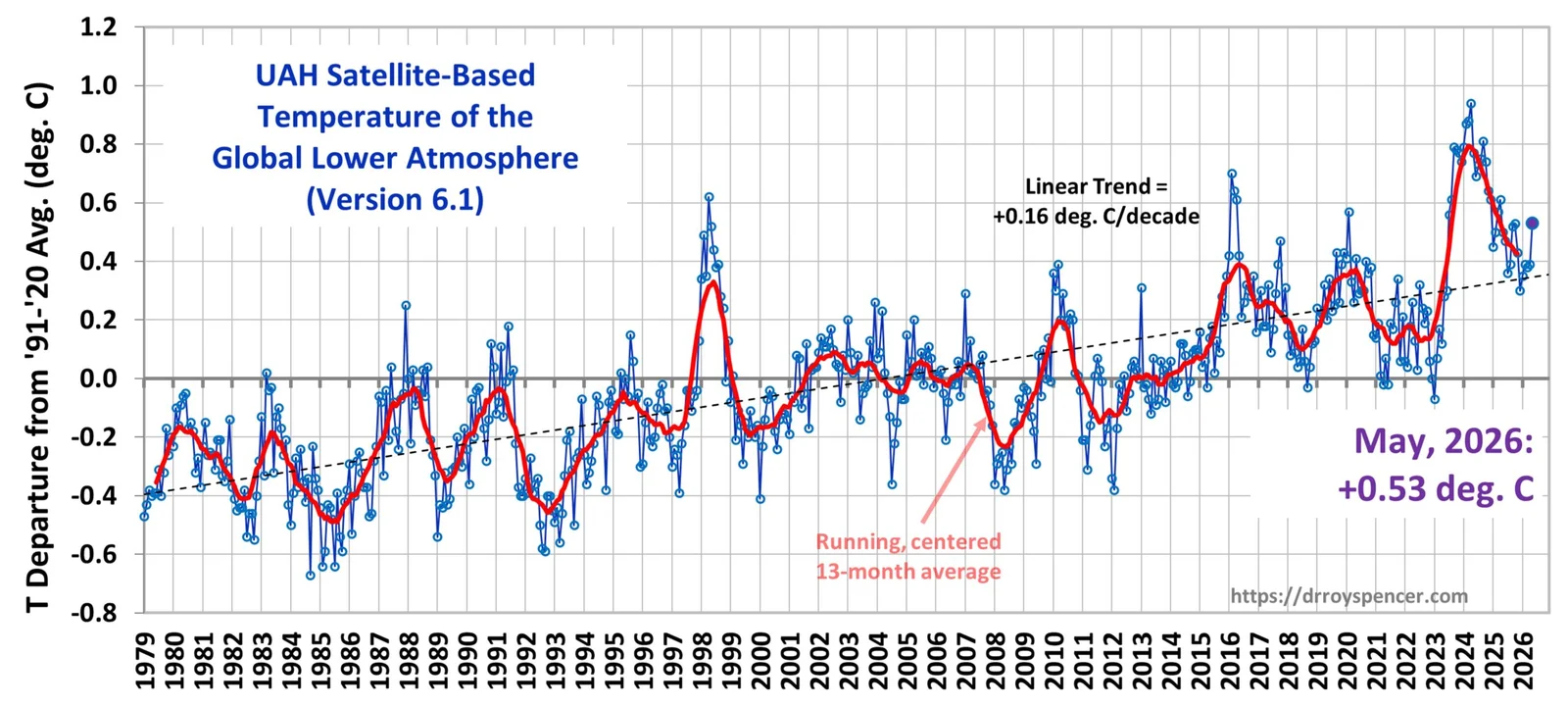
May, 2026 temperature

Old Rocks

Diamond Member
Joined
Oct 31, 2008
Messages
66,057
Reaction score
11,743
Points
2,040
Location
Portland, Ore.
Looks like this years warmup has started. We are still in ENSO neutral, so this looks like an indicator of things to come;

1780448744373.webp
 
Linear trend right in line with previous warming trends back to the mid 1800's.

:rolleyes:
Yes, back to when the industrial revolution started putting GHG's into the atmosphere. However, you are posting a fabrication when you say that the rate of increase has stayed the same.

"Over the last decade, the annual rate of warming jumped from 0.18°C to 0.3°C per decade, doubling expectations from earlier models. Declines in reflective aerosols and marine sulfur emissions have revealed the full force of greenhouse gases, while permafrost thaw and ice melt feedback intensify the pace of global warming trends. These accelerating changes signal urgent challenges for communities, policymakers, and natural systems worldwide."

 
Meh, it's been below average here for a spell. Supposed to warm-up over the weekend.

I'm sure we will "survive" the WEATHER the same as we always do.
Same here. Actually a little cooler than post Memorial Day temps of past years. Only 83 right now. And it was 53 this morning at 7am. Next week we're looking at highs in the high 70's. Hardly a heat wave for June.
 
Yes, back to when the industrial revolution started putting GHG's into the atmosphere. However, you are posting a fabrication when you say that the rate of increase has stayed the same.

"Over the last decade, the annual rate of warming jumped from 0.18°C to 0.3°C per decade, doubling expectations from earlier models. Declines in reflective aerosols and marine sulfur emissions have revealed the full force of greenhouse gases, while permafrost thaw and ice melt feedback intensify the pace of global warming trends. These accelerating changes signal urgent challenges for communities, policymakers, and natural systems worldwide."


LOL you are using just a 10-year baseline, it has been similar in other warming trends too but they cool back down in them.

Where is it changing from polar to temperate, or from continential to temperate.

We have been over this many times there is very little change going on.

Once again posting this,

Köppen climate classification​


The Köppen climate classification divides Earth's climates into five main climate groups, with each group being divided based on patterns of seasonal precipitation and temperature. The five main groups are A (tropical), B (arid), C (temperate), D (continental), and E (polar).

LINK

As usual you also forgot this BBC interview where DR. Jones showed very similar warming trends of the past.

LINK
 
LOL you are using just a 10-year baseline, it has been similar in other warming trends too but they cool back down in them.

Where is it changing from polar to temperate, or from continential to temperate.

We have been over this many times there is very little change going on.

Once again posting this,

Köppen climate classification​


The Köppen climate classification divides Earth's climates into five main climate groups, with each group being divided based on patterns of seasonal precipitation and temperature. The five main groups are A (tropical), B (arid), C (temperate), D (continental), and E (polar).

LINK

As usual you also forgot this BBC interview where DR. Jones showed very similar warming trends of the past.

LINK
The Midwest Region
The Midwest Region is particularly affected by the increasing temperatures, leading to a shift in crop production. The Midwest has experienced rising temperatures across all seasons, growing seasons becoming longer, and increased frequency and severity of extreme precipitation events. These changes have resulted in a variety of responses among different crops, with some adapting better than others. The USDA's Midwest Climate Hub aims to work with various commodities to determine the impacts of different climate conditions on production.

USDA


USDA
Agriculture in a Changing Climate | USDA Climate Hubs


iere.org
How Climate Conditions Limit Agriculture in America?
 
15th post


March is 2+ moths ago. It has been colder and below normal recently. EMH documented the record highs (and lows) in the Nashville thread.

That's weather. The record high/low stuff for Nashville is recorded near the airport and likely has a +5F Urban Heat Island Effect on it, meaning if you subtracted out the Urban Heat Island Effect this year, there would have been more record lows than highs.
 
LOL, yet the climate of the great plains is still the same.
No, it is not;
The Midwest has experienced a warming trend
The Midwest has experienced a warming trend over the last century, with average temperatures increasing by 2.3°F (1.3°C) since 1951. This increase is part of a broader trend across the U.S., with projections indicating further increases in temperature by 2050 and 2100. The warming has been particularly pronounced in the Great Lakes region, where average temperatures have risen by 2.3°F (1.3°C) across the 8 U.S. Great Lakes states. The Midwest's unique climate change experience includes cooler summer highs despite warmer nights and winters, highlighting the region's distinct climate dynamics.

Purdue University+1


Purdue University
MRCC - News: Annual Summary (All)


National Oceanic and Atmospheric Administration
Climate Data Online (CDO) - The National Climatic Data Center's (NCDC ...


Climate.gov
State Temperature Trends | U.S. Climate Resilience Toolkit

W
hile the warming has not moved that area from mid-continent to temperate, it has affected what you can get a good return on when farming;


Has​

The warming in the Midwest has significantly impacted the crops planted in the region. Extreme heat events have been a major concern, leading to reduced crop yields and quality. Farmers are increasingly turning to technology and data-driven solutions to help manage these challenges. Despite advancements, achieving resilience remains a significant challenge, as the region faces the dual threat of intense heat waves and frequent droughts. These climate changes are projected to have substantial impacts on the $76 billion agricultural sector in the Midwest, affecting both the productivity and financial health of the region's farms.

Farm Progress+1


Farm Progress
Varied weather conditions lead to show crop challenges


USDA
Assessing the Impacts of Climate Change on Midwest Agriculture


rootrivercurrent.org
A Warming Climate is Changing Growing Conditions
 
March is 2+ moths ago. It has been colder and below normal recently. EMH documented the record highs (and lows) in the Nashville thread.

That's weather. The record high/low stuff for Nashville is recorded near the airport and likely has a +5F Urban Heat Island Effect on it, meaning if you subtracted out the Urban Heat Island Effect this year, there would have been more record lows than highs.
Deny, deny, deny. LOL
 
Back
Top Bottom