prior to the ice age well are you saying now that prior to the ice age CO2 in the atmosphere was really high and admitting that high levels of CO2 is a problem.
The ice age began with CO2 concentrations around 1000ppm. If CO2 causes warming, exactly how do you think that happened?
Well assuming your numbers are correct its clear that the levels went down at some point in history
Of course they did...Ice core studies show us that CO2 follows temperature changes around like a lost puppy...when it began cooling off as the earth dropped into an ice age, the oceans began to cool and cold water holds more CO2 than warm water. So naturally, CO2 levels began to fall, and the colder it got, the more CO2 was dissolved into the oceans...When the earth started warming, the oceans started warming and outgassing that CO2 that they had been storing when it was cold.
The increase in CO2 is due to natural events. I can provide plenty of peer reviewed, published science that says that our contribution to atmospheric CO2 is not even enough to over come the natural variation from year to year in the earth's own CO2 making machinery....while you can't provide any that says that we are to blame for rising CO2. The best you can provide is alarmist opinion that we are the cause...science says otherwise.
The issue now is man raising CO2 levels and what are the consequences
Like I said, you can't provide any published, peer reviewed science that says that we are the cause of the rising atmospheric CO2...and you certainly can't provide any empirical evidence that the rising CO2 is altering the global climate...
Here are seven peer reviewed, published studies which show very clearly that our effect on the total atmospheric CO2 is largely unmeasurable.. human beings, with all our CO2 producing capacity don't even make enough CO2 to overcome the year to year variation in the earth's own CO2 making machinery...
The fact is that the amount of CO2 we produce from year to year does not track with the amount of increase in atmospheric CO2.
https://www.researchgate.net/public...SPHERIC_CO2_TO_ANTHROPOGENIC_EMISSIONS_A_NOTE
CLIP: “
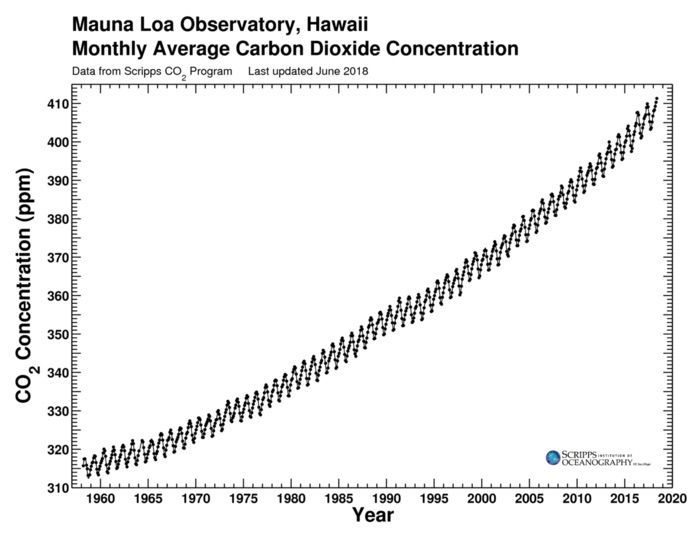
A necessary condition for the theory of anthropogenic global warming is that there should be a close correlation between annual fluctuations of atmospheric CO2 and the annual rate of anthropogenic CO2 emissions. Data on atmospheric CO2 and anthropogenic emissions provided by the Mauna Loa measuring station and the CDIAC in the period
1959-2011 were studied using detrended correlation analysis to determine whether, net of their common long term upward trends, the rate of change in atmospheric CO2 is responsive to the rate of anthropogenic emissions in a shorter time scale from year to year. … [
R]esults do not indicate a measurable year to year effect of annual anthropogenic emissions on the annual rate of CO2 accumulation in the atmosphere.”
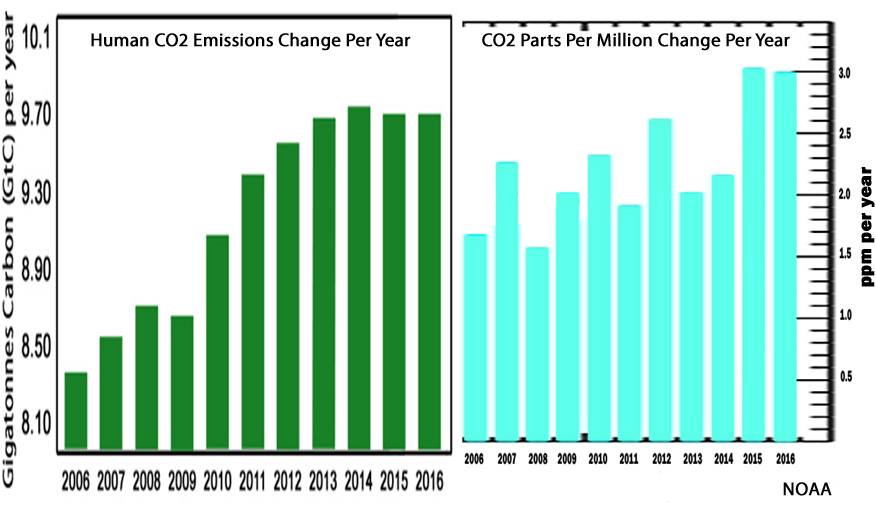
If you look at the graph...assuming that you can read a graph...you will see for example, that there was a rise in our emissions between 2007 and 2008 but a significant decline in the atmospheric CO2 concentration. Do you believe that human CO2 went somewhere to hide and waited around for some years before it decided to have an effect on the total atmospheric CO2 concentration? Then between 2008 and 2009, there was a decline in the amount of CO2 that humans emitted into the atmosphere, but a significant rise in the atmospheric CO2 concentration. Then from 2010 to 2014 there was a large rise in man made CO2 emissions but an overall flat to declining trend in the atmospheric CO2 concentration. Between 2014 to 2016 there was a slight decline in man made CO2 emissions, but a pronounced rise in the atmospheric CO2 concentrations. Like I said, we produce just a fraction of the natural variation in the earth's own CO2 making machinery from year to year and we are learning that we really don't even have a handle on how much CO2 the earth is producing...the undersea volcanoes are a prime example of how much we don't know.
https://www2.meteo.uni-bonn.de/bibliothek/Flohn_Publikationen/K287-K320_1981-1985/K299.pdf
CLIP:
“The recent increase of the CO2-content of air varies distinctly from year to year, rather independent from the irregular annual increase of global CO2-production from fossil fuel and cement, which has since 1973 decreased from about 4.5 percent to 2.25 percent per year (Rotty 1981).”
“Comparative investigations (Keeling and Bacastow 1977, Newll et al. 1978, Angell 1981) found
a positive correlation between the rate of increase of atmospheric CO2 and the fluctuations of sea surface temperature (SST) in the equatorial Pacific, which are caused by rather abrupt changes between upwelling cool water and downwelling warm water (“El Niño”) in the eastern equatorial Pacific. Indeed the cool upwelling water is not only rich in (anorganic) CO2 but also in nutrients and organisms. (algae) which consume much atmospheric CO2 in organic form, thus reducing the increase in atmospehreic CO2. Conversely the warm water of tropical oceans, with SST near 27°C, is barren, thus leading to a reduction of CO2 uptake by the ocean and greater increase of the CO2. … A crude estimate of these differences is demonstrated by the fact that
during the period 1958-1974, the average CO2-increase within five selective years with prevailing cool water only 0.57 ppm/a [per year], while during five years with prevailing warm water it was 1.11 ppm/a. Thus in a a warm water year, more than one Gt (1015 g) carbon is additionally injected into the atmosphere, in comparison to a cold water year.”
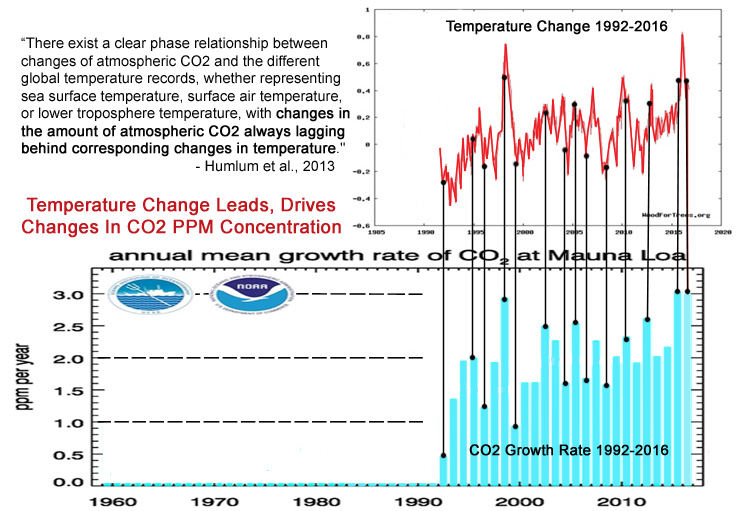
Practically every actual study ever done tells us that increases in CO2 follow increases in temperature...that means that increased CO2 is the result of increased temperature, not the cause of increased temperature...which makes sense since warm oceans hold less CO2 and as they warm, they outages CO2.
https://www.researchgate.net/public...spheric_carbon_dioxide_and_global_temperature
CLIP"
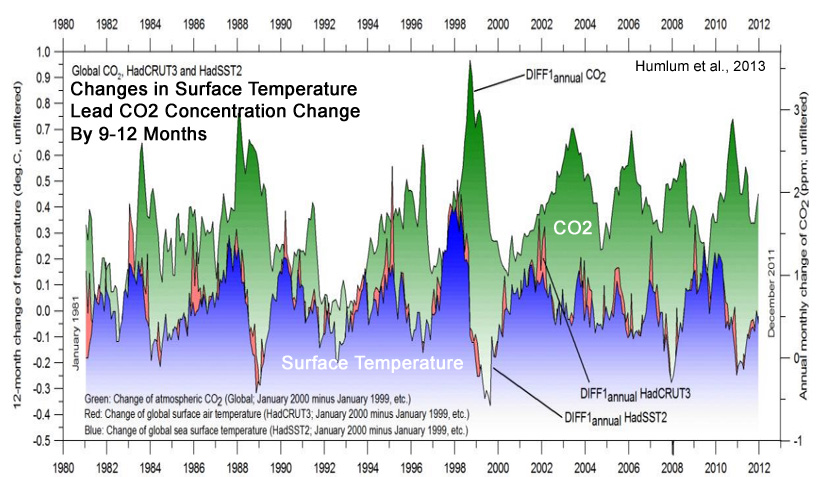
“There exist a clear phase relationship between changes of atmospheric CO2 and the different global temperature records, whether representing sea surface temperature, surface air temperature, or lower troposphere temperature,
with changes in the amount of atmospheric CO2 always lagging behind corresponding changes in temperature.”
(1) The overall global temperature change sequence of events appears to be from 1) the ocean surface to 2) the land surface to 3) the lower troposphere.
(2) Changes in global atmospheric CO2 are lagging about 11–12 months behind changes in global sea surface temperature.
(3) Changes in global atmospheric CO2 are lagging 9.5–10 months behind changes in global air surface temperature.
(4) Changes in global atmospheric CO2 are lagging about 9 months behind changes in global lower troposphere temperature.
(5) Changes in ocean temperatures appear to explain a substantial part of the observed changes in atmospheric CO2 since January 1980.
(6)
CO2 released from anthropogenic sources apparently has little influence on the observed changes in atmospheric CO2, and changes in atmospheric CO2 are not tracking changes in human emissions.
(7) On the time scale investigated, the overriding effect of large volcanic eruptions appears to be a reduction of atmospheric CO2, presumably due to the dominance of associated cooling effects from clouds associated with volcanic gases/aerosols and volcanic debris.
(8)
Since at least 1980 changes in global temperature, and presumably especially southern ocean temperature, appear to represent a major control on changes in atmospheric CO2.
SAGE Journals: Your gateway to world-class research journals
CLIP: “[T]he warming and cooling of the ocean waters control how much CO2 is exchanged with atmosphere and thereby controlling the concentration of atmospheric CO2. It is obvious that when the oceans are cooled, in this case due to volcanic eruptions or La Niña events, they release less CO2 and when it was an extremely warm year, due to an El Niño, the oceans release more CO2. [D]uring the measured time 1979 to 2006 there has been a continued natural increase in temperature causing a continued increase of CO2 released into the atmosphere. This implies that temperature variations caused by El Niños, La Niñas, volcanic eruptions, varying cloud formations and ultimately the varying solar irradiation control the amount of CO2 which is leaving or being absorbed by the oceans.”
https://pubs.acs.org/doi/abs/10.1021/ef800581r
CLIP: “[With the short (5−15 year) RT [residence time] results shown to be in quasi-equilibrium, this then supports the (independently based) conclusion that the long-term (∼100 year) rising atmospheric CO2 concentration is not from anthropogenic sources but, in accordance with conclusions from other studies, is most likely the outcome of the rising atmospheric temperature, which is due to other natural factors. This further supports the conclusion that global warming is not anthropogenically driven as an outcome of combustion.”
Error - Cookies Turned Off
“[T]he trend in the airborne fraction [ratio of CO2 accumulating in the atmosphere to the CO2 flux into the atmosphere due to human activity] since 1850 has been 0.7 ± 1.4% per decade, i.e. close to and not significantly different from zero. The analysis further shows that the statistical model of a constant airborne fraction agrees best with the available data if emissions from land use change are scaled down to 82% or less of their original estimates. Despite the predictions of coupled climate-carbon cycle models, no trend in the airborne fraction can be found.”
Like it or not, that last sentence means that there simply is not a discernible trend in the percentage of atmospheric CO2 that can be linked to our emissions...that is because in the grand scheme of things, the amount of CO2 that we produce is very small...not even enough to have any measurable effect on the year to year variation of the earth's own CO2 making processes...
Here is a paper from James Hansen himself...the father of global warming and the high priest of anthropogenic climate change...
Climate forcing growth rates: doubling down on our Faustian bargain - IOPscience
CLIP: “However, it is the dependence of the airborne fraction on fossil fuel emission rate that makes the post-2000 downturn of the airborne fraction particularly striking.
The change of emission rate in 2000 from 1.5% yr-1 [1960-2000] to 3.1% yr-1 [2000-2011], other things being equal, would [should] have caused a sharp increase of the airborne fraction”
Even someone who can't read a graph should be able to look at that one produced by hansen and see that the amount of CO2 in the atmosphere simply does not track with the amount of CO2 that we produce.
You can go on endlessly about what you believe...and what you have been told but when you look at the actual science, it is clear that what you believe and what you have been told simply is not true. That is the problem with letting someone else provide you with an opinion...if they don't want you to know the problems inherent in your opinion, they don't give you information like the published, peer reviewed papers above...they simply let you believe that we are the cause of rising CO2 in the atmosphere and tell you that it is true without having any data at all to support the claim
Ice cap is melting. Russia and other countries are shipping thru the northern ice where previously they couldn't because it was too thick. Thus they are crushing this ice and raising sea levels
s
Is there any alarmist claptrap that you won't believe? The fact is that with the exception of the little ice age, which we are still warming out of, there is more ice in the arctic now than there has been for most of the past 10,000 years. Do you ever actually research anything or do you just assume the opinions given on alarmist blogs are correct?
By 2050, up to $106 billion worth of coastal property will likely be below sea level (if we continue on the current path).
Bullshit. May, might, could, maybe etc etc etc. That is all based on failed climate models...every last bit of it..
The real story is Coal-fired power plants are the largest source for atmospheric CO2 concentrations (easily bypassing vehicles) and readings have shown then reaching 400 parts per million which is setting new records in the history of man. Pre industrial times numbers are about 280 ppm. So obviously coal fired plants are a problem.
More bullshit...I provided 7 peer reviewed, published articles above stating that our contribution to atmospheric CO2 levels is the next thing to undetectable...show me some published, peer reviewed science that says, and provides empirical evidence that we are even moderately responsible for the increases in atmospheric CO2 levels...My bet is that you can't...
the issue is what is man doing and the consequences for the future of our children
The real issue is how badly our educational systems are failing...and people like you who are incapable of actually researching the topic on your own and are therefore left to simply accept whatever bullshit you are fed are a prime example of that failure.
if sea levels rise and coastal cities are flooded what is the economic cost and the human suffering costs
Sea level is rising at a rate of about 3mm per year...grab yourself some historic photos of coastal areas....look at all the change that hasn't happened...you are little more than a hand waving hysteric with no empirical evidence to support your claims.