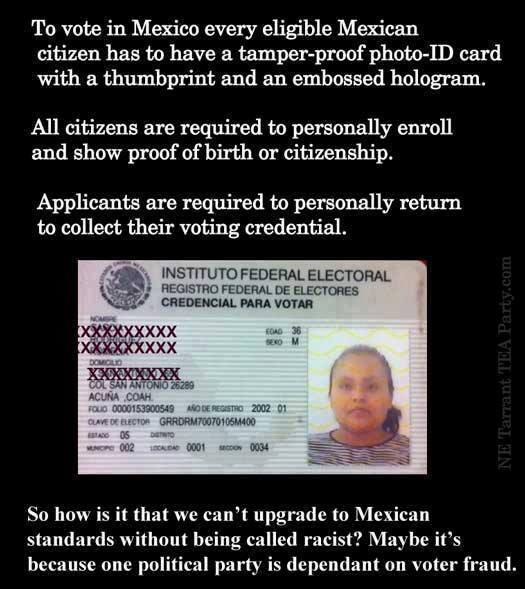
1. Nonpartisan election administration. Mexico's Federal Electoral Institute (IFE) is a nonpartisan, professional institution in which political party representatives have access but no control. IFE manages a nation-wide system with uniform rules. In contrast, the United States has 13,000 counties and municipalities that manage our national elections with different rules and less capacity. Partisan officials generally control the process, and in a close election, the opposition is often suspicious of the result.
No.2 was the ID
3. Poll workers. Mexico views the conduct of elections like Americans view jury duty – a civic obligation – and they recruit on a random basis a large number of people from each district. They are well-trained in every stage of the electoral process. When I asked a U.S. election official about the criteria for choosing poll workers, he said: "I'll take anyone with a pulse." Most poll workers are very senior citizens without the kind of stamina necessary to manage a polling station for 12 hours, and in most cases, they are poorly trained as compared to their Mexican counterparts.
4. Campaign finance/corruption. Each of Mexico's main political parties receive approximately $24 million of public financing for a three-month campaign. They can also receive 10% of their funds from supporters, but no one can give more than $71,000. In contrast, in the United States, there will be an estimated $6 billion raised privately, and with the Citizens United Supreme Court decision, corporations can spend unlimited amounts of money. Major contributors could have extraordinary access and substantial influence over public policy. Some would define that as corruption on a scale that even the drug cartels couldn't compete.
5. Equitable access to the media/negative advertising. IFE pays for media advertising, and ensures that the candidates have equal access. IFE also tries to discourage any negative advertising. A substantial amount of the $6 billion raised by the candidates in the United States goes for media advertising, and a recent study showed that 70 percent of ads in this year’s presidential contest has been negative. Just think what $6 billion could do as an endowment to a university; it would have lasting positive effects. Who believes that negative advertising can have a lasting positive effect?
6. Neutralizing incumbency. Since its revolution, Mexico's constitution prohibits re-election in order to prevent incumbents from using government to manipulate the electoral process. IFE goes even further by trying to prevent the president from even campaigning in the most indirect way for his party's candidates. In the United States, incumbents have a huge advantage in fund-raising because special interests can contribute to members of Congress while they are writing laws.
7. Judging disputes. Mexico has minutely-detailed election laws, and a professional and independent Electoral Tribunal to judge election disputes. The United States has few laws and no court with the expertise to settle such disputes.
8. Observers. Mexico invites international polling observers while the U.S. government does not welcome any international observers, and only two states allow them.