The Beautiful Way
By James Hadfield
The ever-so-slightly hidden history of Japan's gay samurai
Nighttime. We see a yukata-clad figure slip into a dark room, its floor covered with sleeping bodies. Picking his way over the futons, he heads for one already occupied and, without hesitating, slides under the covers. But as he starts to get comfortable, his quarry turns suddenly and holds a dagger to his throat, asking: "Cry out? Or shall I do it for you?"
"I don't want to die without making love to you," he replies.
Nothing unusual so far, save for the fact that the object of his affections isn't a woman, but an androgynous young man.
The scene is from Nagisa Oshima's 1999 film Gohatto, known overseas by the title Taboo. A staid, marginally engaging samurai drama, it is however notable for focusing on a subject left quietly untouched by other such movies: the samurai tradition of male love.
Set in the dying days of the Tokugawa era, Gohatto tells of a dazzlingly pretty but cold-hearted young man whose induction into a samurai clan causes no end of problems. No sooner has he arrived than his comrades are fighting to court his affections, spouting overripe romanticisms like I'd give my life to wake to the nightingale's song after holding you in my arms all night long, or teasing each other about whether they have that leaning.
On this evidence, you'd assume that the whole samurai world was gay a notion that Oshima himself isn't quick to dismiss. In the past, no one dared touch the subject of homosexuality, whether it was latent or overt, he said at the time of the film's release. [But] in my opinion, one cannot understand the world of the samurai without showing the fundamental homosexual aspect."
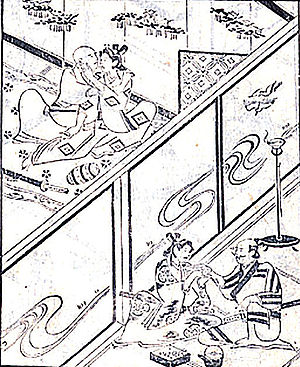
This isn't historical revisionism. Though modern portraits of the era may try to ignore the fact, homosexuality was in fact widespread amongst the samurai class. Much as the knights of yore had their ladies, the valiant warriors of medieval Japan were apt to take other men as lovers. Such relationships generally developed between adolescents and grown males, often progressing from the sexual to the platonic as the younger man came of age.
Oda Nobunaga, Tokugawa Ieyasu and Musashi Miyamoto are just a few of the famous figures known to have had male partners, Nobunaga even dying with his lover at his side. In his seminal book Male Colors: The Construction of Homosexuality in Tokugawa Japan, meanwhile, Gary P. Leupp cites evidence that at least seven of the 15 Tokugawa shoguns... had well-documented, sometimes very conspicuous, homosexual involvements.
The Japanese have traditionally had many words for male-male love. It is nanshoku (男色

, literally male colors; we hear of bido (美道
, the beautiful way; or wakashudo (若衆道
, the way of the youth (often shortened to just shudo). Importantly, these words are used to describe behaviors rather than identities which explains why some modern academics are uneasy translating them as more loaded terms such as homosexuality and gay.
The origins of nanshoku are often traced back to Kukai (aka Kobo Daishi), founder of the Shingon school of Buddhism. Legend has it that, on returning from his travels in Tang China during the early 9th century, Kukai imported not only the Buddhist faith and Chinese script, but also the way of the youth. Besides the fact that China enjoys a very long tradition of homosexuality, there's precious little evidence to support this view; all the same, Mount Koya, the headquarters of the Shingon sect, would go on to become synonymous with shudo during the coming centuries.
It wouldn't be alone in that respect: there are numerous references in medieval literature to homosexuality within Buddhist monasteries. Though documents indicate that Kukai himself was unswerving in his vow of chastity, many monks interpreted their own pledges as applying only to heterosexual activity. By all accounts, the isolated, sex-segregated communities became havens of homoeroticism, centering around the young acolytes (chigo) and pages. These boys would be fawned over, dressed in all kinds of finery and placed at center stage in elaborate monastic ceremonies. Sometimes, they would enter into relationships with the older monks although the emphasis was said to be as much on education and companionship as it was on sex.
When Jesuit missionaries pitched up in the late 16th century, they were appalled, not just at what the monks were getting up to, but also how blithely the general population accepted it. Father Francis Cabral wrote in a letter in 1596 that such abominations of the flesh... [are] regarded in Japan as quite honorable; men of standing entrust their sons to the bonzes to be instructed in such things, and at the same time to serve their lust.
By this point, though, the practice of shudo had been adopted by an altogether different group: the samurai. Following the monks' example, many samurai became involved in pederastic relationships, a mature warrior taking an attractive adolescent male as his lover. The relationship would start at an early age, usually finishing with the youth's coming-of-age ceremony, which occurred when he was eighteen or nineteen.
If you read that and think pedophilia, you wouldn't be the first. Yet what seems shocking to a modern, Western audience was idealized and even encouraged in medieval Japan. Not only did the warrior class have little contact with women: the flourishing of homosexuality went hand-in-hand with rampant misogyny. The fairer sex were treated as anything but popular wisdom held that women were for breeding, not pleasure, and men who spent too long in their company risked becoming soft and effeminate. By contrast, same-sex relationships were seen as purer, even more desirable. The closest analogy would be Ancient Greece, whose culture of pederasty was underpinned by similar beliefs.
The importance of shudo extended beyond satisfying carnal urges, too: for the youth, it was seen as an important stepping stone to adulthood and a successful career. As academic Paul Schalow writes: They were not primarily sexual relationships but included education, social backing and emotional support. Together [the partners] vowed to uphold samurai ideals. Samurai status was thus strengthened by a well-chosen match. Though sexual activity may cease when the youth came of age, the relationships would often persist, developing into lifelong companionship. However, taking a male partner did not prevent a samurai from subsequently marrying as mentioned before, homosexuality was seen as a behavior, not an identity.
Tsunetomo Yamamoto's Hagakure (literally hidden behind the leaves), an 18th century manual viewed by many as the apotheosis of samurai philosophy, contains a number of references to shudo. Samurais have to bear the following in mind, it says; a good 'wife' never meets a second 'husband.' The object of your love is one for life. Otherwise, you are the same as a prostitute. Too shameful for a samurai.
Indeed, shudo was only seen as objectionable insofar as it could lead to conflicts or public disgrace. There were few attempts to regulate homosexual behavior, but those that did focused on the potential for violence or public disorder, rather than any perceived degeneracy.
The Hagakure highlights another problem, this one of a more philosophical nature: the potential conflict of interest between serving one's lord and one's lover. It recounts a conversation between Ryotetsu Hoshino, the pioneer of the homosexual relationship in our country, and his student Edayoshi. When asked what he thinks of shudo, Edayoshi replies much to the pleasure of his teacher that it is something to like and yet not to like. Later, he expounds on this: The secret of this art is to throw away your life for your partner; otherwise your relationship will be shameful. But if you do throw away your life for your partner, then there is no life anymore to devote to your Lord himself. That's why I answered in such a manner.
During the Tokugawa era (1603-1867), the joys of homosexuality filtered into popular culture, finding an enthusiastic promoter in Ihara Saikaku, a popular 17th century poet and writer. In collections like The Great Mirror of Male Love, Saikaku extolled the virtues of male love, telling of trysts between beautiful youths and brave warriors, often culminating in the inevitable (and oh-so-romantic) seppuku. Though undoubtedly homoerotic, these tales downplayed the sexual side of the relationships, emphasizing instead the dedication and purity of those involved.
In one story, 'They Loved Each Other even to Extreme Age', Ihara sums up the prevalent thoughts of the time in a slightly tongue-in-cheek aside: Male love is essentially different from the ordinary love of a man and a woman; and that is why a Prince, even when he has married a Princess, cannot forget his pages. Woman is a creature of absolutely no importance; but sincere pederastic love is true love.
All good things come to an end, of course, and the same was true of shudo. The Tokugawa era brought with it a long period of peace leading to the decline of the warrior class, and with them the ideals that they valued so highly. The merchant class warmed to the ways of male love, but they did things differently, vying for the attentions of popular kabuki actors or, failing that, prostitutes. The lofty ideals of the samurai version of shudo were abandoned in favor of straight-up sex. As Gary Leupp writes: For the merchants and artisans of Tokugawa cities, male-male sex became largely a commercial transaction devoid of the commitments required by earlier traditions of male homosexuality.
When the Meiji restoration brought with it a tide of Westernization, this was but the death knell of an already dying tradition. Homophobia came bundled with the more enlightened strands of Western thought entering the country and, in an effort to appear more civilized to the outside world, authorities drove homosexuality underground, even briefly criminalizing it from 1873 to 1881. Though attitudes would thaw again, the heyday of shudo would never return well, how could it? Times change, and in today's Japan pederasty feels about as likely to make a comeback as the samurai themselves.
Still, the history of the gay samurai lingers on, a salutary reminder that what passes for conventional these days wasn't always considered so. And if nothing else, it's a great one to slip into conversation the next time you hear someone singing the praises of Japan's legendary warriors. Yes, but did you know...?
http://www.seekjapan.jp/article-1/812/The+Beautiful+Way