This pipeline would be used to transport oil to the Gulf, loaded on Tankers, then sold on the worldwide oil market to the highest bidder. There are ZERO guarantees that any of this oil stays in America.
What are you going to do? This crude is going to the Gulf refineries no matter what. We are your number one supplier.
Rail or truck or pipeline. Pick your poison. Block the pipeline? Okey dokey what next?
Block all rail transport from Canada to the US? Or block all tankers from Canada to the US?
You need the crude.
Or are you going to legislate that your very own US companies who have purchased the crude not be able to sell it anywhere but in America?
That would be very Venezuelan of you.
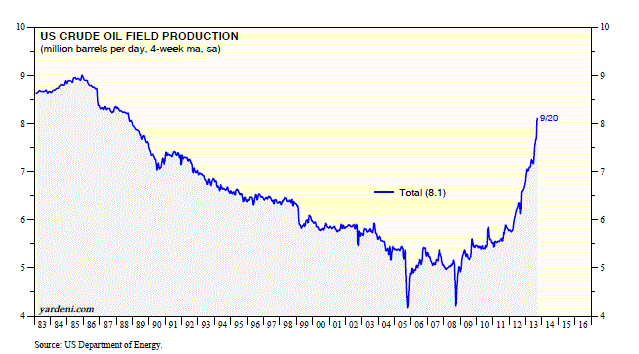
we dont need the crude.
Give me a break.
Plas we're your number one supplier for many reasons. A major reason is energy security.
Your own government said so.
Media Note
Office of the Spokesman
Washington, DC
March 14, 2008
Keystone Pipeline Presidential Permit
On March 14, the Department of State issued a Presidential Permit authorizing TransCanada Keystone Pipeline LP to construct, operate and maintain facilities related to the Keystone crude oil pipeline project.
The Keystone pipeline will extend 1,300 miles from the Canadian border through the U.S. Midwest.
When fully operational, the Keystone pipeline is anticipated to increase U.S. oil imports from Canada by an amount equivalent to as much as 4.5 percent of total U.S. daily imports.
Canada is the United States' largest supplier of oil, natural gas, and electricity. The Department has determined that issuance of the permit to TransCanada Keystone Pipeline LP is in the national interest, in part, because it increases U.S. market access to crude oil supplies from a stable and reliable trading partner, Canada, that is in close proximity to the United States.
Canadian oil represents a safe, secure supply for the North American market. In 2004, Canada became the largest supplier of crude oil to the United States. In 2006, Canada supplied the United States with 2.3 million barrels of oil per day (mbd), equivalent to 17% of total U.S. imports.
The permit was signed in the State Department’s Treaty Room by the Undersecretary of State for Economics, Energy and Agriculture Affairs, Reuben Jeffery III, who also serves as the Department’s International Energy Coordinator. Canadian Ambassador Michael Wilson witnessed the signature.
The United States and Canada have a wide array of bilateral and multilateral mechanisms to discuss energy and the environment, and will continue to address the importance of mitigating greenhouse gases from all sources of energy production.
Prior to making its determination to issue the permit to TransCanada Keystone Pipeline LP, the Department completed an environmental review of the entire project.
All public documents related to the Department’s decision regarding TransCanada Keystone LP’s application can be downloaded at
www.keystonepipeline.state.gov.
2008/192
Keystone Pipeline Presidential Permit