The rate of sea level rise has increased from less than 1 mm per year in 1880 to over 3.7 mm per year at present. And that rate is accelerating.
Climate Change: The current rate of CO2 rise is unprecedented in the recent history of the Earth
With the exception of rapid atmospheric changes triggered by major volcanic events, asteroid impacts and methane release, which led to the great mass extinction of species [1], the current rate of CO2 rise (2005-08: 1.66-2.55 ppm/year) is unprecedented in the recent history of the Earth, driving polar ice melt and sea level rise rates in excess of IPCC projections. Warming of large parts of the Arctic and Antarctic circles by 3-4oC during 1975-2009 (~0.09–0.12 degrees C/year) triggers fast feedback effects from ice melt, albedo loss and open water infrared absorption, and from the carbon cycle. Estimates of future sea level rise derived from 40 years records (1.6-3.7 mm/year), glacier flow rates and ice shelf collapse dynamics, and yet little-quantified positive feedbacks, render exponential to non-linear sea level rise on the scale of tens of meters over the next few centuries possible. The rise in the oceans heat content (1950-2004: 16.10^22 Joules), lowered pH (8.2 - 8.1), and enhancement of the CO3(-2) to HCO3(-) transition, threatens algae, calcifying plankton and reef habitats from shallow habitats to abyssal depths [2]. The best outcomes of the looming Copenhagen climate summit, 25 percent carbon emission reduction relative to 1990 levels, would be unable to arrest the rise of mean global temperatures over 2 degrees Celsius relative to pre-industrial levels. The rise in CO2 emissions by 41% since 1990 [3] and continuing land clearing go counter to the urgently required measures at mitigation, massive reforestation, revegetation, application of biochar and chemical draw-down of atmospheric CO2. While governments vie to vested interests and economists calculate the price of the Earth, a denial syndrome underpinned by an ideology of human mastery over nature is enhanced by a massive disinformation campaign by contrarians who ignore the basic laws of physics and chemistry and falsify climate data.
Of all the physical and chemical indicators of climate change the rate of sea level rise is the most sensitive parameter, reflecting both thermal expansion of upper layers of the oceans and ice sheet collapse rates.
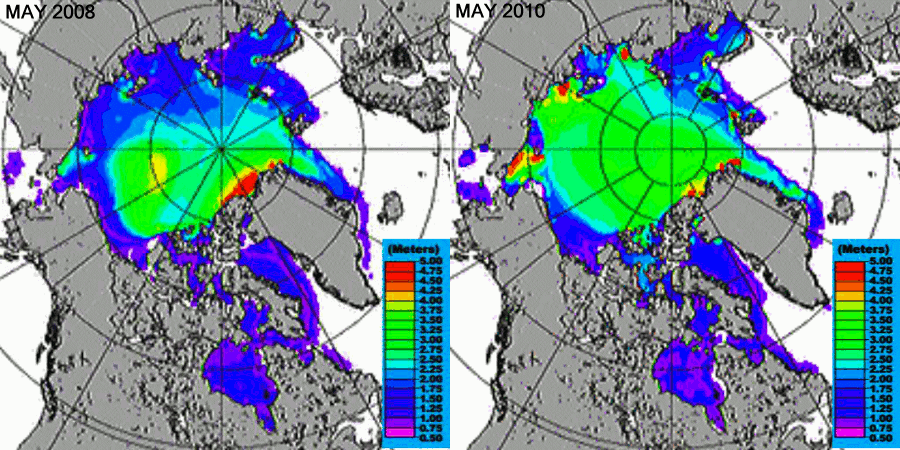
The rise of sea level rates from below 1 mm/year about 1880, to about over 3.7 mm/year by 2008 (Figures 1, 2) [4-8] constitutes the definitive warning for H. “Sapiens”. In Greenland mass ice loss increased from 137 billion ton (GtI) ice/year in 2002–2003 to 286 GtI/year in 2007–2009 [6]. In Antarctica ice mass loss increased from 104 GtI/year in 2002–2006 to 246 GtI/year in 2006–2009 [6]. According to Kerr (2009) “the latest analysis of the most comprehensive, essentially continuous, monitoring of the ice sheets shows that the losses have not eased in the past few years.” [7, 8].Recent reports highlight major underestimates by IPCC reports on which most economic and government assessments since 2001, including the Stern and Garnaut reports, have been based [9-12]. Economic models attempt correlations between target atmospheric CO2 stabilization levels (cf. 450, 550, 650 ppm) ([10] Fig SPM-6) and economic costs of mitigation. For example, for a range of emission scenarios, stabilization of CO2 at 450 ppm by 2050 was purported to cost 3-4% of GDP, while stabilization at 750 ppm was supposed to cost less than 1% GDP by 2050 ([10] Fig. SPM-9).