Yes, Micheal Mann, whose initial study has been supported by over a dozen independent studies from all over the world by scientists using different proxies.
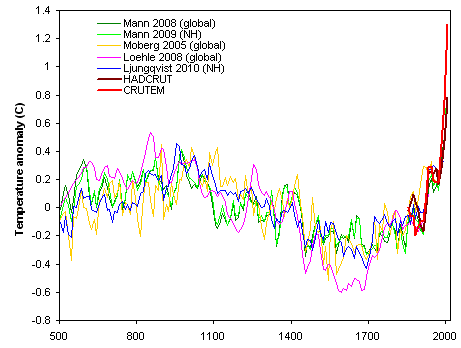
Figure 2. Comparison of northern hemisphere and global temperature reconstructions. Northern hemisphere instrumental temperature records shown for comparison (CRUTEM land only, and HADCRUT land/ocean).
It's worth noting that
all the reconstructions show the Medieval Warm Period, the Little Ice Age, and 20th-century warming (though Loehle 2008 only runs through 1935).
Loehle's Medieval Warm Period is both warmer and earlier than the rest (and, as noted above, Loehle recognizes that his early peak circa AD 850 is probably incorrect). Loehle also shows a much colder Little Ice Age. All of the reconstructions diverge more in the period before AD 800, with Moberg being the coolest, Loehle the warmest, and Mann and Ljungqvist being in the middle of the pack.
When comparing Ljungqvist 2010 to Loehle 2008, it's important to remember that Ljungqvist's reconstruction is for the
mid- and high-latitude Northern Hemisphere only, while Loehle's was supposed to be
global. In this light, the presence of relatively extreme temperatures in Loehle's reconstruction during both the Medieval Warm Period and the Little Ice Age ought to be viewed somewhat skeptically. Whether or not these episodes were truly "global", they were certainly strongest in the Northern Hemisphere, particularly in the North Atlantic region. Ljungqvist 2010 suggests that his own reconstruction may have underestimated the magnitude of Northern Hemisphere cooling during the Little Ice Age, but Loehle's still appears to be an outlier if it is considered as a global reconstruction.
Finally, it's worth noting that comparison to the instrumental record suggests that modern temperatures are significantly warmer than those during the height of the Medieval Warm Period. Additional projected 21st Century warming will produce a climate unlike anything experienced in the history of human civilization.
New temperature reconstruction vindicates ...