Yes, I agree. Privatizing pensions and health care is the way which many developed countries will follow.
What is more astounding about Japan is that 40 percent of state expenditures are financed through borrowings.
I don't know whether there are ways to cut these spendings avoiding drastic dropping of citizens well-being. Privatizing pensions is a too late move, it seems. What to do with huge amount of pensioners which already rely on state pensions?
Cutting spendings of big infrastructure projects will be echoed by closing some jobs, which in turn will require additional state spendings on support of the fired.
Maybe vast using of foreign workforce will help to solve this problem. But the Japanese aren't in favour of it.
Well obviously not. Clearly if you cut spending, well being will decline. This is unavoidable.
If me and my family are spending more money than we make, so that we are going deeper and deeper into debt.... there is only one of two options... keep going until we end up bankrupt, and then lose everything..... or we cut as much as is required to get our spending under the level of our income. And that means less cells phones... less movies... less eating out.... less vacationing... less amusement parks... maybe even smaller car, older car, and the kids are getting cards for Christmas.
Overall well being is going to be affected.
But again... the alternative is that you just keep going until the economy implodes like Greece. Would you rather have care you pay for, or have health care that is closed? I still have pictures of Greek hospitals and clinics with the bars over the door, because there was no money, and it was closed.
Would you rather have less retirement, or zero retirement? I still have pictures from Greek pensioners, on the ground outside state run banks, crying because the banks had no money at all.
Same is true of the rail system. Do you want fewer trains that cost a bit more, but run on time? Or closed stations?
So again, my point to the Japanese people would be, it's going to change. The question is, are you going to make reasonable cuts that are painful, but not utterly destructive to the economy? Cuts that you control?
Or do you want to be like Greece, and literally run out of money, and have foreigners enforce cuts on you, because you are slave to the lender, and in the mean time have your entire country resort to burning wood, because people can't even afford natural gas heat?
Smog shrouds Athens as Greeks choke on fuel bills
One of the few first world countries to have a smog alert from people burning wood, because the economy imploded.
And by the way, everything that is true of Greece and Japan, is also true of the US. If we don't figure this crap out, we will end up just like Greece.
The situation can be compared with those ones which many family face, but there is a significant difference. When a family gets a loan and after some time they see troubles with repaying it, then yes, the only way is cutting spendings. And this is reasonable.
But if a country cuts its spendings, it can lead to declining in economy and after that to even more declining in revenues. For example, the government decides to cut high speed railway projects. This leads to factories being shutted down and workers being fired. These workers and their families cut spendings in the shops and markets and this causes the goods not being sold, so the volume of production declines and this leads to more workers being fired and the amount of taxes gathered by the state also declines. This is very simplified, but I think you got my point.
I think that Japan doesn't need to cut spendings. It will deeper the stagnation of the economy which hasn't been doing too well for the last twenty years. It needs to reload its economy, give it new impulse. To poor in new blood in a proper manner.
I would disagree with that concept.
The only time that government cuts directly lead to long term economic decline, is if the economy is socialized. So for example, Cuba which socialized nearly all of it's economy, was thus dependent on Soviet Union spending. When that income was cut, the economy in Cuba imploded. Again... because it was socialized. If the economy is socialized, and dependent on government spending, then naturally if you cut government spending, the economy is directly cut too.
However, in a free-market Capitalist economy, that isn't the case.
If my company sells a product across the country, and world wide, why would cutting food stamps harm my company? It would not.
And in fact, those people who had their food stamps cut, will likely end up having to work a job to pay for food, which means that the labor force will increase, and this would benefit my company.
Cutting government spending in a free-market capitalist economy, will result in economic growth, not decline. Now, let me clarify that I mean in the long term. In the extreme short term, you might see a slight economic decline, but it would be short, followed by growth.
This mythology that government spending results in growth, is simply not born out in reality. It's mainly the product of people with invested interest in government spending.... such as the universities and research think tanks that gain money from government for producing pro-government research... from the specific groups that benefit from government spending (such as companies like Amtrak or Cargill and others that benefit from subsidies).... and lastly and most importantly the politicians themselves who proclaim themselves to be for the people by handing out tax dollars stolen from the people, back to the people in exchange for votes.
However, if you simply look at the facts of history, there is scant evidence supporting this theory that gov-spending = economic growth.
For example:
Calvin Coolidge cut government spending during a recession. The result was a bounce back that resulted in the roaring 20s.
Hoover / FDR engaged in massive government spending. The result was the great depression.
WW2 - After the war, government spending was drastically cut, and hundreds of economists predicted a massive recession. Instead the economy grew much faster than during the high spending before.
In the 1990s, the contract with America that the Republicans pushed, drastically cut welfare and food stamps, down to I believe 1/3. If I remember right, welfare and food stamp rolls fell by 2/3rds.
This drastic decline in government spending, resulted in... no economic decline whatsoever, and while not spectacular growth, is was growth.
And of course most recent, Obama drastically increased spending, which resulted in the Great Recession, the slowest recovery from a recession in all American history.
So I really am skeptical of the idea that cutting government spending has the disastrous effects people claim.
Well, I can't say much about American realities of the past. The only thing I remember for sure is that we were taught in the school that massive state projects had helped the US climb out of the recession.
Cuba isn't a good example. Because of the American embargo imposed on it.
Frankly, assertion that state programs are bad for the economy doesn't get along with my logic. The more money are pouring into the economy, the more projects can be realized and more goods can be produced. And for employers (and employees alike) it doesn't matter where the money come from. But it can end bad for the state finances, yes.
About your example with food stamps. If you give up them, the people relyed will spend their money on food rather than on production of your company.
Yes, I know that is what you were taught. I was taught that as well.
I am now persuaded that what was taught in schools about the Great Depression, are all lies. Not that your teachers were lying. They were simply telling you, what they themselves were told.
But the idea that having people move bricks from one side of the street to the other, and then move them back, is going to rescue the economy, is ridiculous.
To clarify, I am not suggesting that none of those public works were useful. Obviously some were. However, it's a bit of a stretch to suggest that these projects ended the depression. There was an estimated 15 Million people unemployed in 1933, and all of the public works projects combined across the entire country, barely employed 3 million people. And here's the kicker.... they were all Temporary jobs. When the project was over, so was the job.
The WPA and CCP were the first two Temp Agencies in US history.
No one retired from the WPA. They used you, and then ditched you. And you were unemployed all over again.
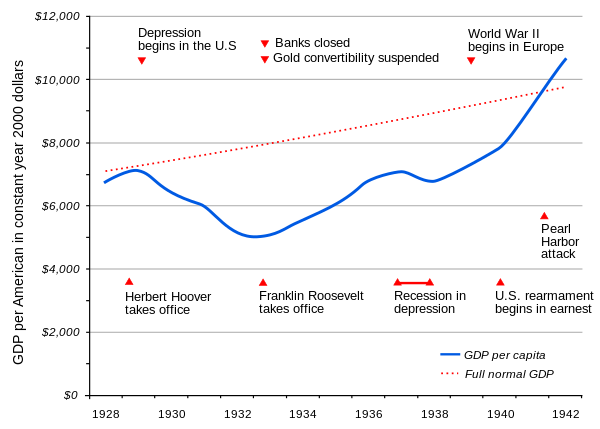
I have something I want you to look at real quick. FDR's new deal came in two parts. The first part was limited in 1933. But the second new deal, was enacted in 1935-1936.
Second New Deal - Wikipedia
The second new deal, was the big one. It involved everything from the expanded WPA, to Social Security, and so on.
Now look at this graph.
What you see around 1936 is a recession, inside the great depression.
FDR's programs and policies, did not improve the economy. They made it worse. We did not recover from the depression because of FDRs programs. We recovered despite those programs.
Frankly, assertion that state programs are bad for the economy doesn't get along with my logic. The more money are pouring into the economy, the more projects can be realized and more goods can be produced. And for employers (and employees alike) it doesn't matter where the money come from. But it can end bad for the state finances, yes.
About your example with food stamps. If you give up them, the people relyed will spend their money on food rather than on production of your company.
But there is one critical aspect you are missing in your theory. Wealth.
You are looking at the money, but not the wealth.
Money has no value, except for what it can buy.
So my favorite example is, take two people on a deserted island. One you give a trillion dollars in cash, and the other you give a life time supply of anything he wants.
Which one is wealthy? One has paper, that he can use for anything but to burn, and the other can live in luxury until he dies.
Your system where you say it doesn't matter where the money comes from, doesn't work. All you have to do is take that system to the logical extreme.
Give everyone money from the government, to live off the government. Give everyone a middle class income of $50,000 a year. Doesn't matter where the money come from, so everyone can live at their homes, with $50K a year from the government.
What is going to happen? We are all going to die. That's what is going to happen, because no one will produce anything. No products or services will be made. No food. No power. No homes. No water. Nothing. Why am I going to slave away at 7 AM at my job, if you pay me to sit at home? I wouldn't. I know I wouldn't. Why would I do that? I don't like my job. I'm doing it not because I give a crap about you getting your computer or other techy gadgets that my company sells you. I'm doing it because I read somewhere homelessness sucks, and bill collectors don't care if I don't like my job.
So it does matter where the money comes from.
What matter is if wealth is generated from that money. That's what matters. And when you pay people to not work, they don't.
Guy with engineering degree, pretends to be homeless and mentally disabled, makes $100,000 a year.
This is the reality.
This is why the Second New Deal resulted in a recession. Because you move people from being productive and generating wealth, to being on the rolls of the state, generating nothing.