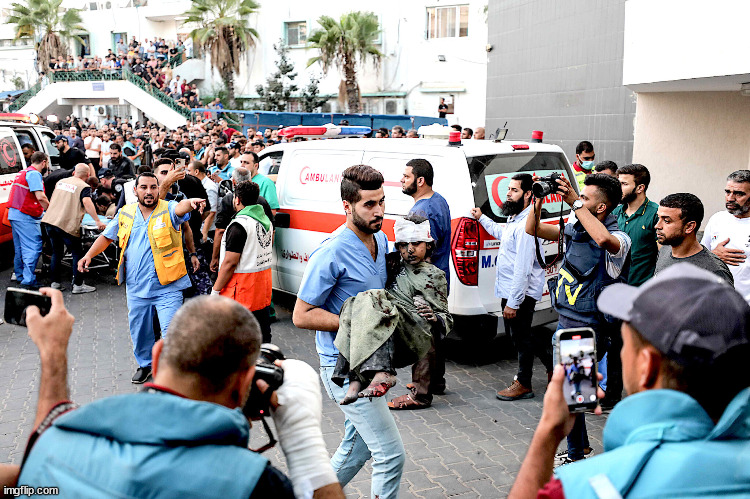
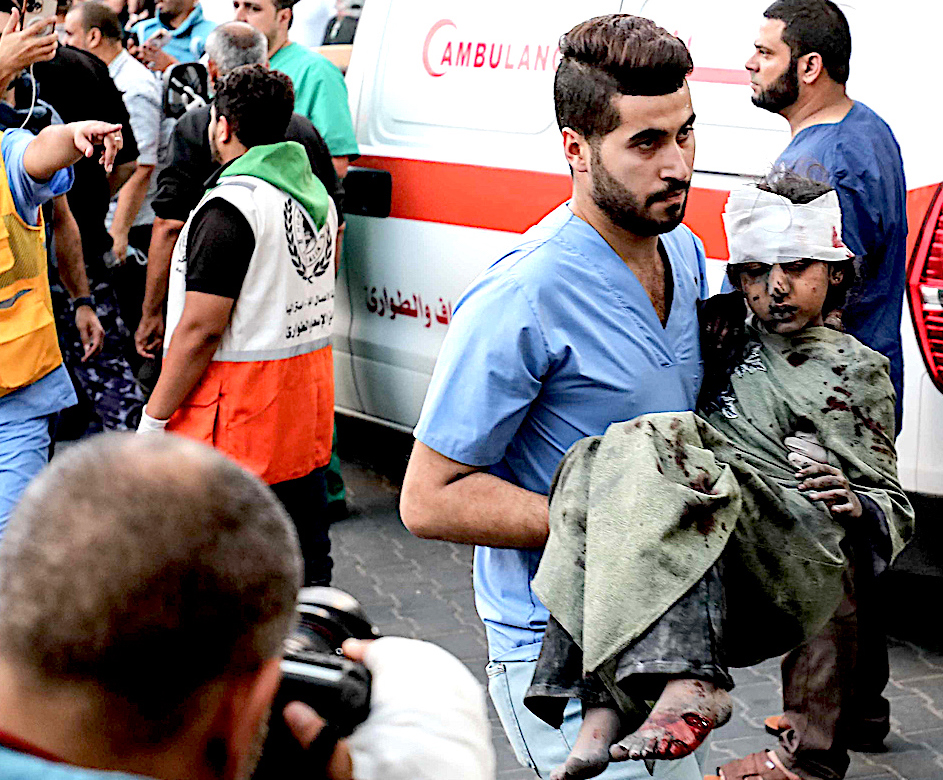
No doubt you believe Israel would never bomb a hospital. Proving you’ve been duped.
From 1982…
[From Noam Chomsky's FATEFUL TRIANGLE on Israel's 1982 invasion of Lebanon. Thanks to Jamie Stern-Weiner for his research]
Repeatedly, Israel blocked international relief efforts and prevented food and medical supplies from reaching victims. Israeli military forces also appear to have gone out of their way to destroy medical facilities—at least, if one wants to believe Israeli government claims about “pinpoint accuracy” in bombardment. “International agencies agree that the civilian death toll would have been considerably higher had it not been for the medical facilities that the Palestine Liberation Organization provides for its own people”—and, in fact, for many poor Lebanese—so it is not surprising that these were a particular target of attack.
In the first bombing in June, a children’s hospital in the Sabra refugee camp was hit, Lebanese television reported, and a cameraman said he saw “many children” lying dead inside the Bourj al Barajneh camp in Beirut, while “fires were burning out of control at dozens of apartment buildings” and the Gaza Hospital near the camps was reported hit… On June 12, four bombs fell on a hospital in Aley, severely damaging it. “There is nothing unusual” in the story told by an operating room assistant who had lost two hands in the attack; “That the target of the air strike was a hospital, whether by design or accident, is not unique either,” William Branigan reports, noting that other hospitals were even more badly damaged. Fragments of cluster bombs were found on the grounds of an Armenian sanitarium south of Beirut that was also “heavily damaged during the Israeli drive.” A neurosurgeon at the Gaza hospital in Beirut “insists that Israeli gunners deliberately shelled his hospital,” it was reported at the same time. A few days later, Richard Ben Cramer reported that the Acre Hospital in Beirut was hit by Israeli shells, and that the hospitals in the camps had again been hit. “Israeli guns never seem to stop here,” he reported from the Sabra camp, later to be the scene of a major massacre: “After two weeks of this random thunder, Sabra is only a place to run through.”
The Acre hospital was again hit on June 24, along with the Gaza hospital and the Islamic Home for Invalids, where “the corridors were streaked with blood.” The hospitals were short of supplies because Israel was blocking tons of medical supplies ready for shipment in Cyprus, according to the International Red Cross. By mid-August, the Islamic Home had been repeatedly shelled, only 15 of 200 staff members remained, and “several of the retarded children have died of starvation for lack of someone who has the time to feed them properly.” At the Palestinian Hospital for the Disabled (perhaps the same institution), “a visitor walking the gloomy corridors is approached by stumbling figures crying ‘Food, food’ in Arabic”; 800 patients remained, all mentally ill, half of them children, cared for by a dozen nurses.
A French doctor reported witnessing “an intense Israeli bombing raid around and against the [Gaza] hospital, which forced the evacuation of the hospital at the time.” When the Beirut mental hospital was hit shortly after, “800 patients varying in condition from senile dementia to violent schizophrenia were released into the streets of Beirut.” The hospital, clearly marked by Red Cross flags, was hit by artillery and naval gunfire, including four phosphorus shells. Medical personnel reported that the patients, including children with mental problems whose nursery was hit by rockets that set beds on fire, were 90% Lebanese. No military target was found within a half-mile. The hospital was, however, “precariously located near the Palestinian ghettoes of Sabra and Shatila, frequent targets of Israeli bombardment,” though the “immediate surroundings are residential” (i.e., not Palestinian slums).
Israel Would NEVER Bomb Hospitals (Part 2)