You on the other hand exhibit the same type of antisemtism that the Nazis did, maybe that's why the Nazis decided to build their death camps in Poland...a willing populace, who hated the Jews as much if not more.
.
Why would I tolerate Jews, exactly?
About 99% of Jews I've dealt with online sound exactly like you do when it comes to Poland.
Just proof of what kind of dumb vermin you, and your ilk are.
Only a complete mistake to Humanity, would think Poland was more anti-Semitic than the Nazis
You on the other hand exhibit the same type of antisemtism that the Nazis did, maybe that's why the Nazis decided to build their death camps in Poland...a willing populace, who hated the Jews as much if not more.
.
Why would I tolerate Jews, exactly?
About 99% of Jews I've dealt with online sound exactly like you do when it comes to Poland.
Just proof of what kind of dumb vermin you, and your ilk are.
Only a complete mistake to Humanity, would think Poland was more anti-Semitic than the Nazis
No mistake, hack, just the truth. Yes, they were just as antisemitic, if not more.
With the influence of the Endecja party growing, antisemitism gathered new momentum in Poland and was most felt in smaller towns and in spheres in which Jews came into direct contact with Poles, such as in Polish schools or on the sports field. Further academic harassment, such as the introduction of
ghetto benches, which forced Jewish students to sit in sections of the lecture halls reserved exclusively for them, anti-Jewish riots, and semi-official or unofficial quotas (
Numerus clausus) introduced in 1937 in some universities, halved the number of Jews in Polish universities between independence (1918) and the late 1930s. The restrictions were so inclusive that – while the Jews made up 20.4% of the student body in 1928 – by 1937 their share was down to only 7.5%,
[99] out of the total population of 9.75% Jews in the country according to
1931 census.
[100]
Although many Jews were educated, they were excluded from most of the government bureaucracy.
[101] A good number therefore turned to the liberal professions, particularly medicine and law. In 1937 the Catholic
trade unions of Polish doctors and lawyers restricted their new members to
Christian Poles (in a similar manner the Jewish trade unions excluded non-Jewish professionals from their ranks after 1918).
[102]
Complex and long history shaped Polish attitudes towards the Jews and Jewish attitudes towards the Poles, but the anti-Jewish sentiment in Poland had reached its zenith in the years leading to the
Second World War.
[105] Between 1935 and 1937 seventy-nine Jews were killed and 500 injured in anti-Jewish incidents.
[106] National policy was such that the Jews who largely worked at home and in small shops were excluded from welfare benefits according to American commentators.
[107] Nevertheless, the impact of right-wing extremism would have been hard to substantiate in towns with percentage of Jews equal or even higher than that of the non-Jewish Poles. In the provincial capital of
Łuck Jews constituted 48.5% of the diverse multicultural population of 35,550 Poles, Ukrainians, Belarusians and others.
[108] Łuck had the largest Jewish community in the voivodeship.
[109] In the capital of
Brześćin 1936 Jews constituted 41.3% of general population and some 80.3% of private enterprises were owned by Jews.
[110][111] The 32% of Jewish inhabitants of
Radom enjoyed considerable prominence also,
[112] with 90% of small businesses in the city owned and operated by the Jews including tinsmiths, locksmiths, jewellers, tailors, hat makers, hairdressers, carpenters, house painters and wallpaper installers, shoemakers, as well as most of the artisan bakers and clock repairers.
[113] In
Lubartów, 53.6% of the town's population were Jewish also along with most of its economy.
[114] In a town of Luboml, 3,807 Jews lived among its 4,169 inhabitants, constituting the essence of its social and political life.
[108]
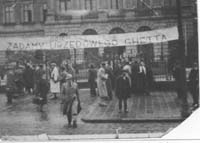
Demonstration of Polish students demanding implementation of "ghetto benches" at
Lwów Polytechnic(1937).
The national boycott of Jewish businesses and advocacy for their confiscation was promoted by the
Endecja party, which introduced the term "Christian shop". A national movement to prevent the Jews from kosher slaughter of animals, with animal rights as the stated motivation, was also organized.
[115]Violence was also frequently aimed at Jewish stores, and many of them were looted. At the same time, persistent economic boycotts and harassment, including property-destroying
riots, combined with the effects of the
Great Depression that had been very severe on agricultural countries like Poland, reduced the
standard of living of Poles and Polish Jews alike to the extent that by the end of the 1930s, a substantial portion of Polish Jews lived in grinding poverty.
[116] As a result, on the eve of the Second World War, the Jewish community in Poland was large and vibrant internally, yet (with the exception of a few professionals) also substantially poorer and less integrated than the Jews in most of Western Europe.[
citation needed]
The main strain of antisemitism in Poland during this time was motivated by Catholic religious beliefs and centuries-old myths such as the
blood libel. This religious-based antisemitism was sometimes joined with an ultra-nationalistic stereotype of Jews as disloyal to the Polish nation.
[117] On the eve of World War II, many typical Polish Christians believed that there were far too many Jews in the country and the Polish government became increasingly concerned with the "Jewish Question". Some politicians were in favor of mass Jewish emigration from Poland.
By the time of the German invasion in 1939, antisemitism was escalating, and hostility towards Jews was a mainstay of the right-wing political forces post-Piłsudski regime and also the Catholic Church. Discrimination and violence against Jews had rendered the Polish Jewish population increasingly destitute, as was the case throughout much of Central and Eastern Europe. Despite the impending threat to the Polish Republic from Nazi Germany, there was little effort seen in the way of reconciliation with Poland's Jewish population. In July 1939 the pro-government
Gazeta Polska wrote, "The fact that our relations with the Reich are worsening does not in the least deactivate our program in the Jewish question—there is not and cannot be any common ground between our internal Jewish problem and Poland's relations with the Hitlerite Reich."
[118][119] Escalating hostility towards Polish Jews and an official Polish government desire to remove Jews from Poland continued until the German invasion of Poland


