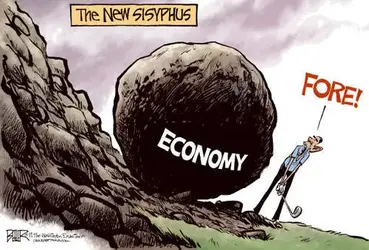
As we celebrate year three of the Great Financial Crisis with the first official bailout of an entire country (Greece), I’m still astounded by the complete and utter lack of coverage the underlying cause of this Crisis has received.
Tens of thousands, if not hundreds of thousands of articles and research reports have been written about the Crisis, and yet I would wager less than 1% of them actually bother talking about what caused it, let alone how the various efforts to stop it have in fact FAILED to address this key issue.
Remember back in 2007? At that time we were told it was all about Subprime mortgages. Then in 2008, we were told it was the investment banks, specifically Lehman Brothers’ (LEHMQ.PK) failure and AIG’s credit default swaps. In 2009, we were told it was poor accounting standards and bad bets made by Wall Street. And here we are in 2010, and we’re still being told it was simply bad bets made by Wall Street.
All of these answers are partially right, but none of them are totally 100% accurate. Why? Because they fail to address the one underlying issue that links ALL of these items. I’m talking about the Black Hole of Finance: a bottomless pit that no official or regulator bothers mentioning in public because acknowledging it would mean acknowledging that all of the efforts to stop the Crisis are truly paltry.
What caused the Crisis?
Derivatives.
You’ve probably heard this term before, or have some vague understanding of what the term means. But the actual reality of derivatives and what they represent for the financial markets remains a topic no one in the mainstream media (or the regulators for that matter) wants to touch.
Why?
Let’s do some quick math.
If you add up the value of every stock on the planet, the entire market capitalization would be about $36 trillion. If you do the same process for bonds, you’d get a market capitalization of roughly $72 trillion.
The notional value of the derivative market is roughly $1.4 QUADRILLION.
I realize that number sounds like something out of Looney tunes, so I’ll try to put it into perspective.
$1.4 Quadrillion is roughly:
-40 TIMES THE WORLD’S STOCK MARKET.
-10 TIMES the value of EVERY STOCK & EVERY BOND ON THE PLANET.
-23 TIMES WORLD GDP.
What’s a derivative?
As their name implies, derivatives are securities whose value is “derived” from an underlying asset (a mortgage, credit card debt, etc). A lot of smart people have tried to explain what these things are, but they usually miss the forest for the trees. A derivative is NOT an asset. It’s, in reality, nothing, just an imaginary security of no tangible value that banks/ financial institutions trade as a kind of “gentleman’s bet” on the value of future risk or securities.
Let me give you an example. Let’s say you and I want to bet on whether our neighbor Joe will default on his mortgage. Is the bet an asset? Does it have any real value? Both counts register a definite “no.”
That’s the rough equivalent of a derivative. There are dozens of different types of these things based on just about everything under the sun. Some derivatives are actually derived off the value of other derivatives, a fact that makes my head hurt every time I think about it.
The other thing you need to know about derivatives is that they are totally unregulated. There is no derivative clearing house. No official report explains the risk or actual value of these things (the notional value of the derivatives market is not the same thing as the actual "at risk" money underlying these securities: I'll detail all of this in tomorrow's essay).
Why Derivatives Caused Financial Crisis - Seeking Alpha