Ask the nearest child (or liberal) for help if you're still confused about Wall Street's (conservative) magic.
Two things come to mind.
Over the past decades, it was pretty obvious that Microsoft had a technique. Every year, a company like the creators of WordPerfect, would come up with a new and innovative addition to their software. The next year, Microsoft would copy their creation and add it to their software package. The dominance of Microsoft has not been their marvelous ability at inventiveness. Microsoft has enjoyed what is called a natural monopoly. When a company, that I was working for, was trying to decide what desktop computers and software to deploy through out the departments, the choice was obvious. The choice was simply the one that had the market dominance. Once Microsoft gained sufficient market share, every company had to use it. Otherwise, they couldn't function in communicating with suppliers and customers.
The second thing that comes to mind is the stock market.
The literal translation for "stock" as in "stock market" is "guessing paper".
The idea of an IPO is to sell partial ownership in a company so that it can raise capital to invest in expansion and leverage into the remaining untapped market demand.
Once beyond the IPO, the purchase and sale of stock has nothing to do with the original company except in the income produced from the dividends or in the returns obtained by selling the stock.
The majority of the gains from the stock market have nothing to do with the functioning of the economy. This is, of course, why the sale and purchase of stock isn't part of the GDP.
The stock market remains little more then a form of gambling. And, in fact, it has been shown repeatedly that stock brokers performance is little more then blind luck, good or bad.
Stock prices are purely psychological in nature with no little underlying economic causality. An excellent example is the stock market performance during and after the December 2007 recession and the performance that occurred when the S&P downgraded the US credit rating to AA+.
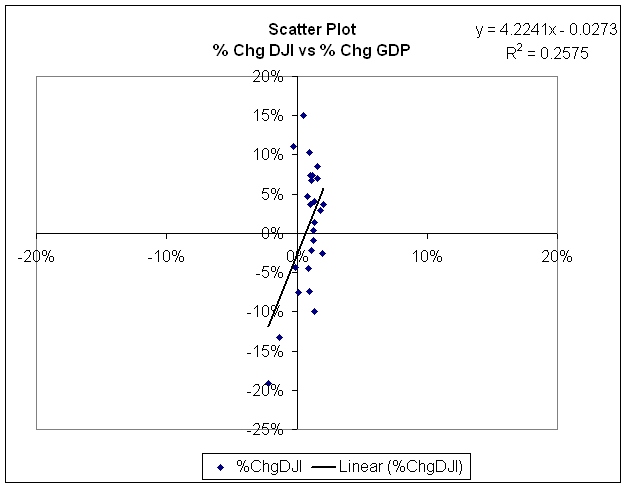
Over the period of time from 2005 through 2010, the correlation between the GDP and the DJI was .50. In terms of R^2 value, that is 25% or 25% of the variability in the stock market is accounted for by the GDP. 75% of the variability in the DJI has nothing to do with the GDP or the actual performance of the companies. The 25%, is little more than stock market investors perception of the economy, not the actual economy. In theory, it is suppose to be based on valuation of the company, the company value divided by the number of stocks outstanding. In reality, it's not. In reality, it is just "Wall Street Magic" and day traders using the magic of technical analysis.
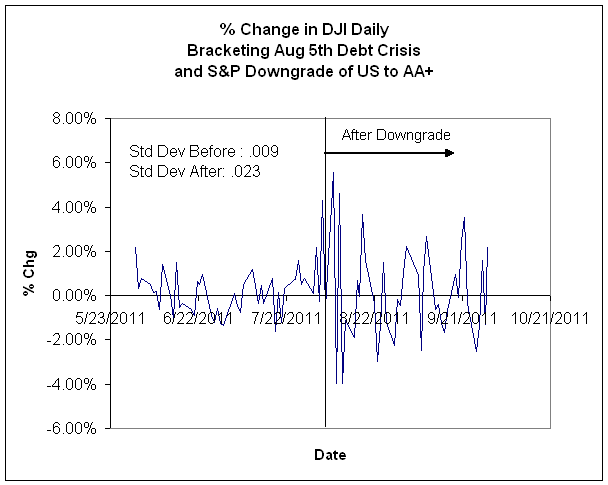
During the 2011 debt ceiling crisis, when the S&P downgraded the US credit rating to AA+, the DJI dropped. It then began to climb once again. What is more interesting is what happened to the day to day variability. The standard deviation of the % change in prices went from 0.9% before, to 2.3% after. Looking the graph below, the variability can be seen to dampen out over time. Nothing in the performance of the economy changed. The change was purely psychological.
In English, the stock market has little to do with anything except the stock market. The stock market has nothing to do with the fundamentals of capitalism, and the free market that Adam Smith described, in it's ability to successfully redistribute scarce resources or create real wealth.
If anything can be described as simply moving money around and doing nothing, it would be the stock market. The stock market, like the price of gold, is just one big bubble. And it is unfortunate that so many retirement funds rely on it.
The graph below shows the stock market % change compared to the GDP % change.
The graph below shows the variability in the DJI stock market prices.



})
})


