After five days of siege and foreboding, the citizens of Baghdad breathed easier on Saturday. Old-world tea houses were once again brimming. So were new militia recruitment centres, where would-be fighters signed up to defend the capital. The city's collective relief stemmed from three live television addresses, only one of them made by an Iraqi. On Friday, President Barack Obama said enough to convince most that he would soon send US jets to deal with the insurgents at the gates. Hours later the Iranian president, Hassan Rouhani, said an alarmed Iran, which is overwhelmingly Shia, would send whatever it took to stem the insurgent Sunni tide. The alliance of common interests was perceived as a rebuff to Isis (the Islamic State in Iraq and the Levant), a jihadist group so hardline it was disowned by al-Qaida. Isis has been rampaging through the country, pledging to rewrite the region's borders.
But it was a religious cleric who succeeded in steeling Iraqis for a fightback. The call to arms by the highest Shia authority in the land, Ayatollah Ali al-Sistani, mobilised in less than one day around a division of militia men who, unlike the military, will not run from a fight with the insurgents. Help is clearly on the way. And it could not come soon enough for many. "I heard the US president speak and his words seemed reasonable," said tribal leader Sheikh Abu Wissam al-Saade at a recruitment centre in the eastern suburb of Karrada, as three new volunteers arrived wanting to fight. "I would say one thing, though, he is partly to blame for this mess. He's been refusing to send us fighter jets for the past six years, because [Kurdish leader Massoud] Barzani has warned him not to." One scrawny recruit signing on with his brother said: "I have come to fight for the sake of my country. This place has been through a lot."
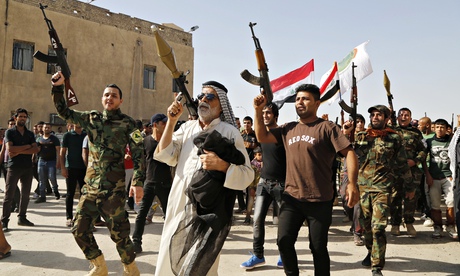
Volunteers, who have joined the fight against predominantly Sunni militants, carry weapons during a parade in the streets in Baghdad's Sadr city.
Karrada wears the scars of insurgency more than most places in Baghdad, with up to five bombs a month shattering its glitzy shopfronts since US forces withdrew. Ground zero of the current threat, however, is around 60 miles to the north. Here, and in the city's vulnerable western approaches, the new volunteers are already preparing to confront Isis. Iraq's immediate future seems sure to be determined by non-state actors and powerful foreign patrons. So much for the state, which has done little more than reel in horror ever since the fall of its three largest cities to a small insurgent force in less than one week. "With the scale of this crisis, all of the military units and the militia groups have melted into each other," said al-Saade. "The fighting force against Da'ash [Isis] has become a common entity."
Those in the provinces contacted by the Observer revealed that they had already dispatched upwards of 15,000 men – most without training – to Baghdad or beyond. Dhi Qaa Yehya Mohammed Bakr said his province had already sent 2,500 fighters to Baghdad, while 25,000 have signed up around the province. Columns of minibuses, some escorted by police trucks, snaked along almost empty highways from the south all day on Saturday. Signs of Shia fervour once again blending with militancy were commonplace in Baghdad . Military trucks carrying tonnes of ammunition pulled out of bases waving flags depicting the revered Shia martyrs, Hussein and Abbas. There was no sign of the Iraqi banners that were only a week earlier a far more frequent sight.
MORE