By the way do you have a link to the page you got those graphs from?
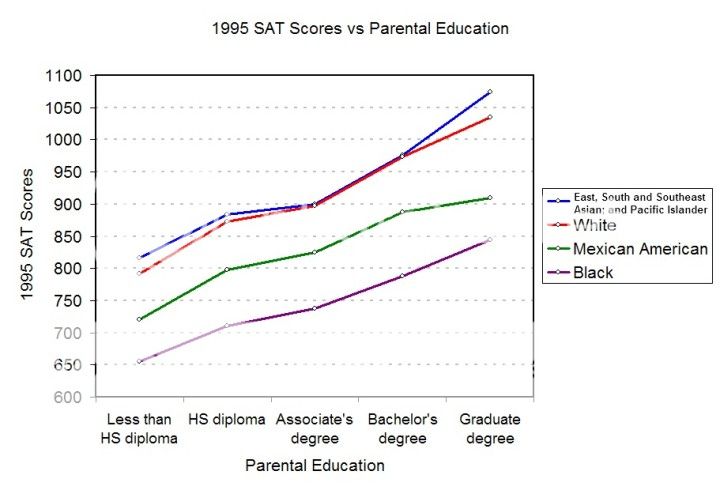
This SAT data is all over the place. The source is the SAT Technical Bulletin. This has been reported for years. Here's a
PBS article on the phenomenon (back then $70,000 was the equivalent of today's $200,000):
One of the most disturbing, I think perhaps the most disturbing fact in our whole book is that black students coming from families earning over 70,000 are doing worse on their SATS, on average--it's always on average--than white students from families in the lowest income group. You want to cry hearing that figure. I mean, it's so terrible.
Last question. How did you link this to genetics? Just curious.
You have to be a creationist to believe that evolution stops at the neck. It is logically impossible to posit that every racial group has the identical distribution of intelligence.
Secondly, you can perform a mental experiment and even verify it with social science evidence.
Intelligence = genetics + environment.
Social Outcome = genetics + schooling + intelligence + poverty/wealth + neighborhood + income + parental education + . . . .
The second one is the most interesting because it is the most wide-ranging.
Come up with every single damn variable in the environment which you believe causes the social disparity. Throw everything plus the kitchen sink into the pot. All of those variables should, together, and with the addition of genetics, explain 100% of the social disparity.
Now look at individual effects from each variable. Add up those effects. What's left over is explained either by genetics or some mystery variable that you haven't included.
The children of two black physicians are raised by well educated parents, they're raised in an environment of wealth, they're raised in good neighborhoods, their peer networks are children of the same social class, they attend good schools. And yet the children of the white janitor and white cafeteria lady outperform on the SAT. This situation does a pretty good job of invalidating the effects which are supposed to arise from quality of schools, parental influences, wealth and income.
Because people from Africa outperform everyone in the US and England when it comes to scholastic achievement.
That's not surprising. Every population group has very intelligent people. There are some very smart people born in Africa. The problem for them is that they're born in Africa and this really limits their economic future - they can't exploit their smarts in those dysfunctional societies. So they immigrate to the US and they do very well for themselves.
This is a selection effect focused on African IMMIGRANTS, not on people from Africa. That is, immigrants from Africa are not randomly selected. We're getting a lot of folks who are the cream of the crop. These are not the refugees who need to be resettled. There's an experiment for you. Compare the outcomes of voluntary immigrants who qualify to immigrate to the US to that of the refugees we accept from Somalia, folks who are randomly selected.
If thats not it how do you explain the Black Mensa members?
Intelligence in a population follows a normal distribution. There are smart black people. It's just that there proportion is smaller than seen in other groups.
Here is the
Journal Of Blacks in Higher Education:
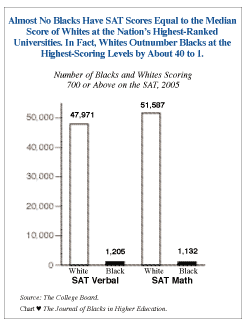
Let's be more specific about the SAT racial gap among high-scoring applicants. In 2005, 153,132 African Americans took the SAT test. They made up 10.4 percent of all SAT test takers. But only 1,132 African-American college-bound students scored 700 or above on the math SAT and only 1,205 scored at least 700 on the verbal SAT. Nationally, more than 100,000 students of all races scored 700 or above on the math SAT and 78,025 students scored 700 or above on the verbal SAT. Thus, in this top-scoring category of all SAT test takers, blacks made up only 1.1 percent of the students scoring 700 or higher on the math test and only 1.5 percent of the students scoring 700 or higher on the verbal SAT.
If we eliminate Asians and other minorities from the statistics and compare just white and black students, we find that 5.8 percent of all white SAT test takers scored 700 or above on the verbal portion of the test. But only 0.79 percent of all black SAT test takers scored at this level. Therefore, whites were more than seven times as likely as blacks to score 700 or above on the verbal SAT. Overall, there are more than 39 times as many whites as blacks who scored at least 700 on the verbal SAT.
On the math SAT, only 0.7 percent of all black test takers scored at least 700 compared to 6.3 percent of all white test takers. Thus, whites were nine times as likely as blacks to score 700 or above on the math SAT. Overall, there were 45 times as many whites as blacks who scored 700 or above on the math SAT.
If we raise the top-scoring threshold to students scoring 750 or above on both the math and verbal SAT a level equal to the mean score of students entering the nation's most selective colleges such as Harvard, Princeton, and CalTech we find that in the entire country 244 blacks scored 750 or above on the math SAT and 363 black students scored 750 or above on the verbal portion of the test. Nationwide, 33,841 students scored at least 750 on the math test and 30,479 scored at least 750 on the verbal SAT. Therefore, black students made up 0.7 percent of the test takers who scored 750 or above on the math test and 1.2 percent of all test takers who scored 750 or above on the verbal section.
Once again, if we eliminate Asians and other minorities from the calculations and compare only blacks and whites, we find that 0.2 percent of all black test takers scored 750 or above on the verbal SAT compared to 2.2 percent of all white test takers. Thus, whites were 11 times as likely as blacks to score 750 or above on the verbal portion of the test. Overall, there were 49 times as many whites as blacks who scored at or above the 750 level.
On the math SAT, only 0.16 percent of all black test takers scored 750 or above compared to 1.8 percent of white test takers. Thus, whites were more than 11 times as likely as blacks to score 750 or above on the math SAT. Overall, there were more than 61 times as many whites as blacks who scored 750 or above on the math section of the SAT.
In a race-neutral competition for the approximately 50,000 places for first-year students at the nation's 25 top-ranked universities, high-scoring blacks would be buried by a huge mountain of high-scoring non-black students. Today, under prevailing affirmative action admissions policies, there are about 3,000 black first-year students matriculating at these 25 high-ranking universities, about 6 percent of all first-year students at these institutions. But if these schools operated under a strict race-neutral admissions policy where SAT scores were the most important qualifying yardstick, these universities could fill their freshman classes almost exclusively with students who score at the very top of the SAT scoring scale. As shown previously, black students make up at best between 1 and 2 percent of these high-scoring groups.
I highlighted a few sections in red. Those points are key to understanding what is going on. When we look about and see disproportionate representation, what we're doing is counting number of white people and number of black people. What we should be doing is counting people based on their capability. For positions which require a lot of mental firepower, in a completely non-discriminatory environment, we should expect to find 45 high achieving whites for every 1 high achieving black. That's the natural baseline. If we find 100:1 then we can probably infer some form of discrimination or inability to locate intelligent black people in the applicant pool or inability to pay high enough for the highly sought after intelligent black person to want to come to work for the organization.
If we see that there is a 20:1 ratio then we can infer that the black person was hired BECAUSE he was black, not because he was qualified, statistically speaking of course.