communism predates capitalism which predates socialism, to clarify my contention. early communes like the smaller north american native tribes had plenty of ways to accommodate ambition. your presumptions on human nature seem based on an idea that we are all ambitious, and that is just as errant as a systemic failure to reward our effort. there is a reason mixed economies work, and that dogmatic economies of any persuasion will fail.
i agree that capitalism should be the basis of our society, but i'd say innovation in public policy would better ensure that, rather than unilateral opposition.
my assertion that socialistic components in our society are expanding more aggressively than private/capitalist ones is just an observation. it stems from efficiency in capitalism. bunch specific of reasons within that, but plainly, fewer folks are involved in every dollar made now than in 1980. this trend is building with exponential character as technology and globalization make capitalism more and more efficient, concentrating its proceeds to fewer, but wealthier among us.
you say you're ok with a safety net. where will all those whose jobs fall victim to this trend fall?
the challenge is to revolutionize the safety net, rather than to deny its role, unilaterally. the economy/society which pulls this off will lead the way through the 21st century like the US led through the 20th.
Again, I am not advocating unilateral opposition to socialistic programs and I do not think anyone else here is either. What you are referring to is a completely separate problem from what we were talking about. We were debating the effects of some of the social programs have had on the lower class and how fox and I believe that some if these programs are helping to create the problem instead of relieving it. Globalization and automation are a different problem that need to be attacked in different ways.
i wont say that globalization and automation are problems, per sa. these are tactics which some of our larger, multinational businesses use to affect the creation of wealth that capitalism is all about. as to whether it is related to the topic at hand, i contend that functions of capitalism, including these, bank on the government's continued investment. much of that investment comes by way of social policies - especially in a contraction/recovery.
i acknowledge the side-effects and externalities to social policies, and contended earlier that these should be reigned in. i contend, again, that a discussion of these externalities alone is just as pointless as a discussion of capitalism which only focuses on the greed at play in the system. the fact of the matter is that capitalism is a big part of what makes life great in the developed world, and that social policy is a big part of what makes capitalism work in the first place.
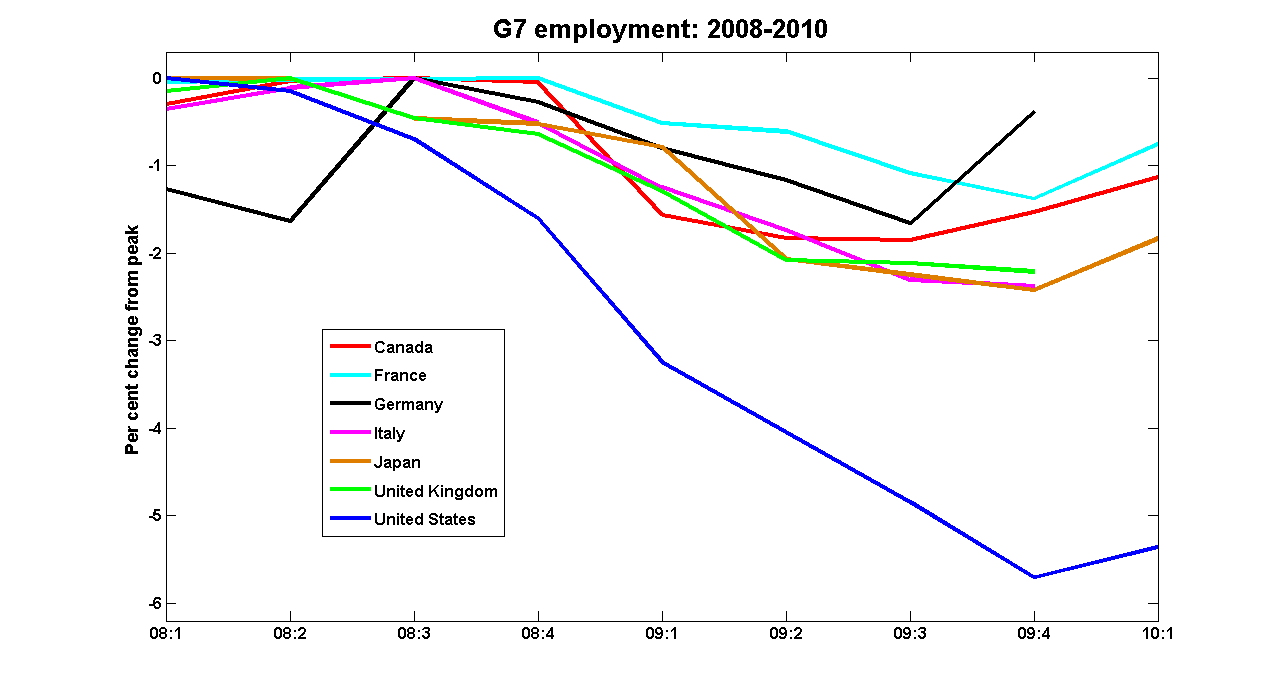
First off, I reject the notion that automation is removing jobs from the economy. Robotics and computers are not new and have been put to use for many years making people more productive. This does cause job losses within a specific and narrow scope but those jobs do not disappear as most people seem to think but, instead, move to other fields as needed. If automation and computers were killing jobs where is the evedense in the unemployment rate?
Where can I find the unemployment rate for previous years?
There has been no drastic drop in unemployment from jobs moving overseas or from increasing productivity at all. There are wide swings that accompany recessions and booms but that is it. If those were killing our jobs then we should see it right there. Truth is, jobs are tied directly to the economy. If there is loose money floating around, someone will take that cash and use people to make more. That is the basis of our economy.
i only contend that this basis is changing from using people to make more money toward more efficient, less labor-dependent processes to achieve the same.
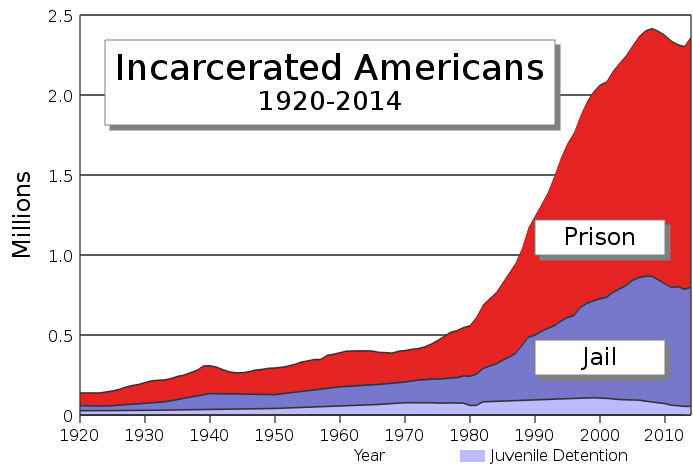
the unemployment rates all show the portion of the labor market which is not used or under-utilized. the labor market is characterized by non-institutional persons over a certain age who are able to work. in this way, you couldn't gain any insight into which people are on welfare or SS, in prison, or working in non-civilian government employment - all communal functions. some, like entitlements and prison, are decidedly socialist.
with the incarceration rate better than doubling in fewer than 10 years, welfare roles at the highest point in history, a boom of civilian public employment, and a bubble of non-civilian cold-war workers, can the 5% reagan/h.w.bush 'full-employment' state of the late 80s really indicate the same as clinton's 5% or dubya's 5%? we attain +/- 5% employment every ten years or so. we have to look at the labor market within the economy in order to scrutinize my claim, and the unemployment rate does not do that at all.
where you argue that a drop-off in one economic activity gives rise to another, moving jobs with it, i dont disagree. but there are more ways which the economy accommodates the invariable inflexibility in the job market, and which account for more individuals than the job market does in the short term. take a look at detroit, MI. this is a city directly hit by globalization, modernization and industrial management technologies. while each of these developments may have bode well for automakers, the economy there has been devastated. the job-loss has not been temporary as you prescribe. the exodus from the city has been a drag on neighboring economies. persons over a certain age found it harder to retrain to new-sector jobs. people found it hard to move from their homes to entirely new cities. the role which prison, welfare, UI and SSI play in these circumstances is massive.
so far, you and fox have approached entitlements as if lazy people are turning down piles of jobs. my counter-proposal reminds that the amount of labor involved in every dollar made is reducing at an increasing rate year on year. hours are decreasing (11% since 1964 per bls establishment survey), OECD's employed to population ratio is declining (though slightly, to the tune of 1% per decade (+/-3,000,000 americans/decade) ). this means that entitlements are increasing as a shrinking job market turns down piles of job-seekers.
the reason why i think all of this applies to the convo at hand, is when y'all come around to actual solutions, basing them on flooding the labor market with former state dependents wouldn't solve an issue in the wider economy. rather, it will create a liability. welfare and prison need to be fixed, among other programs, but ultimately, there is a lot of work to do in the wider economy to keep the job growth we have on target.