a perfect case for the
Hague ?
"
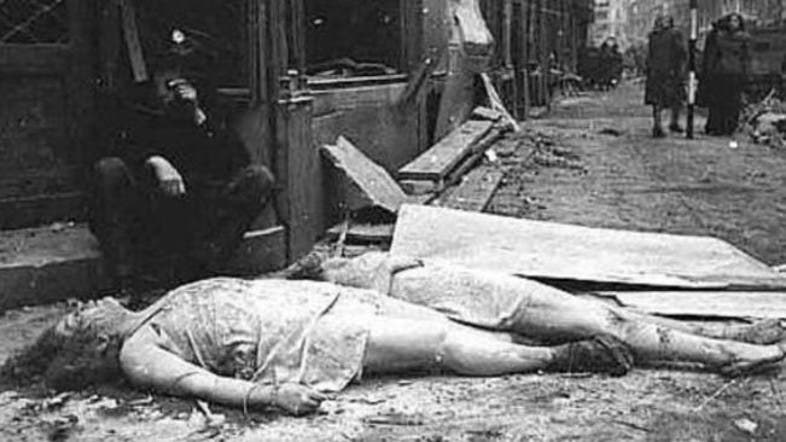
Between the months of January and August of
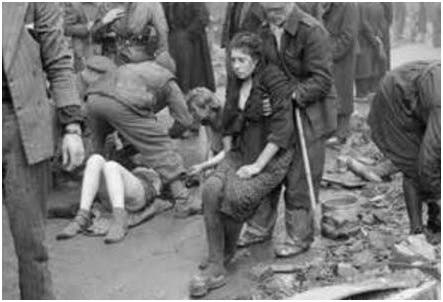
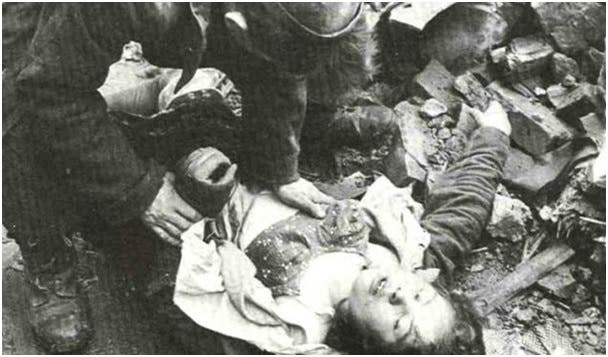
1945, Germany saw the largest incident of mass rape known in history, where an estimated two million German women were raped by the Soviet Red Army soldiers, as written by Walter Zapotoczny Jr. in his book, ‘
Beyond Duty: The Reason Some Soldiers Commit Atrocities’.
Between the months of April and May, the German capital Berlin saw more than 100,000 rape cases according to hospital reports, while East Prussia, Pomerania and Silesia saw more than 1.4 million rape cases.
Hospital reports also stated that abortion operations were being carried out daily across all German hospitals."
Natalya Gesse, who was a Soviet war correspondent at the time, said that the Soviets didn’t care about the ages of their victims. “The Russian soldiers were raping every German female from eight to eighty. It was an army of rapists,” she said.
This caused the deaths of no less than 200,000 girls and women due to the spread of diseases, especially that many eyewitnesses recounted victims being raped as much as 70 times in that period.
Our fellows were so sex-starved,” a Soviet major told a British journalist at the time, “that they often raped old women of sixty, seventy or even eighty - much to these grandmothers’ surprise, if not downright delight.”
In his book, Zapotoczny said that even female Russian soldiers did not disapprove of the rapes, some finding it amusing.
In 1948, rape cases decreased vastly after Soviet troops were ordered back to their camps in Russia and left residential areas in Germany.
IN PICTURES: How German women suffered largest mass rape in history by Soviets
Hitler and his supporter’s fault.
so according you rape of children, Jewish women, etc. is perfectly ok?
No but you start a war, slaughter a few million innocents, that might happen to you in response
and who stated the war? Koba did it for sure
The Nazi’s and their supporters. They should feel lucky they didn’t get worse treatment
The Nazi’s and their supporters, do you think Koba, and his empire was a nazi state too? i partly agree
rightist
USSR politic :
"After the
1917 revolution, authorities in the
USSR decided to abolish the use of the
Arabic alphabet in native languages in Soviet-controlled Central Asia, in the
Caucasus, and in the Volga region (including
Tatarstan). This detached the local Muslim populations from exposure to the language and writing system of the
Koran. The new alphabet for these languages was based on the
Latin alphabet and was also inspired by the
Turkish alphabet. However, by the late 1930s, the policy had changed. In 1939–1940 the Soviets decided that a number of these languages (including
Tatar,
Kazakh,
Uzbek,
Turkmen,
Tajik,
Kyrgyz,
Azeri, and
Bashkir) would henceforth use variations of the
Cyrillic script. It was claimed that the switch was made "by the demands of the working class....
Progress in the spread of Russian language as a second language and the gradual displacement of other languages was monitored in Soviet censuses. The Soviet censuses of 1926, 1937, 1939, and 1959, had included questions on "native language" (родной язык) as well as "nationality." The 1970, 1979, and 1989 censuses added to these questions one on "other language of the peoples of the USSR" that an individual could "freely use" (свободно владеть). It is speculated that the explicit goal of the new question on "second language" was to monitor the spread of Russian as the language of internationality communication.
[35]
Each of the official homelands within the Soviet Union was regarded as the only homeland of the titular nationality and its language, while the Russian language was regarded as the language for interethnic communication for the whole Soviet Union. Therefore, for most of the Soviet era, especially after the
korenizatsiya (indigenization) policy ended in the 1930s, schools in which non-Russian Soviet languages would be taught were not generally available outside the respective ethnically based administrative units of these ethnicities. Some exceptions appeared to involve cases of historic rivalries or patterns of assimilation between neighboring non-Russian groups, such as between Tatars and Bashkirs in Russia or among major Central Asian nationalities. For example, even in the 1970s schooling was offered in at least seven languages in
Uzbekistan: Russian,
Uzbek,
Tajik,
Kazakh,
Turkmen,
Kyrgyz, and
Karakalpak.
While formally all languages were equal, in almost all Soviet republics the Russian/local
bilingualism was "asymmetric": the
titular nation learned Russian, whereas immigrant Russians generally did not learn the local language.
In addition, many non-Russians who lived outside their respective administrative units tended to become Russified linguistically; that is, they not only learned Russian as a second language but they also adopted it as their home language or mother tongue – although some still retained their sense of
ethnic identity or origins even after shifting their native language to Russian. This includes both the traditional communities (e.g.,
Lithuanians in the northwestern
Belarus (
see Eastern Vilnius region) or the
Kaliningrad Oblast (
see Lithuania Minor)) and the communities that appeared during Soviet times such as
Ukrainian or
Belarusian workers in
Kazakhstan or
Latvia, whose children attended primarily the Russian-language schools and thus the further generations are primarily speaking Russian as their native language; for example, for 57% of Estonia's Ukrainians, 70% of Estonia's Belarusians and 37% of Estonia's Latvians claimed Russian is the native language in the last Soviet census of 1989. Russian language as well replaced
Yiddish and other languages as the main language of many Jewish communities inside the Soviet Union.
Another consequence of the mixing of nationalities and the spread of
bilingualism and linguistic Russification was the growth of ethnic
intermarriage and a process of
ethnic Russification—coming to call oneself Russian by nationality or ethnicity, not just speaking Russian as a second language or using it as a primary language. In the last decades of the Soviet Union, ethnic Russification (or
ethnic assimilation) was moving very rapidly for a few nationalities such as the
Karelians and
Mordvinians.
[36] However, whether children born in mixed families where one of the parents was Russian were likely to be raised as Russians depended on the context. For example, the majority of children in families where one parent was Russian and the other Ukrainian living in North
Kazakhstan chose Russian as their nationality on their internal passport at age 16. However, children of mixed Russian and Estonian parents living in
Tallinn (the capital city of
Estonia), or mixed Russian and Latvian parents living in
Riga (the capital of
Latvia), or mixed Russian and Lithuanian parents living in
Vilnius (the capital of
Lithuania) most often chose as their own nationality that of the titular nationality of their republic – not Russian.
[37]
More generally, patterns of
linguistic and
ethnic assimilation (Russification) were complex and cannot be accounted for by any single factor such as educational policy. Also relevant were the traditional cultures and religions of the groups, their residence in urban or rural areas, their contact with and exposure to Russian language and to ethnic Russians, and other factors.
[38]
"
Russification - Wikipedia