Gathering in Brussels for an emergency meeting, interior ministers from across Europe agreed to share 40,000 migrants sheltering in Greece and Italy, but only on a voluntary basis, a watered-down version of a plan announced in May. But as the fractious meeting stretched into the evening, there seemed little prospect that ministers would endorse a new plan put forward last week by Jean-Claude Juncker, president of the European Commission, for a program of resettlement for a further 120,000 asylum seekers that would be compulsory for member countries.
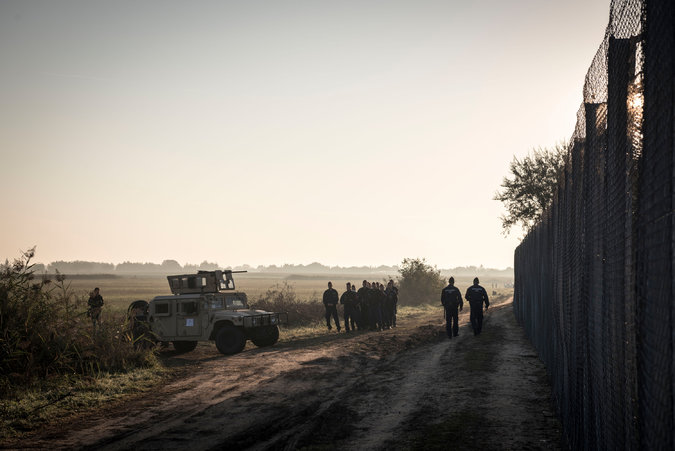
Soldiers were deployed on Monday near Roszke, Hungary, close to the Serbian border.
Jean Asselborn, the minister of foreign affairs of Luxembourg, which holds the union’s rotating presidency, told a news conference late Monday that a majority of countries accepted “in principle” Mr. Juncker’s plan, but added that the discussions had been “very difficult.” Discussions will not resume until next month, a blow to Mr. Juncker, who last week pleaded for “immediate action.” In a sign of the disharmony caused by Europe’s worst humanitarian crisis since World War II, ministers did not issue a joint final statement as is customary and left Luxembourg to issue a summary of the discussions in its own name.
The rancorous haggling in Brussels over the distribution of 160,000 migrants — a small part of the total — played out as Austria, Slovakia and the Netherlands introduced border controls on Monday, after a decision by Germany on Sunday to set up checks on its own southwestern frontier and halt train traffic with Austria. The reintroduction of border controls, described as a temporary measure to restore order to an often chaotic flow of migrants, was the most serious challenge in years to Europe’s cherished system of passport-free travel across much of the Continent.
MORE