You wrote: "By the way, the answer to your question is unknowable. "
WRONG!!!
From the Bureau of Labor Statistics...
Tables 1 - 10; Characteristics of Minimum Wage Workers: 2011
Total, 16 years and over 73,926,000 - total at or below minimum wage 3,829,000 5.2%
16 to 24 years 14,436,000 --- total at or below minimum wage 1,896,000 2.56%
25 years and over 59,490,000 -- total at or below minimum wage 1,933,000 2.61%
So Idiot! IT IS knowable first of all!
And guess what ...dummy... Which group would have the most to lose??
2.5% of kids under 24 who had NO skills,etc....
All for 2.6% over 25 then????
My point is clear. Employers will have to fork over $5,000 more a year for an unskilled, entry level worker age under 24... so who really loses??
But people like you low information sort... you FEEL rather then think and that's the problem... you felt there were more but you didn't research and find out!
SO how many people will be affected by raising minimum wage ??? ALL of us!
A) cost of services/goods will increase to cover rising employee costs BECAUSE all employees will then want pay raises .."if the janitor is making as much as I a manager.." I want pay raise!"
That conversation will be taking place after raising the minimum wage!
B) Some of those 3.8 million will BE REPLACED by robots!!!
Look at this restaurant of the future that is NOW!!!
View attachment 29564
Here is another quote from this low information source, me boy:
"A second important and (largely) undisputed finding is that there is no obvious link between the minimum wage and the unemployment rate. During the nineteen sixties, when the minimum wage was raised sharply, unemployment rates were sharply lower than they were in the nineteen eighties, when the real value of the minimum wage fell dramatically. If you look across the states, some of which set a minimum wage above the federal minimum, you cant see any sign of higher rates leading to higher unemployment. In Nevada, where the national minimum of $7.25 an hour applies, the jobless rate is 10.2 per cent. In Vermont, where the minimum wage is $8.60 an hour, the unemployment rate is 5.1 per cent. What these figures tell us is that other factors, such as the overall state of the economy and how local industries are doing, matter a lot more for employment than the level of the minimum wage does.
Now, this doesnt mean that changes in minimum wages dont affect employment at all. Other things being equal, they can obviously have an impact. Faced with a rise in their wage bills, some employers may choose to employ fewer workers. But this happens much less often than some elementary textbooks (and many neoclassical economists) would suggest. When the minimum wage goes up, many firms that employ low-wage workers simply pass on the higher costs to the customers in higher prices. (Since many of their competitors face an identical rise in costs, they dont necessarily lose any business.) Other firms work their employees harder or give them more training, to increase their productivity. Even in academic studies that do show higher minimum wages having a negative impact on employment, the effect is generally a small one, and it is usually confined to teen-agers and unskilled workers.
As isor as should bewell known, there are also a number of studies that show minimum-wage laws having no effect at all on employment, and even some studies showing a small positive effect. Since Berkeleys David Card and Princetons Alan Krueger (who is now chairman of the Council of Economic Advisors) carried out their famous survey of New Jersey fast-food restaurants, two decades ago, and a found a slight increase in employment following a rise in the minimum wage, an enormous amount of effort has been put into discrediting their results, which many orthodox economists saw as a violation of fundamental economic laws. (If the price goes up, the quantity demanded must fall!) But this effort has largely failed. For whatever reason, minimum-wage laws just dont seem to affect employment very much."
The Case for a Higher Minimum Wage : The New Yorker
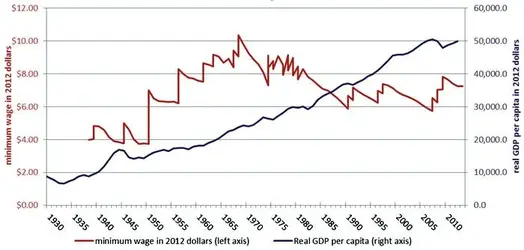
The fact that GDP per capita has never been affected by mw increases as shown in on of my prior posts should also tell you something, assuming you have brain activity.
Sorry, me boy. You loose.
A) NO YOU LOSE! You said.."question is unknowable"!!!
What the f..k is this?????
From the Bureau of Labor Statistics...
Tables 1 - 10; Characteristics of Minimum Wage Workers: 2011
Total, 16 years and over 73,926,000 - total at or below minimum wage 3,829,000 5.2%
16 to 24 years 14,436,000 --- total at or below minimum wage 1,896,000 2.56%
25 years and over 59,490,000 -- total at or below minimum wage 1,933,000 2.61%
So Idiot! IT IS knowable first of all!
And guess what ...dummy... Which group would have the most to lose??
2.5% of kids under 24 who had NO skills,etc....
All for 2.6% over 25 then????
B) NO YOU LOSE AGAIN...
"no obvious link between the minimum wage and the unemployment rate."
"The Record Is Clear: Minimum Wage Hikes Destroy Jobs
"
In a comprehensive, 182-page summary of the research on this subject from the last two decades, economists David Neumark (UC-Irvine) and William Wascher (Federal Reserve Board) determined that 85 percent of the best research points to a loss of jobs following a minimum wage increase.
But a study published in the Journal of Human Resources found that a higher minimum wage can actually increase the proportion of families living at or near the poverty line, as the resulting reduction in work hours (or a loss of employment altogether) leads to less take-home pay rather than more.
And of course most people don't consider the other benefits accruing to minimum wage earners!!!
Congress has put in place a significant income supplement in the form of the Earned Income Tax Credit. A single parent with two children receives an additional $5,200 in income from this credit, bumping their effective hourly wage from $7.25 to $9.76. Some states have added to the federal EITC, boosting the wage even further.
The Record Is Clear: Minimum Wage Hikes Destroy Jobs - Forbes
So not only can YOU not spell " it is LOSE" NOT "LOOSE"!
But you also said it was "unknowable" AND I showed you it was!
Then you throw out there is no link between minimum wage and unemployment rate..
AND I provide you academic studies ...
So ONCE again... You LOSE on spelling... you lose on "unknowables" you lose on THERE IS an obvious link between minimum wage and unemployment!
I am 100% confident that somewhere at sometime an employer faced with an increasing minimum wage will do one or all of the following:
a) Let the least seniority worker go and increase the hours of the rest of the employees obviously paying more but NOT more then savings my letting employees go.
b) Hire robots as the original thread proposed as an alternative and in doing so save money in lower employee costs, SS/Medicare/ minimum wage.
c) Contracting with a firm that can offer same services at lower price and in doing so let the employee go.
Any one or more of the above happens. It is how good businesses operate in order to meet their margins.
But most uninformed and haters of capitalism don't comprehend this.