It's embarassing - I haven't been to grad school in almost 20 years, but I will share my proof anyhow since someone else might be able to make it work:
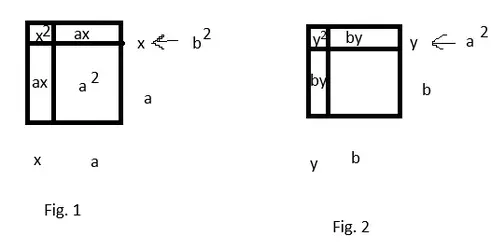
In fig. 1, we have a square for a, then increase the size of the square by an area of b2, the sum of areas is a2+b2. The extra part is ax, x2 and ax.
In fig. 1, we have a square for b, then increase the size of the square by an area of a2, the sum of areas is a2+b2. The extra part is by, y2 and by.
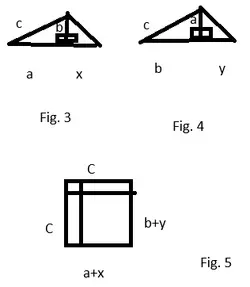
If we look at a,b and c in fig.s 3 and 4, it looks like c=a+x or c=b+y. If we could prove that then we could prove the Pythagorean theorem.
Notice that (a+x)2 = a2 + b2 = (b+y)2. (1) They were all the same thing. If c=a+x and c=b+y, 2C2= (a+x)2 + (b+y)2 = a2 + 2ax + x2 + b2 + 2by + y2. (2) But these are all the parts in fig. 1 and fig. 2, which each add to a2+b2, so 2c2 = 2a2+2b2 or c2 = a2+b2. (3) See fig. 5.
Now we need to gather that c=a+x. c ≤ a+x by area because c must be in the square (fig. 1/fig. 2) because a and b are in the square. That gives a maximum area of the diagonals. On the sides 1x1=1. On the diagonals √2*√2/2 = 1. Thus c ≤ a+x. (4)
Now we need to gather that c ≥ a+x. Or c ≥ b+y (both are equivalent).
From figs 1 and 2, b2 = 2ax+x2, and a2 = 2by+y2. (5)
Adding, a2+b2 = 2ax + 2by + x2 + y2. (6)
C2 =? 2ax + 2by + x2 + y2 (7)
C2 ≥? a2 + 2ax + x2 (8)
C2 ≥? b2 + 2by + y2 (9)
This leads to 2ax+2by+x2 +y2 ≥? a2 + 2ax + x2 (10)
And 2by + y2 ≥? a2. (11)
We also get 2ax+2by+x2 +y2 ≥? b2 + 2by + y2 (12)
And 2ax + x2 ≥? b2. (13)
We solve quadratic equations
Y= (-2b + √(4b2+8a2b))/2 (14)
X = (-2a + √(4a2+8ab2))/2 (15)
The roots must be positive. Hence 4b2+8a2b > 0 and 4a2+8ab2 > 0. (16,17)
4b2 > -8a2b (18)
This is guaranteed when b>0.
Y will be > 0 because √4b2 already makes the -2b positive.
4a2 > - 8ab2 (19)
This is guaranteed when a>0.
X will be >0 because √4a2 already makes the -2a positive.
By the quadratic formulas (14) and (15), x = greater than -a and y = greater than -b, so if c>0, c ≥ a+x and c ≥ b+y and at the boundary point c=a+x =b+y. (20).
Note that c,a and b work >0 and then x and y will be.
(4) and (20) mean that c=a+x and then (1),(2) and (3) mean that C2=a2+b2
Then by (3) we solved the problem.
We could have more easily said that C2 = (a+x)2 = a2+b2.




 Sweden has boarded a suspected stateless merchant ship. Moscow shadow - pirate fleet ?
 We can't trust the press as I and other republicans keep saying
 Trump Warns Iran "The Big One is Coming" as More Stealth Bombers Deploy
