Volcanism, mass extinction, and carbon isotope fluctuations in the Middle Permian of China | Jason R Ali - Academia.edu
The close temporal link between the onset of eruptions and extinction suggests a cause-and-effect scenario. Cooling and acid rain (caused by SO2 effusion and sulfate aerosol formation)and consequent environmental deterioration are candidates for this link ( 18, 19). The dominance of pyroclastic volcanism (rather than more quiescent-style flood basalt eruptions) in the initial eruptive stages of the Emeishan province and the large scale of the flows (30 to 200 m thick)suggest that such effects are likely to have been severe. The subsequent negative shift of C isotope values is too large to be attributed to relatively heavy volcanic CO2 (d 13 C = 5), but it may record the release of much lighter thermogenic C from the site of volcanism (20).This was in the aftermath of the biotic crisis, but the high diversity of the post-extinction biota suggests that the light C flux is not linked to any prolongation of the environmental stress that caused the extinction.Our study of the volcano-sedimentary recordof southwest China reveals that the Middle Permian marine crisis precisely coincided with the onset of Emeishan volcanism. This provides evidence for a potential link between mass ex-tinction and the eruption of this igneous province, although the absolute time scale for the event is not yet known. The subsequent negative d 13C excursion implies that the C cycle was destabilized for some time after the extinctions, perhaps by C release from thermogenic sources.
Let me know the next time a major eruption raises the temperature. So far, in recorded history, that has never occurred. Instead quite the opposite has occurred. Every time a volcano erupts there is a near immediate global cool down.
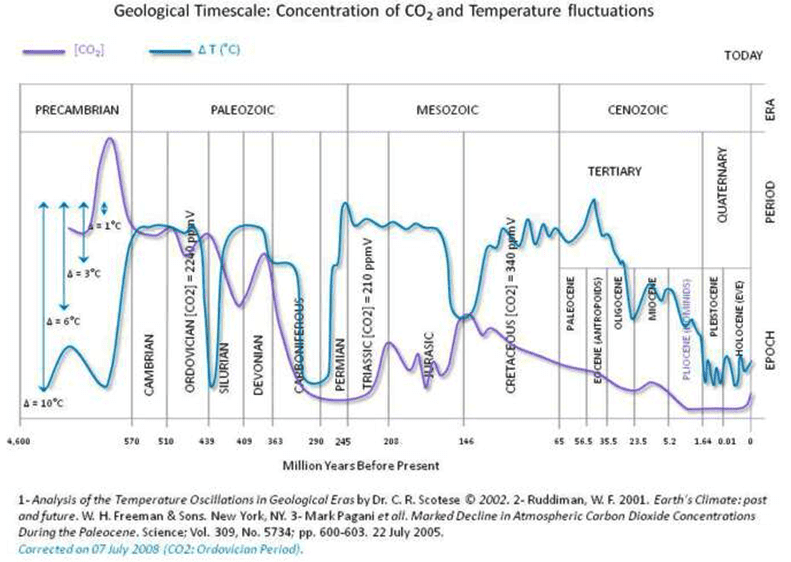
In recorded history, we have not had a trapp type eruption. We have not even had the more common large caldera eruption. However, we do know that trapp eruptions have occurred because of the vast amounts of lava that are in the Siberian, Deccan, and Columbia basalts, just to mention three such eruptions. We also know, from several proxy sources, that when these occur, they emit enormous amounts of CO2, and trigger further GHG emissions from the resultant clathrate emissions, and also, if the volcanic dikes impign on coal, as happened with the Siberian Trapps, and also the Chinese eruption, that vast amounts of CH4 are emitted.
By the very site that you linked to, the Siberian Trapp eruptions resulted in a very rapid increase of 6 C in a very short time. In fact, whenever we find Trapp type eruptions, we find rapid increases in GHGs, and rapid increases in temperatures.