Nature 433, 403-406 (27 January 2005) | doi:10.1038/nature03301; Received 4 November 2004; Accepted 20 December 2004
Uncertainty in predictions of the climate response to rising levels of greenhouse gases
D. A. Stainforth
1, T. Aina
1, C. Christensen
2, M. Collins
3, N. Faull
1, D. J. Frame
1, J. A. Kettleborough
4, S. Knight
1, A. Martin
2, J. M. Murphy
3, C. Piani
1, D. Sexton
3, L. A. Smith
5, R. A. Spicer
6, A. J. Thorpe
7 & M. R. Allen
1
- Department of Physics, University of Oxford, Parks Road, Oxford OX1 3PU, UK
- Computing Laboratory, University of Oxford, Parks Road, Oxford OX1 3QD, UK
- Hadley Centre for Climate Prediction and Research, Met Office, Exeter EX1 3PB, UK
- Rutherford Appleton Laboratory, Chilton, Oxfordshire, OX11 0QX, UK
- London School of Economics, London WC2A 2AE, UK
- Department of Earth Sciences, The Open University, Milton Keynes MK7 6AA, UK
- Department of Meteorology, University of Reading, Reading RG6 6BB, UK
Correspondence to: D. A. Stainforth
1 Correspondence and requests for materials should be addressed to D.A.S. (Email:
d.stainforth1@physics.ox.ac.uk).
Topof page
The range of possibilities for future climate evolution
1, 2, 3 needs to be taken into account when planning climate change mitigation and adaptation strategies. This requires ensembles of multi-decadal simulations to assess both chaotic climate variability and model response uncertainty
4, 5, 6, 7, 8, 9. Statistical estimates of model response uncertainty, based on observations of recent climate change
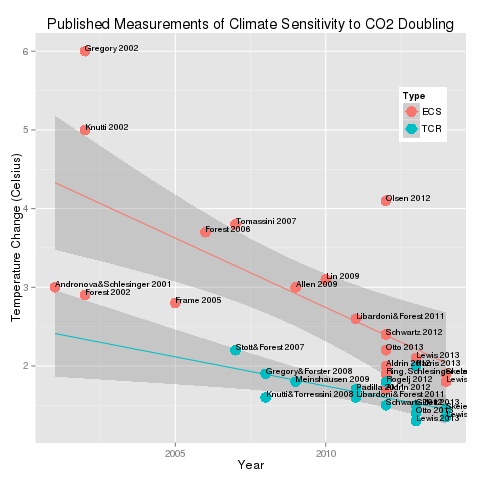
10,11, 12, 13, admit climate sensitivities—defined as the equilibrium response of global mean temperature to doubling levels of atmospheric carbon dioxide—substantially greater than 5 K. But such strong responses are not used in ranges for future climate change
14 because they have not been seen in general circulation models. Here we present results from the 'climate
prediction.net' experiment, the first multi-thousand-member grand ensemble of simulations using a general circulation model and thereby explicitly resolving regional details
15, 16,17, 18, 19, 20, 21. We find model versions as realistic as other state-of-the-art climate models but with climate sensitivities ranging from less than 2 K to more than 11 K. Models with such extreme sensitivities are critical for the study of the full range of possible responses of the climate system to rising greenhouse gas levels, and for assessing the risks associated with specific targets for stabilizing these levels.
Given what we are seeing right now, this is not a reassuring article.